
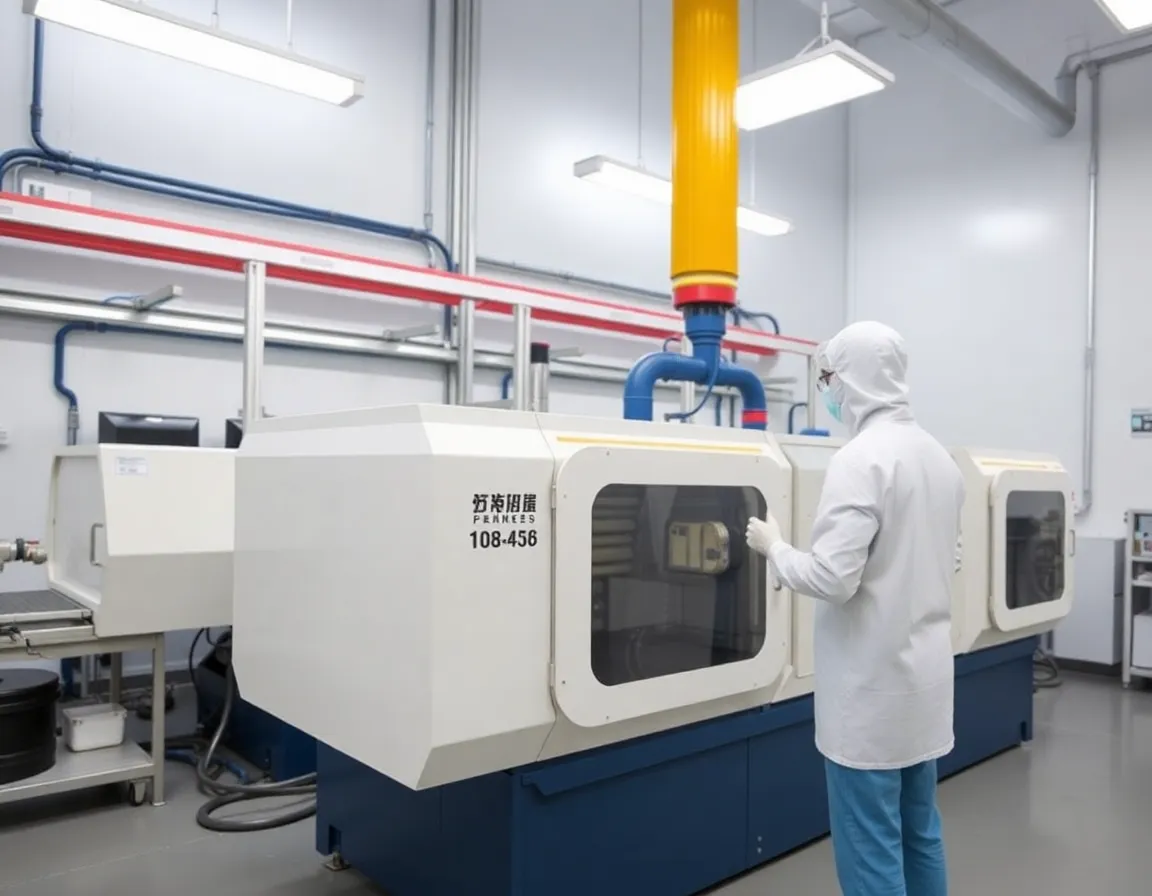
Introduction : L'intersection de la précision et de la pureté
Dans le monde de la fabrication avancée, peu d'environnements exigent autant de rigueur que la salle blanche. Lorsque vous combinez les contrôles stricts de particules d'une salle blanche avec le processus de moulage par injection à haut volume et haute tolérance, vous arrivez à une discipline spécialisée : Moulage en salle blanche de classe ISO 8. Ce processus ne consiste pas simplement à maintenir un atelier propre ; c'est une méthode scientifiquement réglementée de production de composants en plastique exempts de contaminants microscopiques, garantissant leur sécurité et leurs performances dans des applications critiques. Pour des industries allant des dispositifs médicaux à l'électronique, la capacité de mouler une pièce dans un environnement contrôlé n'est pas un luxe—c'est une nécessité absolue.
Un environnement de classe ISO 8, tel que défini par la norme 14644-1 de l'Organisation internationale de normalisation (ISO), permet un maximum de 3 520 000 particules par mètre cube pour une taille de 0,5 micron ou plus. Bien que cela puisse sembler un nombre stupéfiant, cela représente une atmosphère contrôlée nettement plus propre que l'air standard d'usine. Dans ce contexte, Moulage en salle blanche de classe ISO 8 comble le fossé entre la production plastique conventionnelle et les exigences ultra-propres de la technologie moderne. Cet article explore les subtilités de ce processus, ses mécanismes opérationnels, ses avantages indéniables et son rôle critique dans la fabrication moderne.
Comprendre les normes de classe ISO 8 et la dynamique des salles blanches
Pour vraiment apprécier la valeur du moulage en salle blanche de classe ISO 8, il faut d'abord comprendre le système de classification qui régit ces espaces. La norme ISO 14644-1 est la référence mondiale pour la classification des salles blanches, remplaçant l'ancienne norme fédérale 209E. La désignation "Classe 8" est souvent considérée comme le niveau d'entrée de la fabrication en salle blanche, mais elle est loin d'être indulgente. Elle se concentre sur le contrôle de la contamination particulaire en suspension dans l'air, qui est la principale menace pour les produits sensibles.
Nombre de particules et contrôle du flux d'air
La métrique principale pour la classe ISO 8 est la concentration de particules admissible. Contrairement aux classes plus strictes (comme ISO 5 ou ISO 7), la classe ISO 8 permet une concentration plus élevée de particules, mais elle nécessite toujours une filtration à haute efficacité pour les particules aériennes (HEPA). En général, ces salles blanches atteignent la propreté grâce à :
- Filtration HEPA : L'air passe à travers des filtres HEPA, qui éliminent au moins 99,971 TP3T de particules à 0,3 micron, garantissant que l'air entrant est pratiquement stérile.
- Pression d'air positive : La salle blanche est maintenue à une pression plus élevée que les zones adjacentes, empêchant l'air non filtré d'entrer par les portes ou les interstices.
- Flux d'air laminaire (ou non unidirectionnel) : Bien que la classe ISO 8 utilise souvent un flux d'air non unidirectionnel (où l'air filtré est mélangé via des évents de plafond), certaines zones critiques peuvent utiliser des hottes à flux laminaire pour créer un balayage unidirectionnel de l'air sur la machine de moulage.
L'objectif n'est pas de créer un vide de stérilité mais d'établir un environnement prévisible et contrôlé where the risk of contamination is minimized to a statistically acceptable level.
Why Not a Cleaner Class?
A common question is why manufacturers don't simply use a cleaner standard like ISO Class 5. The answer lies in economics and practicality. The cost of achieving and maintaining an ISO Class 5 cleanroom is exponentially higher than an ISO Class 8 due to the need for more air changes per hour, more sophisticated gowning protocols, and more frequent testing. For many applications—particularly those where the product is not in direct contact with sterile body tissue or where downstream washing is performed—an ISO Class 8 environment provides the optimal balance between contamination control and operational cost.
The Mechanics of Cleanroom Injection Molding
Moulage en salle blanche de classe ISO 8 is not just about placing a standard injection molding machine inside a clean room. It requires a holistic approach that modifies equipment, materials handling, and operational procedures to prevent the machine itself from becoming a source of contamination.
Machine Design and Modifications
Standard injection molding machines generate contamination through hydraulic fluids, lubricants, and mechanical wear. In a cleanroom setting, these machines are heavily modified or replaced with specialized alternatives. Key adaptations include:
- Electric vs. Hydraulic Drives: All-electric injection molding machines are preferred because they eliminate hydraulic oil leaks, which are a major source of particulate and chemical contamination.
- Stainless Steel Enclosures: The machine's exterior is often cladded with stainless steel or smooth polymer panels to prevent paint flaking and to facilitate easy wiping with cleaning agents.
- Closed-Loop Cooling Systems: Water cooling lines are sealed and routed to prevent condensation and microbial growth, which can shed particles into the air.
- Localized Exhaust: Vents are placed over the barrel and nozzle area to capture any fumes or off-gassing from the molten plastic, preventing them from recirculating.
Manutention et séchage des matériaux
Contamination can also originate from the raw plastic resin itself. Pellets often carry static charges that attract dust and can be contaminated with paper fibers or other debris. In a cleanroom molding operation:
- Vacuum Conveying: Resin is transferred from sealed drums to the machine hopper using closed vacuum systems, eliminating manual pouring.
- Central Drying: Desiccant dryers are used to remove moisture, but they must have exhaust filters to prevent the release of fines (microscopic plastic dust) into the cleanroom.
- Ionized Air Knives: Before the resin enters the barrel, it may pass through an ionizing blower to neutralize static charge, allowing particles to be easily filtered away.
The Molding Cycle and In-Mold Monitoring
The actual molding cycle in an ISO Class 8 environment demands precision. The mold itself is typically made of polished, hardened steel to resist wear and prevent the generation of metallic particles. Moreover, the molding process often employs capteurs dans le moule to monitor cavity pressure and temperature. This data is crucial because it allows for real-time adjustments to the process, reducing the likelihood of flash (excess plastic) or short shots, which are defects that require secondary operations and increase the risk of contamination.
Critical Benefits and Applications Across Industries
The adoption of Moulage en salle blanche de classe ISO 8 is driven by the undeniable advantages it offers in product quality and regulatory compliance. The benefits extend beyond simple cleanliness, impacting the structural integrity and performance of the final part.
Primary Benefits
- Reduced Bioburden: For medical devices, the process minimizes the initial microbial load, making downstream sterilization (like ethylene oxide or gamma radiation) more effective and reliable.
- Enhanced Surface Quality: By preventing dust particles from becoming embedded in the plastic surface, the final product has a smoother, more consistent finish, which is critical for optical components or sealing surfaces.
- Improved Mechanical Properties: Contaminants can act as stress concentrators, leading to premature cracking or failure. Cleanroom molding ensures that the polymer's molecular structure is uniform, yielding stronger parts.
- Conformité réglementaire : Products manufactured in a controlled environment are easier to validate and document for FDA (Food and Drug Administration) or ISO 13485 (medical devices) audits.
Key Application Sectors
While any industry can benefit from cleaner parts, certain sectors rely on ISO Class 8 molding as a baseline requirement:
- Medical Devices: This is the largest market. Components like syringes, IV luer locks, surgical instrument handles, and implantable drug-delivery housings are molded here. The cleanroom environment prevents endotoxins and particulates from entering the patient's body.
- Emballages pharmaceutiques : Inhaler valves, diagnostic test cassettes, and pill bottles require a clean environment to prevent contamination of the medication.
- Electronics and Optics: Connectors, camera lens housings, and LED diffusers must be free of dust to prevent electrical short circuits or optical aberrations.
- Aérospatiale et défense : Fittings and housings used in hydraulic systems require extreme purity to prevent valve blockage in sensitive flight control systems.
Best Practices for Operating an ISO Class 8 Molding Facility
Operating a successful ISO Class 8 cleanroom molding line requires more than just hardware; it demands a culture of discipline and a rigorous adherence to standard operating procedures (SOPs). Here are the critical best practices for maintaining purity and efficiency.
Personnel Gowning and Behavior
Humans are the largest source of contamination in any cleanroom. Even with an ISO Class 8 designation, which is more forgiving than Class 7, personnel must follow strict protocols:
- Full Gowning: Workers must wear cleanroom suits, hoods, booties, and face masks. Gloves must be powder-free and changed frequently.
- Minimal Movement: Rapid movements generate turbulence and shed particles. Personnel are trained to move slowly and deliberately.
- No Paper or Cardboard: Only cleanroom-grade paper and plastic packaging are allowed inside the controlled area.
Cleaning and Maintenance Schedules
Preventive maintenance is the lifeblood of cleanroom molding. A machine breakdown inside the cleanroom can cause a catastrophic contamination event.
- Daily Wipe-Down: All surfaces must be wiped with low-lint wipes and appropriate solvents (usually isopropyl alcohol) to remove any residue.
- HEPA Filter Certification: Filters must be tested and certified every 6-12 months to ensure they are functioning at the required efficiency.
- Lubrication Control: Only food-grade or cleanroom-approved lubricants can be used on moving parts, and they must be applied in minimal quantities to prevent overspray.
Process Validation and Monitoring
To ensure the cleanroom is performing as designed, continuous monitoring is essential. This involves both environmental monitoring (EM) and process monitoring.
- Particle Counters: Portable particle counters should be used to verify that airborne particle counts are within the ISO Class 8 limits during production.
- Microbial Monitoring: Settle plates (petri dishes) are placed in strategic locations to capture viable microorganisms that fall onto surfaces. These are incubated to check for colony-forming units (CFUs).
- First Article Inspection: The first part produced after a mold change is thoroughly inspected not only for dimensions but also for surface contamination using a microscope.
Conclusion: The Future of Pure Manufacturing
Moulage en salle blanche de classe ISO 8 represents a sophisticated balance between the demands of precision engineering and the realities of economic manufacturing. It is not the strictest classification available, but it is the most versatile, offering a pragmatic solution for products that require a high degree of cleanliness without the astronomical costs associated with sterile environments. As technology advances, with the miniaturization of medical implants and the increasing sensitivity of electronics, the role of this molding process is set to expand.
Manufacturers who master the discipline of ISO Class 8 molding gain a significant competitive advantage. They are not merely producing plastic parts; they are producing guarantees of purity. By investing in specialized equipment, rigorous training, and a culture of cleanliness, they ensure that the components leaving their facility are safe, reliable, and ready for the most demanding applications. In an era where product failure can have life-altering consequences, the quiet precision of the ISO Class 8 cleanroom is a powerful testament to the fact that in manufacturing, purity is the ultimate form of precision.