
금속-플라스틱 하이브리드 부품의 제조 예산을 평가하려면 툴링 제작, 수지 선택, 자동화 수준에 대한 상세한 이해가 필요합니다. 개발 초기 단계에서 맞춤형 인서트 사출 성형 비용 요인을 명시하면 엔지니어링 팀이 생산 툴링에 착수하기 전에 단위 경제성을 최적화할 수 있습니다. 사전 성형된 금속 핀, 나사산 체결구 또는 전도성 부스바를 용융 폴리머와 직접 결합하면 2차 조립 단계를 없애면서 기계적 인발 강도를 향상시킵니다. 이 가격 가이드는 핵심 비용 변수, 툴링 투자, 제조 비용 절감을 위한 실용적인 DfM 방법을 분석합니다.
목차
인서트 사출 성형 견적에 영향을 미치는 4가지 핵심 변수

견적 산정이 어떻게 이루어지는지 이해하면 구매 관리자가 자본 지출을 최적화하는 데 도움이 됩니다. 주요 인서트 사출 성형 가격 변수는 인서트 조달 복잡성, 툴 캐비티 강재 선택, 로딩 자동화, 재료 수율에 집중됩니다. 사전 스탬핑된 구리 부스바 또는 맞춤형 널링 황동 나사산 스터드는 금속 공차에 대한 엄격한 치수 제어가 필요합니다. 금속 공차 변동은 셧오프 랜드 실링에 직접 영향을 미치며, 여기서 긴밀한 강재 피팅이 플라스틱 플래시가 전기 접점 패드로 흘러가는 것을 방지합니다.
툴 강재 선택은 초기 비반복 엔지니어링 예산의 상당 부분을 차지합니다. 경화된 S136 스테인리스강 또는 H13 공구강 에서 캐비티를 가공하면 사전 경화된 연강에 비해 초기 금형 비용이 증가하지만 1,000,000회 이상의 사이클을 초과하는 장기 툴 수명을 보장합니다. 고크롬 스테인리스 강은 난연성 폴리머의 부식성 아웃개싱에 저항하여 빈번한 금형 유지보수와 폴리싱 다운타임을 없앱니다.
평가 사이클 타임 수동 작업자 로딩과 자동화 간의 차이 robotic insert loading impacts piece-part pricing significantly. Manual insert placement suits low-volume bridge production of 1,000 to 5,000 parts by avoiding automated end-of-arm tooling costs. High-volume automotive runs utilize multi-axis articulated robots to load inserts within seconds, reducing machine hold times and lowering unit labor costs.
Scrap rate management and resin waste control form the final major cost component. Processing high-performance thermoplastics requires precise process controls to prevent short shots or insert displacement under hydraulic injection pressure. Minimizing runner system scrap through hot runner manifolds reduces overall material consumption on expensive engineering polymers.
Core pricing evaluation drivers include:
- Metallic insert sourcing cost—Purchasing standardized off-the-shelf brass fasteners lowers costs compared to custom progressive die stampings.
- Tool cavity steel hardness—Specifying fully hardened H13 or S136 steel increases NRE tooling costs but minimizes maintenance over long runs.
- Automation end-of-arm tooling—Integrating 6-axis robotic loading automation requires upfront capital but slashes unit labor expenses.
- Runner system efficiency—Utilizing valve-gated hot runner systems eliminates sprue scrap on high-cost engineering polymers.
How to Optimize Your Insert Tooling Budget without Sacrificing Precision
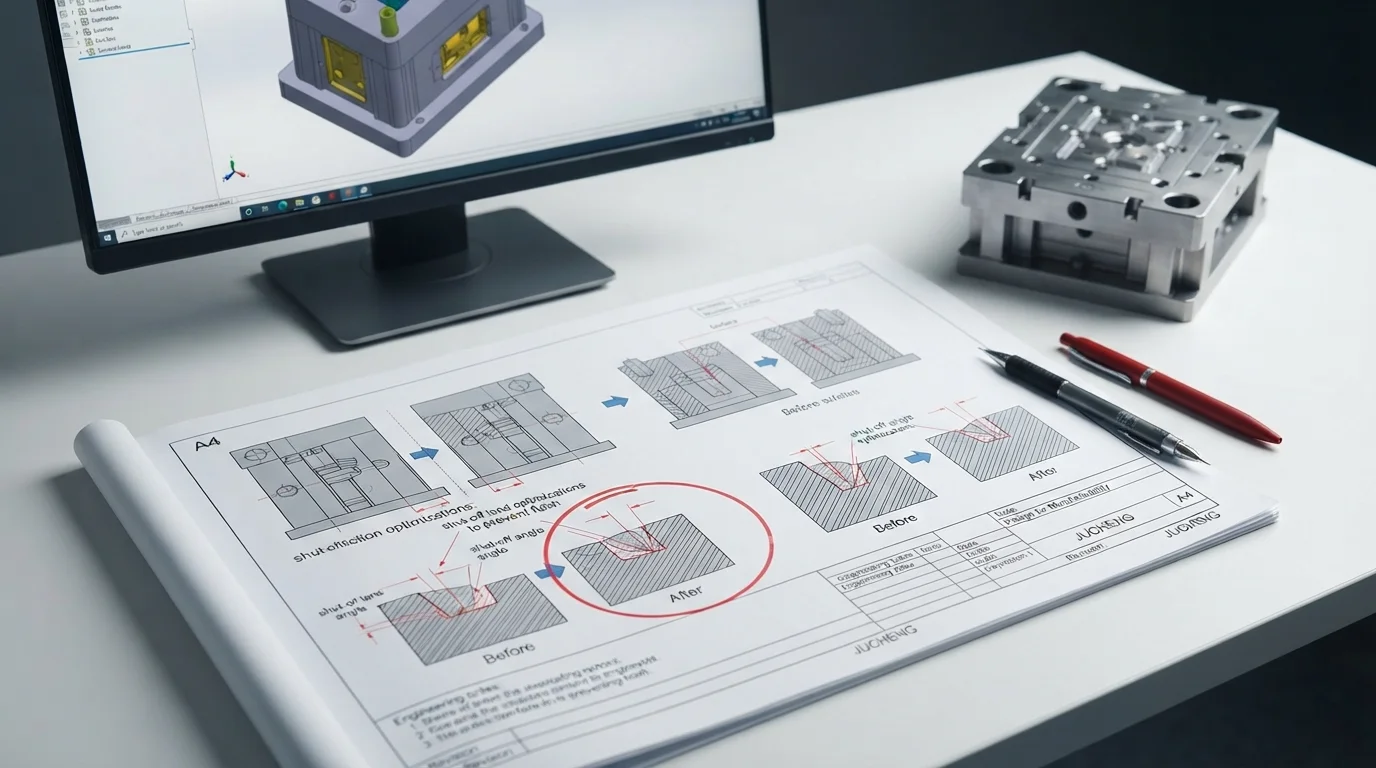
Stripping unnecessary tooling expenses begins with a comprehensive Design for Manufacturability (DfM) review completed prior to cutting mold steel. Technical reviews evaluate draft angles, wall thickness uniformity, and core pin locating mechanisms to prevent core displacement during injection. To minimize insert molding cost, optimizing the mold shut-off area is essential for reliable 인서트 몰딩.
Standardizing insert geometries across multiple product lines reduces custom stamping and machining expenses. Designing uniform boss wall thicknesses prevents localized sink marks and eliminates the need for expensive secondary cosmetic fills. Incorporating simple pass-through shut-offs or sliding core line modifications allows features to be molded directly in the line of draw, eliminating complex side-action sliders.
| Cost Optimization Strategy | Tooling Budget Impact | Unit Price Impact | 주요 엔지니어링 이점 |
|---|---|---|---|
| Standardized Threaded Inserts | Zero custom tooling NRE | 15% – 25% Reduction | Eliminates custom progressive stamping dies |
| Line-of-Draw Pass-Through Shut-Offs | 20% – 35% Lower Mold Cost | 5% – 10% Reduction | Eliminates hydraulic side-action sliders & lifters |
| Robotic Automation (High Volume) | Higher initial automation setup | 30% – 50% Reduction | Cuts cycle time & eliminates operator placement errors |
자주 묻는 질문 (FAQ)
How does manual insert placement affect part unit cost compared to robotic automation?
Manual insert placement lowers initial NRE capital by eliminating custom robotic end-of-arm tooling, making it ideal for low-volume prototype runs of 1,000 to 5,000 units. Automated robotic insert placement increases initial tooling investment but dramatically reduces machine cycle time and labor expense, resulting in significantly lower unit costs for high-volume production runs exceeding 50,000 parts.
Why does metal insert quality impact mold maintenance costs?
Out-of-spec metal inserts with dimensional variations prevent mold shut-off steel from sealing properly against active contact areas. Oversized inserts crush steel shut-off lands upon clamp-up, causing expensive tool damage and flashing. Undersized inserts leave micro-gaps that permit molten resin to bleed onto terminal contact faces, causing high scrap rates and frequent tool cleaning.
What is the most effective way to lower initial insert molding tooling expenses?
Conducting an early DfM review to eliminate complex side-action undercuts is the most effective way to reduce tooling costs. Redesigning features to utilize line-of-draw shut-offs or simple hand-loaded loose cores eliminates expensive hydraulic sliders. Standardizing threaded brass insert sizes across your assembly also lowers insert purchasing costs.