
Evaluating manufacturing budgets for metal-plastic hybrid components requires a detailed understanding of tooling fabrication, resin selection, and automation levels. Specifying custom insert molding cost drivers during early development stages allows engineering teams to optimize unit economics before committing to production tooling. Combining pre-formed metallic pins, threaded fasteners, or conductive busbars directly with molten polymer eliminates secondary assembly steps while improving mechanical pull-out strength. This pricing guide analyzes core cost variables, tooling investments, and practical DfM methods for reducing manufacturing expenses.
目次
4 Key Variables Influencing Insert Injection Molding Quotations

Understanding how quotation estimates are compiled helps procurement managers optimize capital expenditure. Primary インサート射出成形 pricing variables center on insert sourcing complexity, tool cavity steel selection, loading automation, and material yield rates. Pre-stamped copper busbars or custom knurled 真鍮 threaded studs require tight dimensional control on metal tolerances. Metal tolerance variation directly impacts shut-off land sealing, where tight steel fitments prevent plastic flash from flowing onto electrical contact pads.
Tool steel selection represents a major portion of initial non-recurring engineering budgets. Machining cavities out of hardened S136ステンレス鋼 または H13工具鋼 increases upfront mold cost compared to pre-hardened soft steels, but guarantees long-term tool life exceeding 1,000,000 cycles. High-chrome stainless steels resist corrosive outgassing from flame-retardant polymers, eliminating frequent mold maintenance and polishing down-time.
評価 サイクルタイム 手動オペレーターによる装填と自動化の違い ロボットによるインサート装填 部品単価に大きな影響を与えます。手動インサート配置は、自動化されたエンドオブアームツーリングコストを回避することで、1,000~5,000個の低量ブリッジ生産に適しています。大量生産の自動車用途では、多軸多関節ロボットを使用してインサートを数秒で装填し、機械の保持時間を短縮し、ユニットあたりの人件費を削減します。.
スクラップ率管理と樹脂廃棄物管理は、最後の主要なコスト要素を形成します。高性能熱可塑性プラスチックの加工には、油圧射出圧力下でのショートショットやインサートのずれを防ぐための精密なプロセス制御が必要です。ホットランナーマニホールドによるランナーシステムのスクラップを最小限に抑えることで、高価なエンジニアリングポリマーの全体的な材料消費量を削減します。.
主要な価格評価の要因は以下の通りです:
- 金属インサートの調達コスト—標準の既製真鍮ファスナーを購入すると、カスタムのプログレッシブダイスタンピングに比べてコストが低くなります。.
- 工具キャビティ鋼の硬度—完全焼入れH13またはS136鋼を指定すると、NREツーリングコストが増加しますが、長期間の運転でのメンテナンスを最小限に抑えます。.
- 自動化エンドオブアームツーリング—6軸ロボット装填自動化の統合には初期資本が必要ですが、ユニットあたりの人件費を大幅に削減します。.
- ランナーシステム効率—バルブゲート式ホットランナーシステムを利用することで、高コストのエンジニアリングポリマーでのスプルースクラップを排除します。.
精度を犠牲にせずインサートツーリング予算を最適化する方法
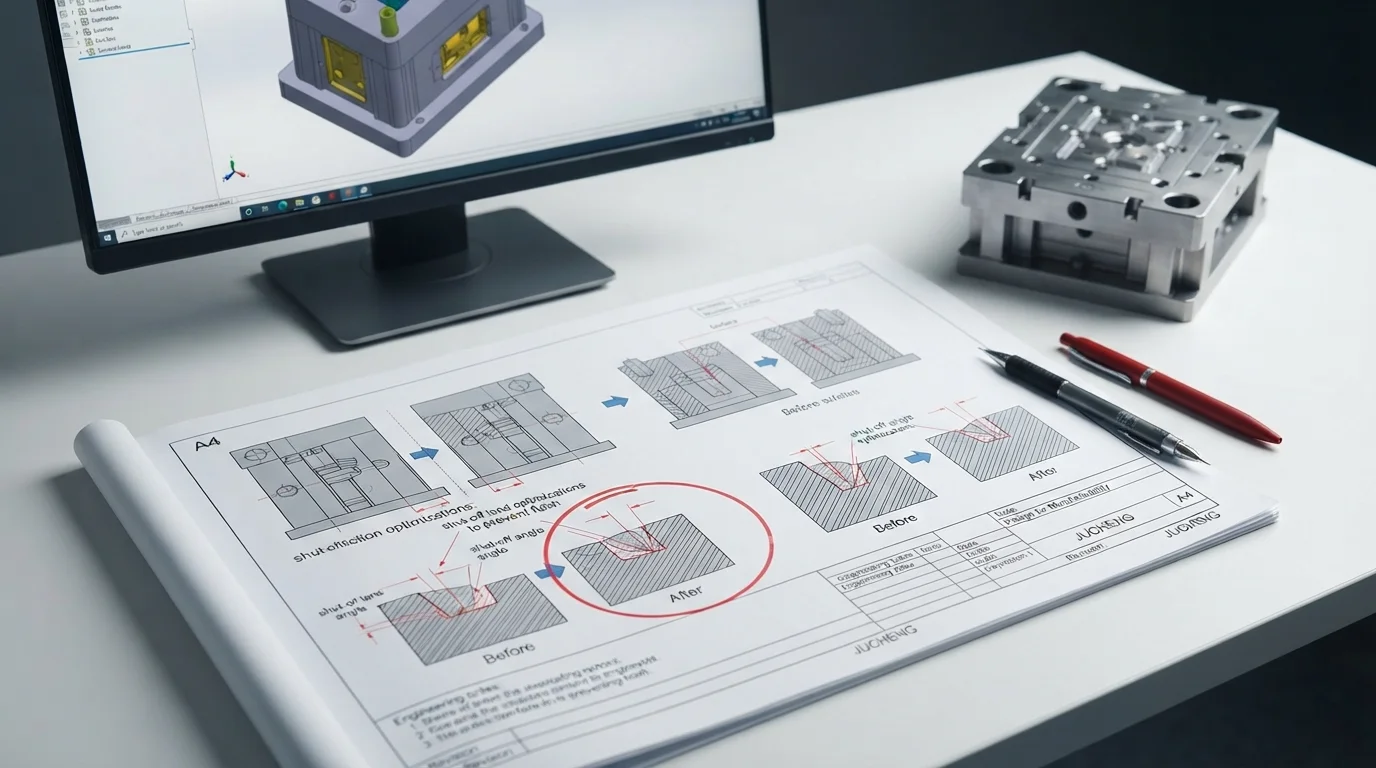
Stripping unnecessary tooling expenses begins with a comprehensive Design for Manufacturability (DfM) review completed prior to cutting mold steel. Technical reviews evaluate draft angles, wall thickness uniformity, and core pin locating mechanisms to prevent core displacement during injection. To minimize insert molding cost, optimizing the mold shut-off area is essential for reliable インサート成形.
Standardizing insert geometries across multiple product lines reduces custom stamping and machining expenses. Designing uniform boss wall thicknesses prevents localized sink marks and eliminates the need for expensive secondary cosmetic fills. Incorporating simple pass-through shut-offs or sliding core line modifications allows features to be molded directly in the line of draw, eliminating complex side-action sliders.
| Cost Optimization Strategy | Tooling Budget Impact | Unit Price Impact | 主な工学的利点 |
|---|---|---|---|
| Standardized Threaded Inserts | Zero custom tooling NRE | 15% – 25% Reduction | Eliminates custom progressive stamping dies |
| Line-of-Draw Pass-Through Shut-Offs | 20% – 35% Lower Mold Cost | 5% – 10% Reduction | Eliminates hydraulic side-action sliders & lifters |
| Robotic Automation (High Volume) | Higher initial automation setup | 30% – 50% Reduction | Cuts cycle time & eliminates operator placement errors |
よくある質問 (FAQ)
How does manual insert placement affect part unit cost compared to robotic automation?
Manual insert placement lowers initial NRE capital by eliminating custom robotic end-of-arm tooling, making it ideal for low-volume prototype runs of 1,000 to 5,000 units. Automated robotic insert placement increases initial tooling investment but dramatically reduces machine cycle time and labor expense, resulting in significantly lower unit costs for high-volume production runs exceeding 50,000 parts.
Why does metal insert quality impact mold maintenance costs?
Out-of-spec metal inserts with dimensional variations prevent mold shut-off steel from sealing properly against active contact areas. Oversized inserts crush steel shut-off lands upon clamp-up, causing expensive tool damage and flashing. Undersized inserts leave micro-gaps that permit molten resin to bleed onto terminal contact faces, causing high scrap rates and frequent tool cleaning.
What is the most effective way to lower initial insert molding tooling expenses?
Conducting an early DfM review to eliminate complex side-action undercuts is the most effective way to reduce tooling costs. Redesigning features to utilize line-of-draw shut-offs or simple hand-loaded loose cores eliminates expensive hydraulic sliders. Standardizing threaded brass insert sizes across your assembly also lowers insert purchasing costs.