
When comparing heat staking vs ultrasonic welding, start with the joint function: both methods join plastic assemblies, but they create the joint differently. Heat staking softens a molded boss so it can form a retaining head around a second component; ultrasonic welding fuses compatible plastic interfaces through vibration and pressure. The choice depends on whether the assembly needs mechanical retention, a continuous seam, service access, or a controlled appearance—not on which process sounds faster.
The functional difference starts in the joint
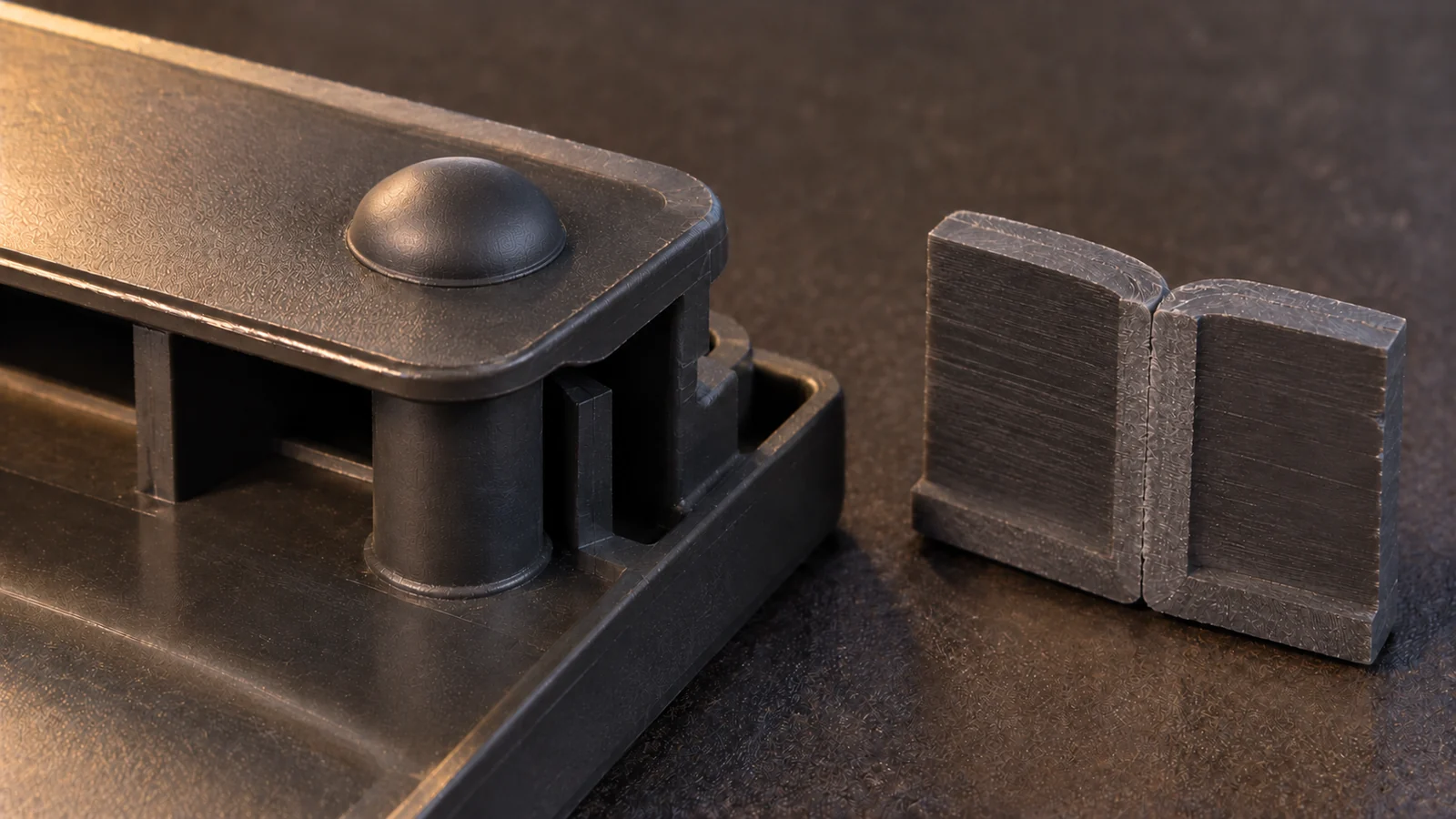
Heat staking is a form of thermal forming. A plastic post or boss is heated and reshaped to capture another part, often a metal insert or component with a hole. The retained component can remain mechanically captured without welding two plastic halves together. Boss dimensions, support, and head formation therefore drive the design.
Ultrasonic welding instead joins suitable thermoplastic interfaces by localized heating generated during vibration and clamping. It can form a seam around a perimeter or at defined joint features. Joint geometry, resin compatibility, fixture support, horn access, and the required seal are central design inputs. See the site’s guides to heat staking and ultrasonic welding for the process contexts.
Compare the tradeoffs that affect the finished assembly
| Decision factor | Heat staking | Ultrasonic welding |
|---|---|---|
| Typical joint function | Captures or retains a component with a formed plastic feature | Fuses compatible plastic interfaces |
| Key part feature | Accessible posts or bosses with controlled material volume | Designed joint land and a supported vibration path |
| Assembly access | Tool must reach each staking location | Horn must contact a suitable surface near the joint |
| Seam or enclosure needs | Retention points; not inherently a continuous seam | Can be designed as a continuous joint, subject to testing |
| Common design risk | Boss cracking, inconsistent head, stress or cosmetic marks | Misalignment, weak fusion, flash, part flex, or weld-line visibility |
| Serviceability | Depends on whether the formed head can be removed | Welded assemblies are generally not designed for nondestructive separation |
These are tendencies, not guarantees. Resin grade, fillers, wall geometry, production rate, and fixture design can change feasibility. A comparison should use actual parts and requirements rather than generic cycle-time claims.
Choose by assembly need, not process label
Heat staking is a logical candidate when a molded boss can retain a second component and the design has room for staking access. It may simplify an assembly that needs discrete retention points. Check the boss root, surrounding wall, material condition, and load path; an undersized or poorly supported post can crack or deform instead of forming a stable head.
Ultrasonic welding is worth evaluating when two compatible plastic components need a fused interface, especially when the seam must follow a defined path. The part should provide a joint feature, locating strategy, and fixture support. If only a metal component is being captured, welding two plastic surfaces may not solve the actual design need.
Also compare the consequence of a process failure. A loose insert, a cracked stake, and a leaking seam require different detection methods. Define assembly acceptance before selecting equipment or making the joint feature final.
Validate strength, appearance, and function
- State the requirement: retention force, pull-out resistance, sealing, alignment, or cosmetic limit.
- Inspect the geometry: boss or joint dimensions, draft, wall support, and tolerance stack.
- Run representative trials: use production-intent materials and fixtures where possible.
- Test the failure mode: pull, torque, leak, section, or visual inspection as appropriate.
- Document the window: record setup, part lot, observed failure location, and acceptance criteria.
Do not use a neat-looking head or seam as a substitute for functional testing. The inspection method should detect the failure that matters to the assembly.
Frequently asked questions
Can heat staking replace ultrasonic welding?
Only when the joint function allows it. Heat staking forms a retention feature; ultrasonic welding fuses plastic interfaces. They are alternatives only for some assembly concepts, not interchangeable operations.
Which process is better for a sealed enclosure?
Ultrasonic welding may be a candidate for a continuous plastic seam, but sealing must be proven with a defined leak test. Discrete heat-staked points do not by themselves create a continuous seal.
What should be decided before the design is frozen?
Confirm materials, load and sealing needs, cosmetic limits, tooling access, tolerance stack, and the test that will demonstrate acceptance. A representative assembly trial should validate the selected method.
The better process is the one whose joint geometry directly meets the assembly’s function and can be inspected reliably.