
Electric mobility relies on high-energy-density battery configurations to achieve optimal range and power output.
Designing structural framing components for these battery packs presents extreme mechanical and electrical challenges.
Engineering departments require specialized components to isolate, protect, and physically position hundreds of individual battery cells.
JUCHENG Injection Molding delivers bespoke contract manufacturing services, translating complex structural designs into highly repeatable molded parts.
Every production run uses advanced, custom-built steel tooling to ensure that high-voltage electrical safety and physical robustness are maintained.
Table of Contents
Design Challenges in Customized Cell Carrier Frameworks
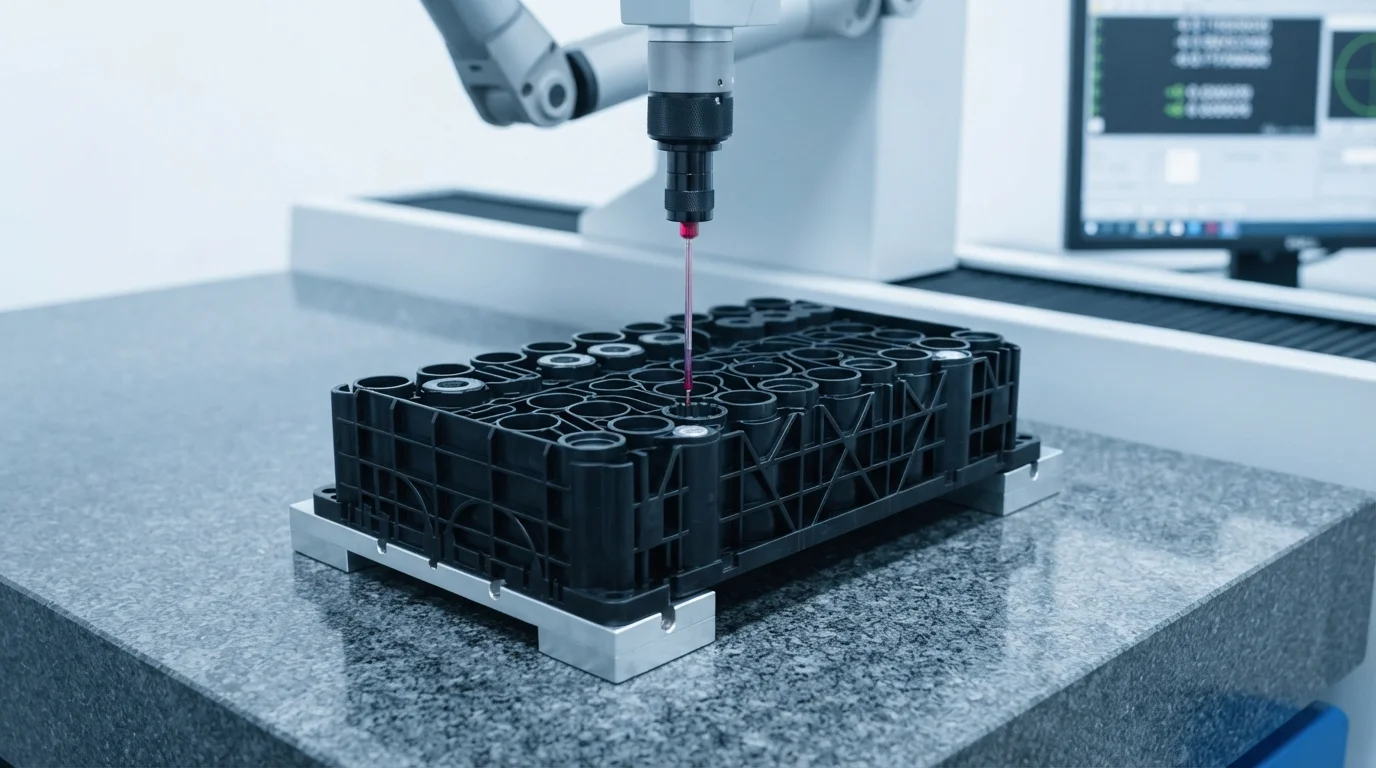
Manufacturing of high-precision electric vehicle battery cell holders demands strict dimensional consistency across every single pocket.
Whether supporting cylindrical formats or prismatic modules, the internal diameters must prevent excessive radial movement while avoiding cell compression.
Improper cell fitting causes high contact resistance, terminal fatigue, and reduced thermal dissipation pathways.
Consequently, our tooling engineers design multi-cavity hot runner molds that ensure uniform plastic flow to prevent asymmetrical shrinkage.
Key design requirements for maintaining pocket alignment include:
- Cell positioning—Securing precise radial alignment prevents electrical terminal strain during vehicle vibration.
- Vibration dampening—Absorbing mechanical shock prevents micro-friction between the plastic carrier and cell sleeves.
- Creep resistance—Preventing structural sag over a ten-year lifespan ensures busbars remain perfectly aligned.
- Thermal venting—Integrating cooling channels between pockets maximizes passive airflow across cell surfaces.
Achieving a tight tolerance of ±0.02 mm on cell pocket diameters of the molded electric vehicle battery cell holders requires meticulous control over mold temperatures and injection speeds.
Using multi-cavity layouts exposes the polymer to potential pressure imbalances between different mold areas.
JUCHENG Injection Molding resolves this by optimizing gate locations through rigorous mold flow analysis, balancing cavity pressures precisely.
Such engineering steps avoid the formation of flash or short shots on critical wall features, securing a perfect slide-fit for every cell.
Thin-wall structures are typical in these designs to save weight and maximize packing efficiency.
Reducing nominal wall thicknesses down to 1.0mm or 1.2mm compromises part structural strength unless structural ribs are perfectly placed.
Our team utilizes advanced DfM analysis to ensure that weld lines are directed away from mechanical stress concentration points.
This prevents structural failures during vehicle crash testing, where the cell carrier must survive high deceleration G-forces without cracking.
Material Compliance and Dimensional Stability
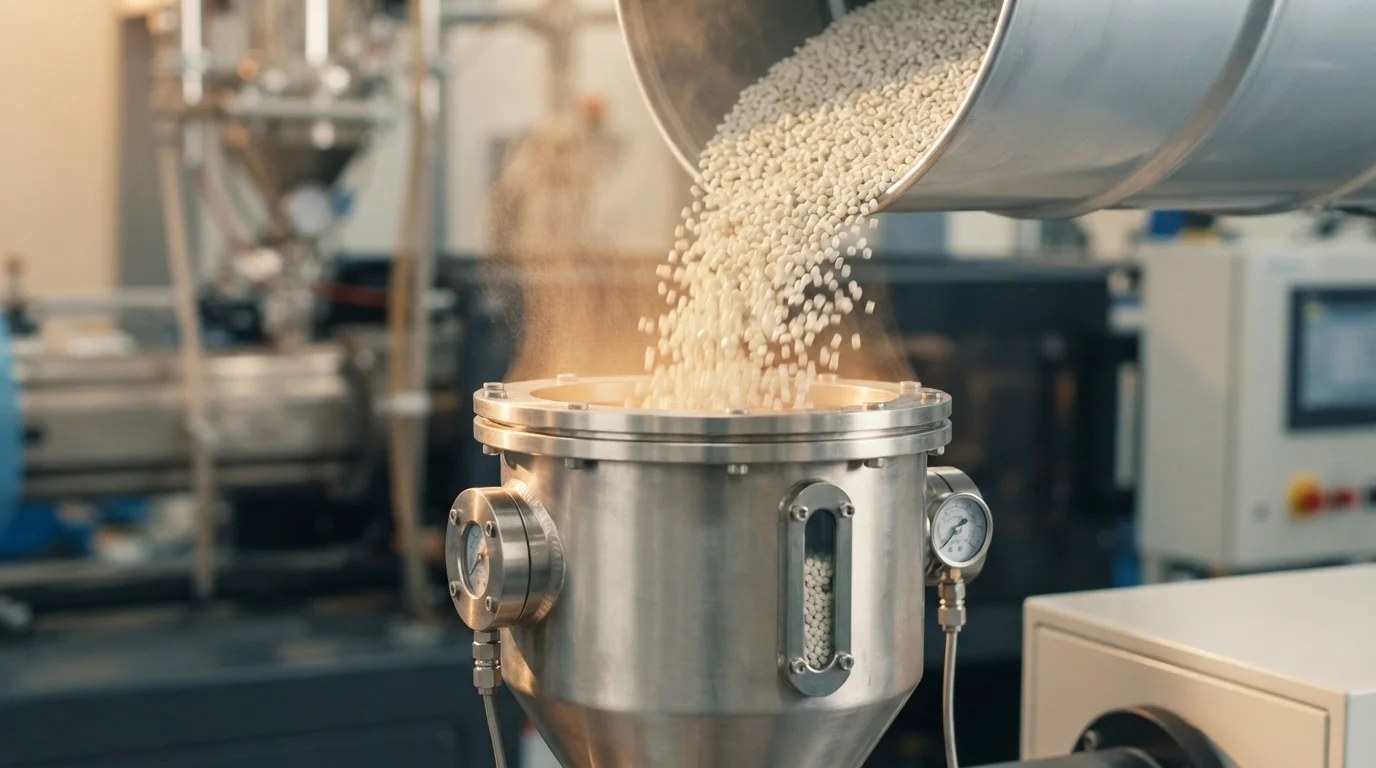
Material selection directly determines the mechanical longevity and electrical isolation characteristics of electric vehicle battery cell holders.
Polymers inside EV battery modules face continuous exposure to high temperatures, environmental vibration, and chemical outgassing.
Selecting 30% glass fiber reinforced polyamide (PA66-GF30 FR) provides the structural stiffness needed to support heavy battery cell stacks.
This material delivers excellent heat deflection temperatures, remaining mechanically stable under continuous operating loads of 120°C.
Flame-retardant (FR) additives are mandatory for high-voltage compliance but often alter polymer shrinkage and melt viscosity.
Because polyamide absorbs atmospheric moisture, JUCHENG utilizes desiccant wheel hopper dryers to dry the resin to below 0.05% moisture content prior to molding.
This critical preparation step prevents hydrolytic degradation, maintaining the high dielectric strength required to insulate neighboring cells.
Additionally, the UL94 V-0 flame-retardant rating must be strictly preserved to prevent fire propagation in the event of local cell thermal runaway.
Dimensional stability over the product’s lifespan prevents cell terminals from experiencing mechanical stress.
Long-term polymer creep can cause cell displacement, leading to weld fracturing on the connected high-voltage busbars.
Our processing engineers counteract this by maintaining uniform holding pressures during the cooling phase, minimizing molded-in residual stresses.
Our strict raw material sourcing ensures that every batch is accompanied by an official Certificate of Analysis to guarantee chemical compliance.
Tooling Configuration & Zeiss CMM Inspection
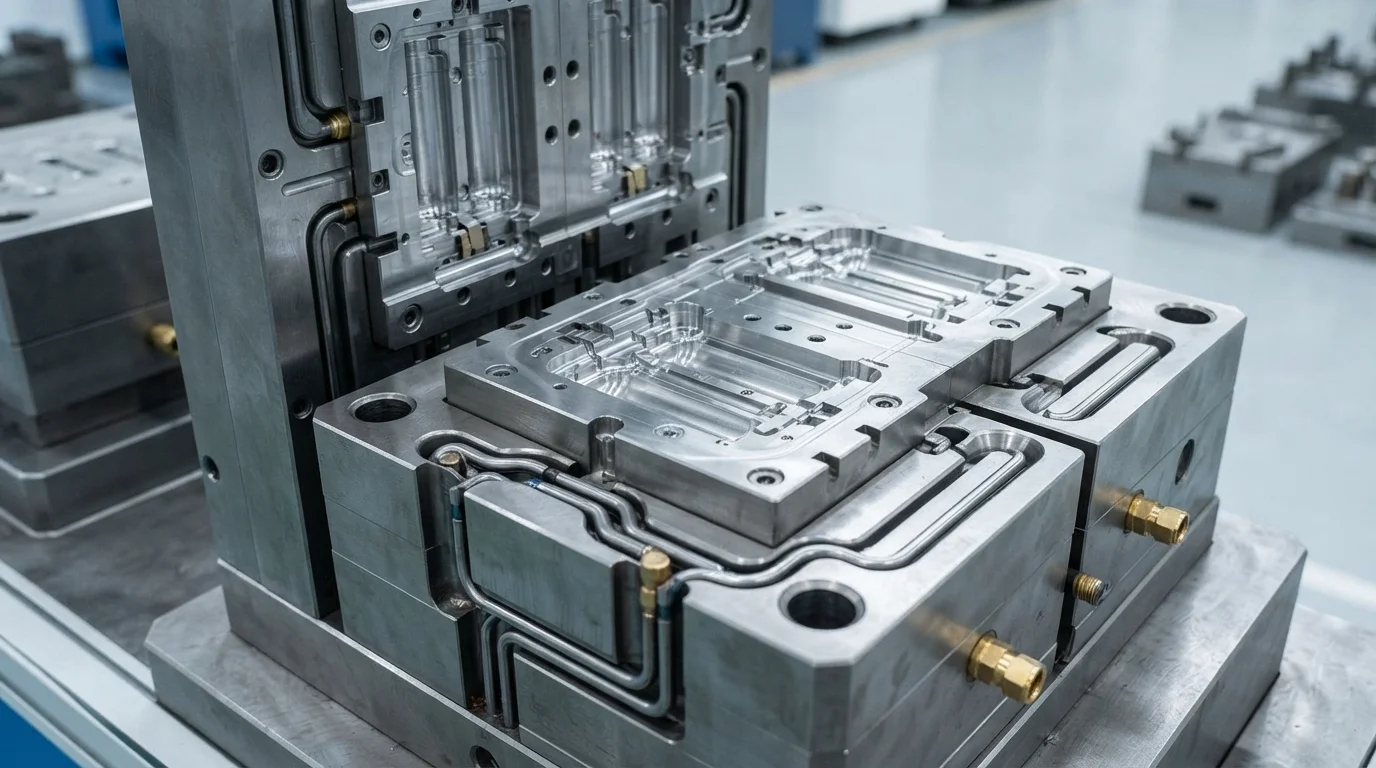
Complex mold tooling configuration optimized for mass-producing electric vehicle battery cell holders utilizes advanced cooling networks and robust ejection mechanisms.
Glass-fiber filled materials are abrasive, meaning mold plates must be cut from hardened H13 tool steel with a hardness of HRC 48-52.
Our in-house tool shop utilizes 5-axis high-speed CNC milling and precision EDM to manufacture intricate mold cavities with perfect finish.
These features enable smooth part ejection and prevent core pins from bending during high-speed production cycles.
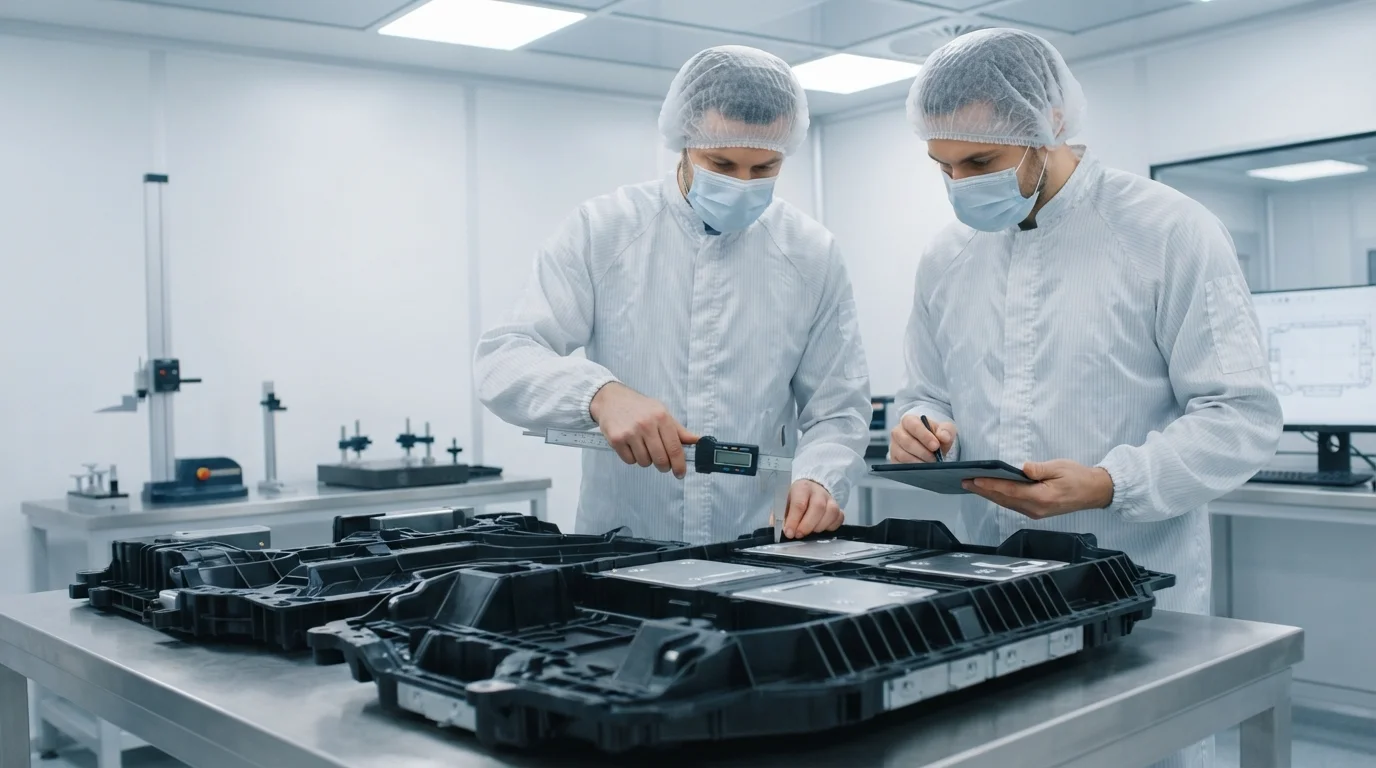
Quality verification inside our climate-controlled inspection laboratories follows a strict measurement sequence:
- Fixture calibration—Securing the molded cell carrier in a custom stress-free fixture ensures measurement repeatability.
- Multi-point scanning—Using a ruby-tipped probe on our Zeiss CMM captures the exact circularity of each cell pocket.
- Concentricity calculation—Computing the true position of cell-to-cell spaces confirms perfect terminal pitch alignment.
- SPC logging—Recording dimensional trends on statistical process charts allows real-time molding parameter tuning.
Ultimately, our rigid cell carriers are engineered to fit seamlessly inside our custom plastic battery housings for EV to ensure high-voltage insulation.
This complete assembly approach minimizes tolerance stack-up issues between different suppliers, ensuring trouble-free automated pack assembly on your production lines.
By combining advanced tooling with IATF 16949-certified quality management, JUCHENG delivers a reliable manufacturing path for next-generation EV platforms.
Frequently Asked Questions (FAQ)
How do you manage warpage in cell holders?
Shrinkage management involves balancing fiber orientation in glass-filled materials.
Glass fibers align parallel to the molten flow path, causing anisotropic shrinkage.
We resolve this by using multi-point hot runner valve gates to balance the filling pressure and align the glass fibers symmetrically, neutralizing residual post-mold warpage.
What tool steels are best for abrasive glass-filled PA66?
Mold plates require hardened tool steel such as S136 or H13, hardened to HRC 48-52.
Glass fibers and outgassing flame retardants are highly abrasive and corrosive.
Selecting premium hardened steels prevents localized cavitation and pocket erosion, ensuring critical tolerance consistency over long production lifespans.
Can you insert-mold battery sensors into the carriers?
Overmolding copper pins or packaging temperature sensors directly into the carriers is a standard capability.
This eliminates downstream manual wire-routing and optimizes the space profile.
Our robotic insert systems place the sensors within tolerances of ±0.05mm, preventing structural leakage and maintaining electrical clearance standards.