
A robot gripper needs an overmold when the contact surface must add compliance, friction, or part protection without asking the structural body to do that job. The overmold is not a shortcut for weak fingers or poor force control: the rigid substrate still carries the load, while the softer layer manages contact. Start by defining the object, motion, gripping force, cleaning exposure, and acceptable surface marks. Those conditions determine whether a bonded soft layer, a mechanically retained insert, or a replaceable pad is the better route.
What the overmold should—and should not—do
A soft layer can increase contact area and reduce local marking, but it cannot compensate for gripper geometry that applies force at the wrong point. Map the contact patch through the full pick-and-place cycle. A part that is stable at pickup may rotate during acceleration, collide with a fixture, or slip when the jaw closes on a dusty or oily surface.
Translate those observations into acceptance criteria: allowable slip, part position after release, visible marking, and wear after representative cycles. If the gripper handles different part sizes, evaluate each contact condition rather than selecting one durometer from a catalog. Softer material may conform more readily, but it can also deform, roll at an edge, or increase drag during release.
Keep the force path in the rigid body. The overmold should provide a controlled interface with the workpiece; the molded substrate and its mounting features should transfer jaw load to the actuator. This distinction prevents a common design error: making the entire finger more compliant when only the contact face needs compliance.
Design the rigid substrate around the load path
Begin with the gripper’s mounting datum, pivot or guide features, and force direction. Thin sections near a screw boss or hinge can flex even when the contact face appears substantial. The substrate also needs support beneath the overmold to avoid local compression that changes jaw position from cycle to cycle.
Material selection should follow the real operating environment. Consider temperature, cleaning agents, oil exposure, impact, sliding wear, and whether the part is changed during maintenance. A thermoplastic elastomer can be a candidate for a compliant contact surface, but grade selection and adhesion depend on the rigid substrate and supplier compatibility data. Compare the operating conditions with the site’s thermoplastic elastomer material options; do not treat “soft” as a complete specification.
Design the overmold thickness and edge transitions so material fills the intended area without creating thin, fragile lips. Avoid abrupt terminations where the soft layer can be peeled by repeated contact. Preserve clearance for the mold shutoff and for the gripper to reach the part without the overmold becoming an unintended interference feature.
Treat the interface as a designed feature
Do not assume that two materials will bond simply because they can be molded in sequence. Chemical adhesion is grade- and process-dependent. When the bond is uncertain or the application imposes peel and shear loads, add geometry that retains the soft material: through-holes, wraparound edges, undercuts where tool release permits, or other mechanical interlocks.
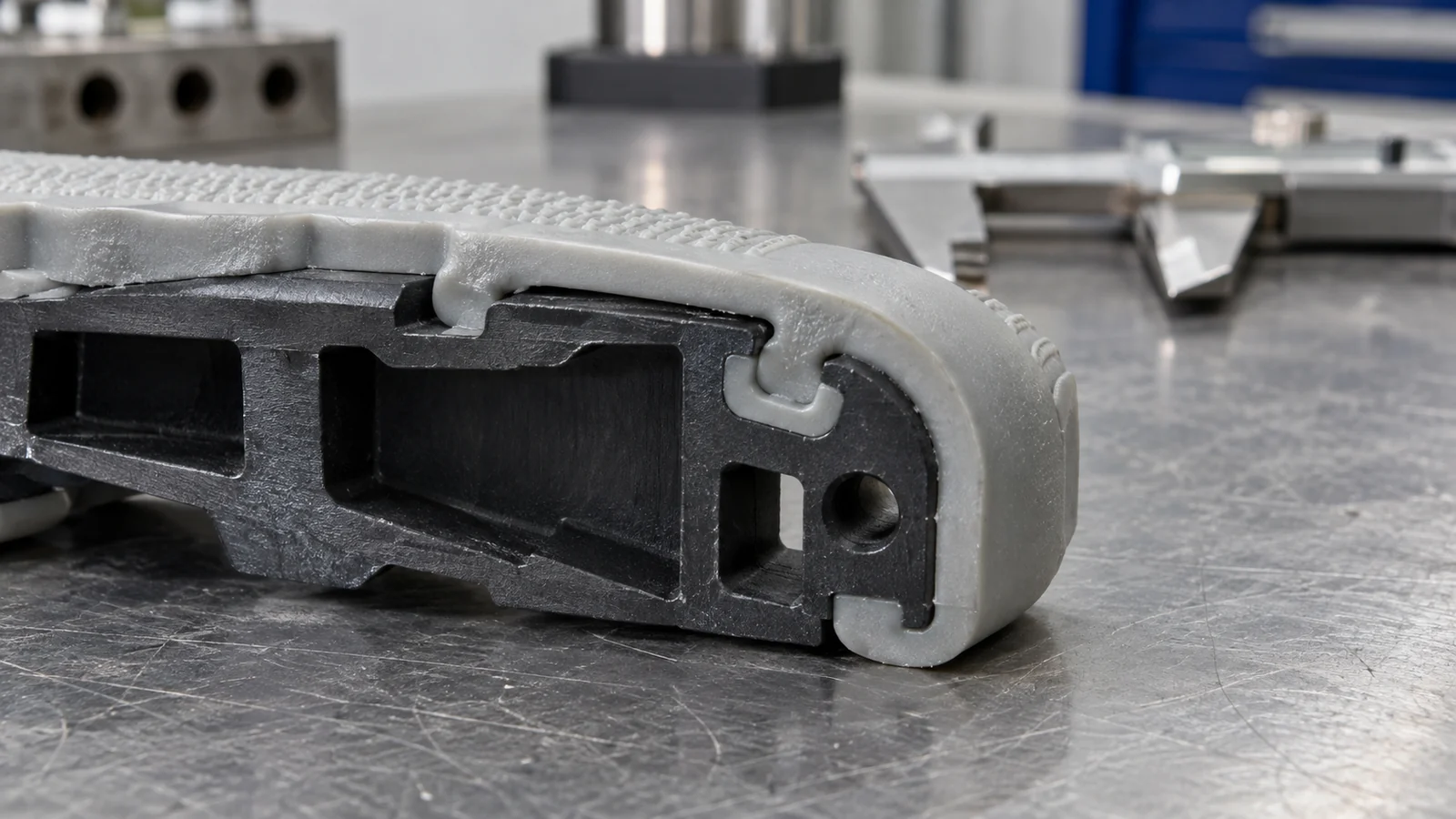
Each retention feature brings a tradeoff. A deep undercut may complicate tooling or demolding; a thin bridge may tear; a broad pocket may trap air or leave a visible witness line. Place gates and vents so the soft material reaches the full contact surface without a weak knit line at the highest-load edge. A DFM review should check whether the substrate can be located repeatably for the second material and whether flash could interfere with jaw alignment.
For plastic overmolding, provide the substrate material and grade, surface finish, contact geometry, expected loads, and environmental exposure. Those inputs help distinguish a bond-dependent design from one that needs mechanical retention.
Validate grip, wear, and release together
A coupon peel test can help compare material pairs, but it does not prove that the finished gripper will perform. The actual part includes curvature, wall thickness, gate location, cooling history, and loading direction. Validate the molded geometry under the same grip and release sequence used in the cell.
- Check contact: confirm the overmold reaches the intended surface and does not obstruct jaw travel.
- Measure retention: test slip and rotation with representative parts, payloads, and acceleration profiles.
- Inspect the interface: look for lifting, edge peel, flash, and damage after repeated cycling.
- Test release: verify that the part separates cleanly rather than sticking, dragging, or shifting position.
- Repeat after exposure: include actual cleaner, oil, temperature, and wear conditions where relevant.
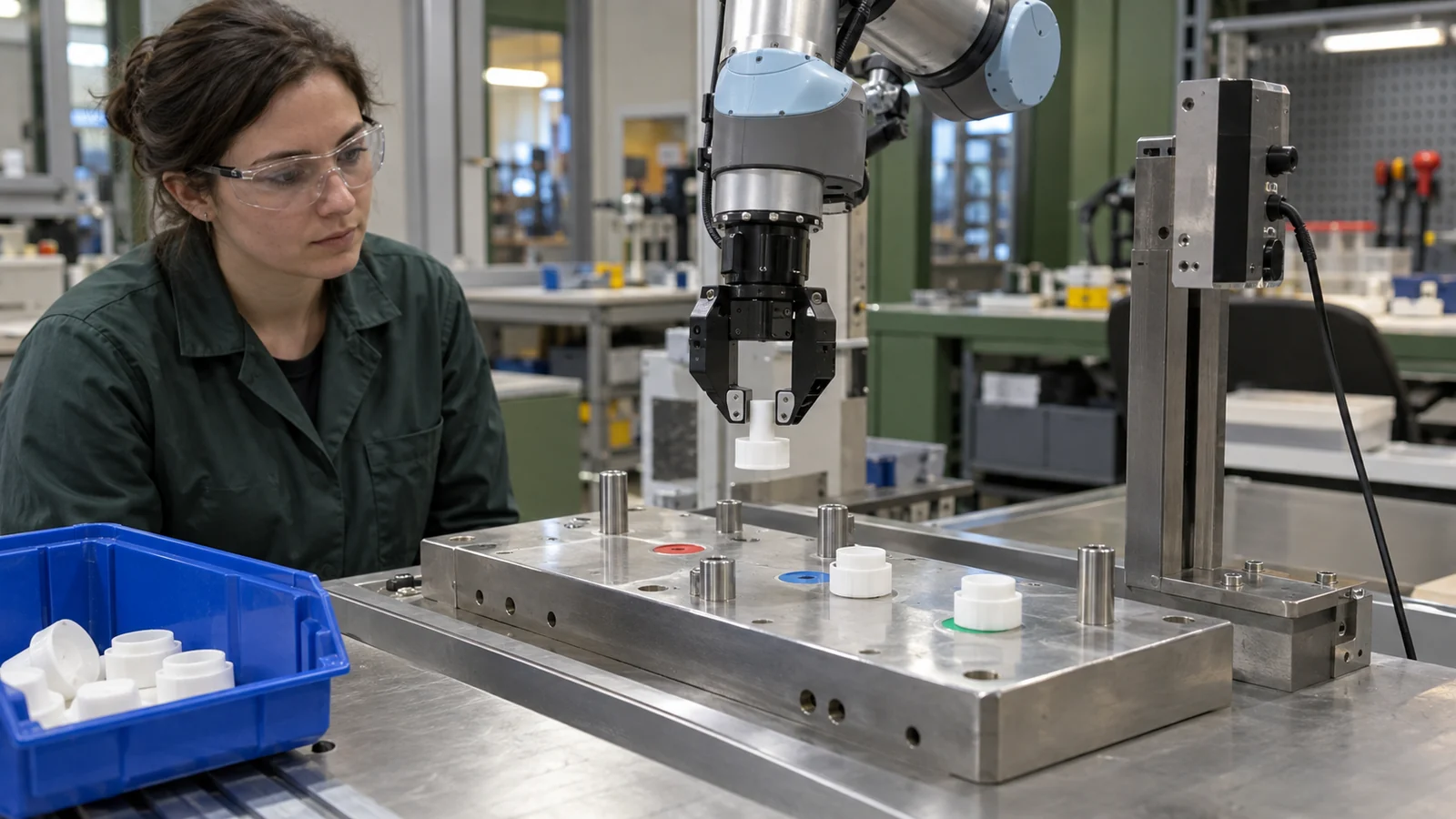
Keep the failure mode visible in the test plan. If a gripper passes a static pull check but loses position during fast motion, the missing evidence is dynamic retention—not simply a higher material hardness.
Choose between overmolding and other routes
Overmolding is useful when the soft interface must remain attached to the rigid component. It is not automatically the lowest-risk choice. A replaceable pad can simplify maintenance; a separate elastomer insert can be appropriate when material replacement matters; a two-material molding route can improve repeatability when geometry and a compatible material system support it.
| Route | Useful when | Main question to resolve |
|---|---|---|
| Overmolded contact face | The soft layer should remain integrated with the rigid body | Can the interface survive real peel, shear, and cleaning loads? |
| Replaceable pad | Wear parts need quick replacement or different contact materials | Will the retention method stay secure without shifting? |
| Two-material molded part | A continuous interface and integrated production are priorities | Are material compatibility, geometry, and tooling sequence established? |
Use robotics injection molding as the broader application context, then define the gripper’s own load and contact requirements. An industry page cannot replace part-level DFM or material validation.
FAQ
Does a softer overmold always improve grip?
No. Friction, contact geometry, surface condition, and jaw force all matter. A softer layer can deform or drag during release, so test the finished part with representative workpieces.
Can the overmold bond to any rigid plastic?
No. Adhesion depends on the exact material grades and molding conditions. Confirm compatibility with supplier data and evaluate mechanical retention when the bond is uncertain.
What should be included in a gripper molding RFQ?
Send the CAD model, substrate material and grade, contact surface, payload and motion profile, service environment, quantity, and acceptance criteria for slip, wear, and part marking.