
Herstellung von Heißkanal-Spritzgießformen
Die Eliminierung von Kaltkanal-Angussabfall und die Aufrechterhaltung eines kontinuierlichen thermischen Gleichgewichts in den Formhohlräumen ist der entscheidende Schlüssel für eine hocheffiziente Massenproduktion. Bei der Herstellung von Heißkanal-Spritzgießformen werden elektrisch beheizte Verteiler und spezialisierte Nadelverschlussdüsen eingesetzt, um das Harz bis zum Hohlraumeingang geschmolzen zu halten. Bei Jucheng Precision, einem nach ISO 9001, ISO 13485 und IATF 16949 zertifizierten Hersteller, sind wir auf hochpräzise Heißkanal-Werkzeuge spezialisiert. Integriert mit digitalen Mehrzonen-PID-Temperaturreglern und 5-Achs-CNC-bearbeiteten Formeinsätzen aus Edelstahl S136 reduzieren unsere Heißkanalformen die Zykluszeiten um 20% bis 40% und gewährleisten gleichzeitig null Angussausschuss, verifiziert durch Zeiss-KMG-Prüfung.
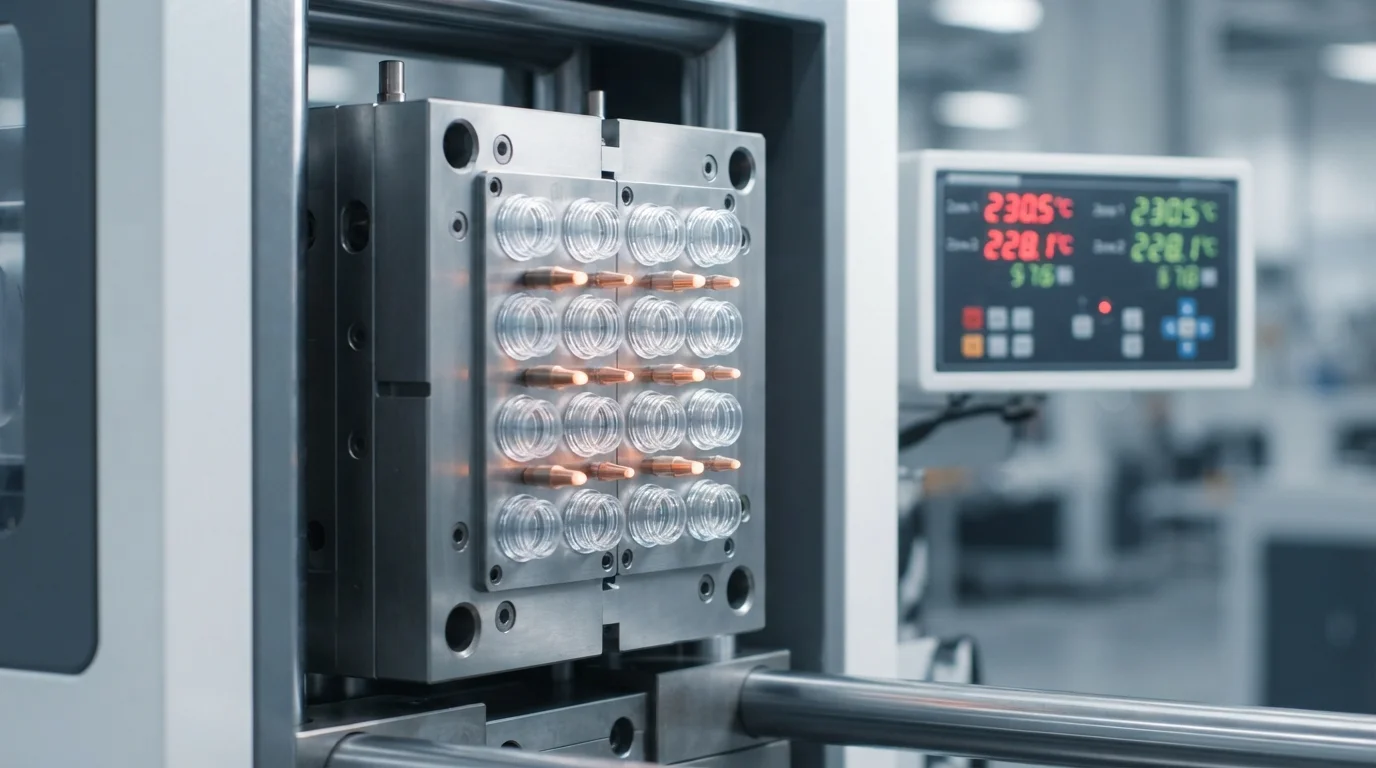
Heißkanalsystemtypen: Nadelverschluss vs. offene Thermoangussspitze
Die Wahl zwischen nadelverschlussgesteuerten und Thermoanguss-Heißkanalverteilern hängt von Ihren ästhetischen Anforderungen und der Scherempfindlichkeit des Harzes ab:
Nadelverschlusssysteme (nadelverschlussgesteuert)
Hydraulische oder pneumatische Ventilnadeln betätigen sich sequenziell, um die Hohlraumbohrung mechanisch zu öffnen und abzudichten. Bietet exaktes Schmelzedruck-Timing, null Angussrest und eliminiert Fadenbildung. Der Goldstandard für optische Polycarbonat (PC) Linsen, Medizinprodukte und Mehrkavitäts-Spritzgussform Werkzeugen zu gewährleisten.
Offene thermische Düsensysteme (Hot Tip)
Harz fließt durch eine kontinuierlich beheizte Düsenöffnung, die bei Stopp des Einspritzdrucks auf natürliche Weise erstarrt. Kosteneffizient und hochzuverlässig für nicht-kosmetische Gebrauchskunststoffe wie Polypropylen (PP) und Polyethylen (PE) Verschlüsse, Behälter und Strukturhalterungen.
Wirtschaftliche und qualitative Vorteile von Heißkanal-Werkzeugen
| Fertigungsvariable | Konventionell Kaltkanalform | Heißkanalsystem-Werkzeug |
|---|---|---|
| Rohmaterialeffizienz | Erzeugt Kaltkanal-Angussabfall (erfordert Wiedermahlung) | 100% Direkteinspritzung des Bauteils (null Angussabfall) |
| Formzyklusgeschwindigkeit | Langsamer (begrenzt durch die Abkühlzeit des dicken kalten Angusses) | Schneller (ausschließlich durch die Wandstärke des Bauteils bestimmt) |
| Erforderliche Schließkraft | Höher (Druckverlust über lange Kaltkanalverteilerkanäle) | Niedriger (direkte Schmelzedruckabgabe in die Kavität) |
| Optische Angussqualität | Erfordert manuelle oder automatisierte Angussschnittmarken | Mechanische Nadelverschluss-Absperrung hinterlässt keinen Angussrest |
Blueprint für Heißkanal-Werkzeugkonstruktion & thermisches Gleichgewicht
Integration von Heißkanalverteilern in Kundenspezifischer Formenbau erfordert strikte thermische Isolierung und Mehrzonen-PID-Regelung:
1. Digitale Mehrzonen-PID-Temperaturregler
Jede Düse und jeder Verteilerblock wird von dedizierten digitalen PID-Reglern überwacht. Die Aufrechterhaltung einer gleichmäßigen Temperatur innerhalb von ±1 °C verhindert die thermische Zersetzung empfindlicher technischer Harze wie Polyamid (PA/Nylon) und Polyetheretherketon (PEEK).
2. Thermische Isolierung des Verteilers & Isolierplatten
Wärme von Heißkanalverteilern darf nicht in den kalten Formgrundstahl übertragen werden. Wir entwerfen thermische Luftspaltbarrieren und Keramik-Isolierplatten, damit die wassergekühlten Kavitätenblöcke Teile schnell erstarren lassen.
3. Sequenzielle Nadelverschluss-Steuerung für geringen Verzug
Bei großen Strukturteilen oder Dünnwand-Spritzguss Gehäuse, Ventilstifte werden sequenziell betätigt. Dies steuert die Zusammenführung der Schmelzefront und eliminiert Schweißlinien sowie lokale Spannungskonzentrationen vollständig.
4. Gehärtete S136-Werkzeuge & leckagefreie Dichtungen
Heißkanaldüsen arbeiten unter intensiven zyklischen Wärmeausdehnungen. Unsere 5-Achs-CNC-Maschinen fertigen gehärtete Kavitätseinsätze aus S136-Edelstahl (52 HRC) mit mikrogenauen Dichtungen, um ein Eindringen von Hochdruckharz in die Verteilerkammer zu verhindern.
Ideale Anwendungsszenarien für Heißkanalwerkzeuge
- Großserienverpackungen & Verschlüsse: Mehrfachkavitäten-Getränkeflaschenverschlüsse, Klappdeckelverschlüsse, Lebensmittelbecher und dünnwandige Verpackungen (gespritzt in Polyethylen (PE) oder Polystyrol (PS)).
- Medizinische Einwegartikel & Optik: Reinraum-Spritzgießen Spritzenzylinder, Infusionskammern, optische Linsen und Biokompatibles & medizinisches Harz in Medizintechnik-Qualität Küvetten ohne Angussmarkierung.
- Automobil- & Elektronikbaugruppen: Hochvolumen-Spritzguss Türverkleidungen, Zwei-Komponenten-Spritzguss Schlüsselanhänger und ABS / Polybutylenterephthalat (PBT) Elektronikgehäuse.
Häufig gestellte Fragen (FAQ)
F: Was ist der Hauptvorteil eines Heißkanalwerkzeugs gegenüber einem Kaltkanalwerkzeug?
A: Heißkanalwerkzeuge eliminieren den Kaltangussabfall vollständig, sparen bis zu 30% an Rohmaterialkosten, verkürzen die Zykluszeiten um 20% bis 40% und liefern makellose Angussoptik.
F: Was ist der Unterschied zwischen Nadelverschluss- und Open-Tip-Heißkanalsystemen?
A: Nadelverschlusssysteme verwenden mechanische Nadelstifte zum Öffnen und Schließen des Angusses und hinterlassen keinen Angussrest. Open-Tip-Systeme setzen auf natürliches thermisches Erstarren an der Spitze und sind dadurch kosteneffizient für nicht sichtbare Teile.
F: Können Heißkanalformen hitzeempfindliche technische Harze verarbeiten?
A: Ja. Durch den Einsatz digitaler Mehrzonen-PID-Regler halten wir gleichmäßige Verteilereltemperaturen innerhalb von ±1 °C ein und verhindern so den thermischen Abbau von Harzen wie PC, PEEK und flammhemmenden Polymeren.
F: Wie überprüfen Sie die Leistung von Heißkanalformen vor der Serienproduktion?
A: Jedes Heißkanalwerkzeug durchläuft eine strenge Formmusterung & Validierung Bemusterung (T0/T1) auf unseren Elektropressen, begleitet von Druckprotokollierung im Formnest und dimensionaler Verifikation mit Zeiss CMM.