
Short answer: In-mold labeling (IML) is commonly chosen for integrated graphics on packaging and relatively repeatable label surfaces, while in-mold decorating (IMD) is often used for durable, formed graphics on appliance, automotive and electronic parts. The terminology overlaps across suppliers, so compare the actual film, forming method, resin interface, part geometry and inspection criteria – not the acronym alone.
The search phrase in mold labeling vs in mold decoration sounds like a clean process comparison, but the useful decision is more specific: which decoration system can reproduce the required appearance on your part, survive its service environment and fit the molding sequence? A label that works on a shallow tub may be a poor starting point for a curved control panel.
This guide frames the choice around the part and the production risk. For manufacturing scope, see our in-mold labeling process, in-mold decoration process, and broader plastic surface finishing options.
In this article:
- What changes between IML and IMD?
- Choose by part geometry and graphics
- Where designs run into trouble
- How to qualify the route
- Frequently asked questions
What Changes Between IML and IMD?
Both approaches place a printed film or label in the mold before resin is injected. The melt forms the plastic part around or against the decoration, integrating the graphic into the finished component rather than applying a conventional label after molding. The difference is usually not a single machine setting; it is the construction and role of the decorated layer.
IML is strongly associated with packaging and containers, where a printed label is positioned in the mold and becomes part of the molded wall. The In-Mold Decorating Association describes the film or label as being placed in the mold before resin is injected, with applications spanning food packaging, personal care, household products and other markets. IMD is commonly used for durable decorative surfaces such as control panels, automotive trim and electronic housings. These are useful tendencies, not universal boundaries: suppliers may use the terms differently, and the actual construction matters more than the name.
Ask whether the decoration is a flat label, a preformed insert, a formed film, a reverse-printed layer, or another stack-up. Then identify which surface is visible, which layer contacts the resin, how the insert is held in the cavity, and whether the graphic must wrap around edges or pass over compound curvature. Those answers reveal more than “IMD or IML” by itself.
For a packaging label, the challenge may be repeatable placement, wrinkle control and a clean label edge. For a dashboard bezel or appliance interface, the harder questions may be film forming, dimensional stability, abrasion, chemical exposure and how the decorated surface meets buttons, openings or mating parts. The process name does not replace those requirements.
Choose by Part Geometry and Graphics
Start with a drawing or CAD model that marks the show surface and the graphic boundary. A broad, shallow surface generally gives the label or film a more forgiving landing area than a deep wall, tight radius or highly contoured face. As geometry becomes more three-dimensional, the insert may need forming before molding, and the print can stretch or shift during forming. Review artwork in its formed state, not only as a flat file.
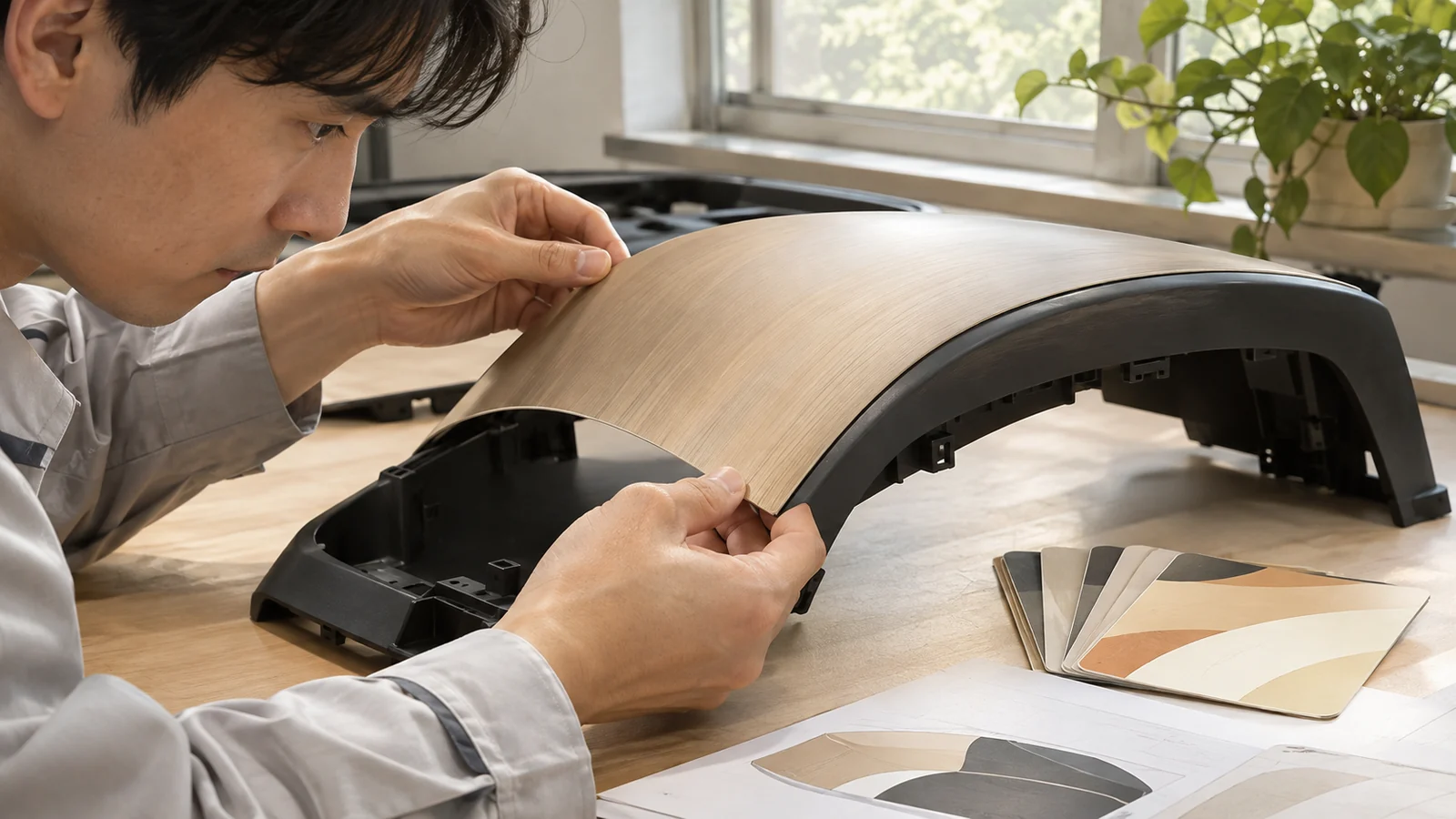
Pay special attention to transitions. A graphic that ends at a sharp corner, crosses a parting line, or approaches a gate, rib, boss or opening can create visual or process risk. Leave deliberate margins around edges and functional features. The exact margin is construction- and supplier-dependent; agree it from the actual film, die-cut tolerance, insert location method and part geometry rather than copying a generic number.
| Decision factor | IML is often considered when… | IMD is often considered when… |
|---|---|---|
| Part role | The graphic is integrated into a container or package wall. | A durable decorative face is part of a functional product. |
| Surface shape | The label area is relatively predictable and placement can be controlled. | A formed film must follow a contoured, visible surface. |
| Key risk | Position, wrinkles, edge appearance and mold-cycle compatibility. | Film forming, print distortion, surface durability and interface design. |
| Proof needed | Placement and appearance across cavities and production runs. | Appearance after forming, molding and relevant service tests. |
Material pairing also matters. The label or film, ink, any tie layer, and molded resin must tolerate the heat and pressure of the cycle and meet the product’s use conditions. “Same or similar resin” is a useful starting concept for some constructions, but it does not prove compatibility for every grade, pigment, coating or recycling stream. Confirm the complete material stack with the film supplier and molding team.
Where Designs Run Into Trouble
Decoration problems often originate upstream of the mold trial. Artwork may be released without a formed-film review; the graphic may enter a high-strain region; the label may be difficult to locate consistently; or the part may lack a stable surface for the insert to sit against. A visual sample made by printing directly on a flat panel cannot prove that the same graphic will remain undistorted on a formed insert.
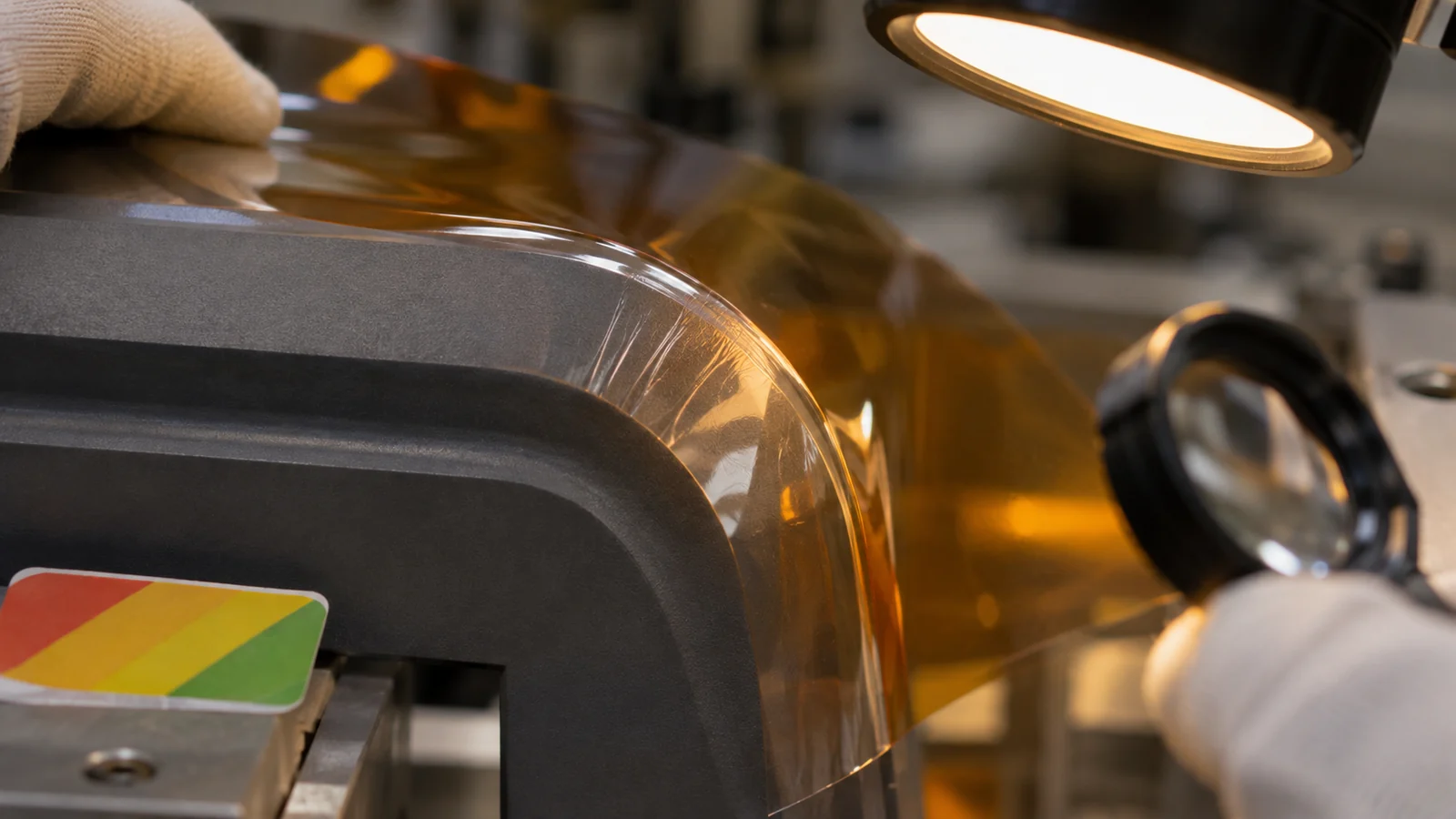 Another risk is treating a cosmetic surface as independent of part structure. A large opening, abrupt thickness change or nearby boss can alter local flow and cooling. That may affect sink, warpage, surface read-through or insert support. Review gate placement against the visible graphic, intended flow path and part strength together.
Inspection language can also be too vague. “No wrinkles” or “good appearance” needs a viewing distance, lighting condition, orientation and defined critical zones. Decide whether small edge variation is acceptable, whether color is checked against a physical standard, and how placement is measured. If suppliers inspect under different conditions, they can disagree while both believe they meet the drawing.
How to Qualify the Route Before Tooling
- Freeze the use case. Record the decorated surface, expected handling, cleaning agents, UV exposure, temperature range and required service life. Avoid turning a general durability preference into an untestable promise.
- Review formed artwork. Map print distortion, edge margins, openings and wrap zones on the 3D part. Identify critical appearance areas and zones that can tolerate variation.
- Confirm the material stack. Name the film or label construction, ink, coating or adhesive if present, resin grade, colorant and contact surface. Ask suppliers to identify compatibility evidence and unresolved assumptions.
- Plan insert handling and mold support. Review how the insert will be located, retained and released, how vents and gates interact with its perimeter, and how the mold can be cleaned or serviced.
- Agree on a representative trial. Use production-intent materials and real geometry where practical. Inspect placement, wrinkles, bubbles, edge condition, color and dimensional effects against written criteria.
The In-Mold Decorating Association’s in-mold process overview is a useful terminology reference, but the part-specific trial remains the decision point. A supplier’s process label is not a substitute for a qualified construction and acceptance plan.
Frequently Asked Questions
Are IML and IMD the same process?
They share the idea of integrating decoration during molding, but the terms are not used identically by every supplier. IML often describes a label integrated into packaging; IMD often describes a formed decorative film for durable product surfaces. Compare the actual stack-up, geometry and process sequence before specifying either term.
Can IML or IMD be added to an existing mold?
Sometimes, but it depends on insert access, location and retention, cavity geometry, venting, gate position, ejection and cycle requirements. An existing tool may need modification or may not reliably support the insert. Review the mold and part together before assuming a retrofit is practical.
Which option is more durable?
Neither acronym guarantees durability. Performance depends on film construction, ink and coating, resin interface, edge exposure, forming strain and the real service environment. Define the abrasion, chemical, temperature and UV tests that matter for the product, then validate the selected construction.