
Structural foam and conventional solid injection molding solve different part-design problems. Structural foam deserves evaluation when the component’s section, stiffness target, and mass objective may benefit from a cellular interior; conventional molding is often a straightforward route when the part needs solid-section behavior, fine detail, or a familiar design window. The choice depends on the finished part and its acceptance criteria—not a blanket claim that one process is lighter, cheaper, or stronger. A useful structural foam injection molding vs conventional injection molding review compares both routes against the same part requirements.
Use this comparison as a screening tool. Align both process concepts to the same geometry, material limits, expected volume, surface standard, and load cases before choosing.
Short answer: compare structural foam with solid molding when the part is thick, large, or stiffness-driven and mass matters. A solid-molding study may be simpler when appearance, thin sections, local detail, or dimensional requirements dominate. Validate the selected route with representative parts.
In this article:
- What changes between the processes?
- Where can each process fit?
- Comparison by buyer criteria
- A practical selection sequence
- Questions to settle before quoting
- FAQ
What changes between the processes?
Conventional injection molding fills a cavity with molten polymer and packs material to form a solid part. In structural foam molding, a foaming agent creates a cellular core while a denser outer skin forms against the mold. That change affects internal structure and may influence filling, surface appearance, dimensional behavior, and tooling considerations.
It does not mean every structural-foam part is hollow, nor does it guarantee a particular weight reduction or mechanical property. Results depend on resin, geometry, mold design, process setup, and what is measured. Base the decision on a feasible part concept and evidence, not a generic comparison chart.
See the process-specific structural foam molding page and the broader plastic injection molding page. These describe process families; neither replaces a part-level review.
Where can each process fit?
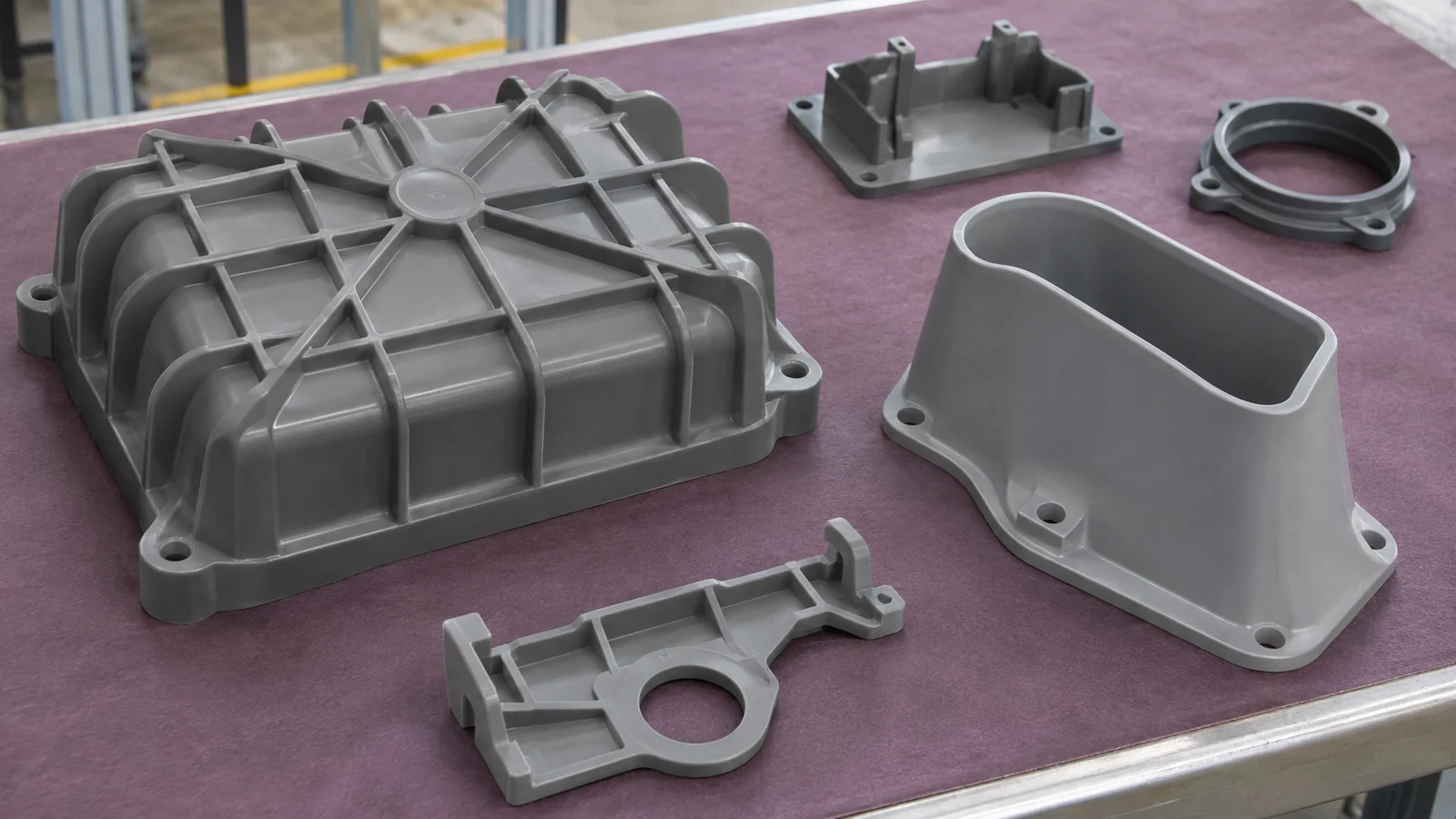
Structural foam is a candidate when the part has a thicker section, a stiffness-oriented architecture, or an assembly-level reason to reduce mass. Its cellular core can change section behavior while the skin provides the mold-facing surface. Large covers, housings, frames, and supports may merit study, provided the surfaces and load paths can meet requirements.
Conventional molding is attractive when the part depends on established solid-wall behavior, fine details, or cosmetic requirements that are easier to define and qualify through a solid route. It may also be the right baseline when there is no meaningful system benefit to a foamed structure. Solid does not automatically mean better quality, just as foam does not automatically mean lower cost.
In both cases, geometry matters. Thick solid sections can create sink or warpage risk; structural foam can still miss a surface, fit, or load requirement. Compare gates, vents, cooling, ejection, transitions, and post-molding operations too.
Comparison by buyer criteria
| Factor | Structural foam | Conventional solid molding | What to verify |
|---|---|---|---|
| Internal structure | Cellular core with mold-facing skin | Solid molded section | Section design, load path, local features |
| Mass objective | May support lower mass depending on design | Mass follows solid design and resin | Compare actual concepts against one requirement |
| Surface | Skin and finish need explicit evaluation | Finish remains tool- and process-dependent | Appearance zones, texture, gloss, inspection light |
| Details | Bosses, ribs, transitions need process-aware design | Details still need fill, pack, and cooling review | Mounts, shutoffs, thin features, interfaces |
| Economics | Value depends on system and tooling tradeoffs | Familiar baseline may simplify qualification | Tooling, cycle, rejects, secondary work, demand |
| Validation | Prove appearance, dimensions, and load response | Prove the same requirements for solid design | Common drawing and acceptance plan |
Neither column promises an outcome. Use the matrix to create questions for engineering, tooling, and procurement—not to declare a universal winner.
A practical selection sequence
- Write the non-negotiables. Identify surface zones, assembly dimensions, loads, service environment, and material restrictions.
- Find the governing problem. Is it mass, stiffness, thick-section appearance, impact, or assembly cost? If no need points toward a cellular structure, retain solid molding as a baseline.
- Sketch both concepts. Mark ribs, bosses, transitions, gates, vents, and cosmetic surfaces for each. Do not compare one optimized design with one unchanged design.
- Define proof. Agree on sample parts, dimensional checks, appearance review, and functional tests before locking tooling assumptions.

For related sink-mark context, see microcellular foam injection molding. Sink reduction alone does not prove structural foam is right for another component.
Questions to settle before quoting
Provide the 3D model, drawing, annual demand range, material constraints, appearance specification, load cases, assembly details, and existing failure data. Flag function-critical dimensions and whether the part will be painted, bonded, machined, or assembled with inserts.
Ask the team to state what evidence approves the route: representative samples, test fixtures, inspection method, and acceptance owner. A written decision record helps avoid late changes when a low-mass concept meets one goal but misses surface or fit requirements.
FAQ
Is structural foam always lighter than conventional molding?
There is no universal guarantee. The result depends on the compared designs, material, and process. Measure representative parts against the same functional requirements.
Is conventional molding always better for cosmetics?
No process label guarantees appearance. Define finish and inspect parts under agreed conditions; tool surface, resin, geometry, and stability matter.
Which process costs less?
That requires part and production data. Compare tooling, cycle assumptions, material use, secondary operations, inspection, and reject risk.
Can an existing solid part be converted directly to structural foam?
Review rather than assume a drop-in change. Wall architecture, gates, vents, mounts, appearance, and validation may need redesign.