
Hot Runner Injection Mold Manufacturing
Eliminating cold runner sprue waste and maintaining continuous thermal equilibrium inside mold cavities is the ultimate key to high-efficiency mass production. Hot runner injection mold manufacturing utilizes electrically heated manifolds and specialized valve gate nozzles to keep resin molten up to the cavity entrance. At Jucheng Precision, an ISO 9001, ISO 13485, and IATF 16949 certified manufacturer, we specialize in high-precision hot runner tooling. Integrated with multi-zone digital PID thermal controllers and 5-axis CNC-machined S136 stainless steel cavity inserts, our hot runner molds shave 20% to 40% off cycle times while ensuring zero sprue scrap verified by Zeiss CMM inspection.
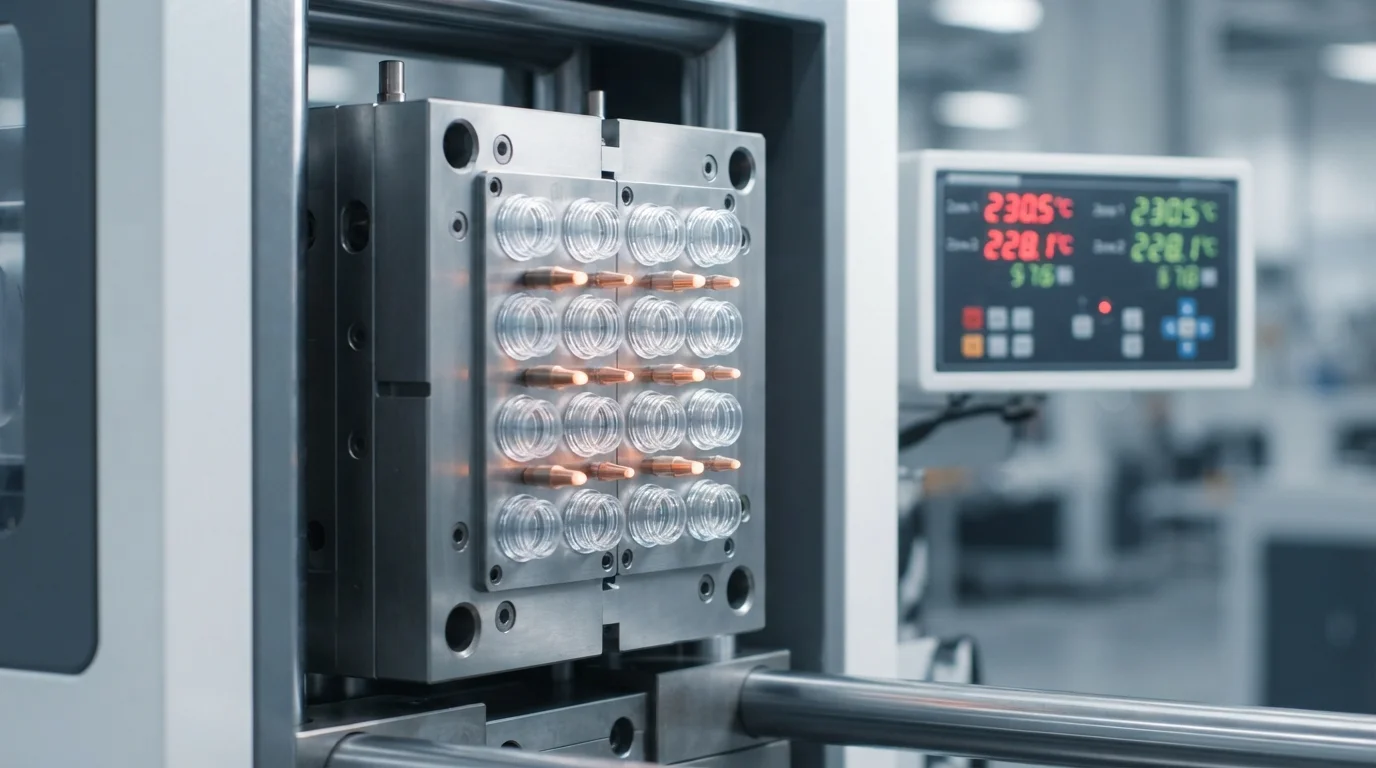
Hot Runner System Types: Valve Gate vs. Open Thermal Tip
Selecting between valve-gated and thermal-sprue hot runner manifolds depends on your aesthetic requirements and resin shear sensitivity:
Needle Valve Gate Systems (Valve-Gated)
Hydraulic or pneumatic valve pins actuate sequentially to open and seal the cavity orifice mechanically. Provides exact melt pressure timing, zero gate vestige, and eliminates stringing. The gold standard for optical Polycarbonate (PC) lenses, medical devices, and Multi-Cavity Injection Mold tools.
Open Thermal Tip Systems (Hot Tip)
Resin flows through a continuously heated tip orifice that freezes naturally when injection pressure stops. Cost-effective and highly reliable for non-cosmetic commodity plastics like Polypropylene (PP) and Polyethylene (PE) caps, containers, and structural brackets.
Economic & Quality Advantages of Hot Runner Tooling
| Manufacturing Variable | Conventional Cold Runner Mold | Hot Runner System Tooling |
|---|---|---|
| Raw Material Efficiency | Generates cold runner sprue scrap (Requires regrinding) | 100% Direct Part Injection (Zero sprue waste) |
| Molding Cycle Speed | Slower (Limited by thick cold sprue cooling time) | Faster (Dictated solely by part wall thickness) |
| Clamping Tonnage Needed | Higher (Pressure loss across long cold runner channels) | Lower (Direct melt pressure delivery into cavity) |
| Gate Cosmetic Quality | Requires manual or automated sprue trimming marks | Mechanical valve shut-off leaves zero gate vestige |
Hot Runner Mold Engineering & Thermal Balance Blueprint
Integrating hot runner manifolds into Custom Mold Making requires strict thermal isolation and multi-zone PID control:
1. Multi-Zone PID Digital Temperature Controllers
Every nozzle and manifold block is monitored by dedicated digital PID controllers. Maintaining uniform temperature within ±1°C prevents thermal degradation on sensitive engineering resins like Polyamide (PA/Nylon) and Polyetheretherketone (PEEK).
2. Manifold Thermal Isolation & Insulation Plates
Heat from hot runner manifolds must not transfer into the cool mold base steel. We design air-gap thermal barriers and ceramic insulation plates, allowing the water-cooled cavity blocks to solidify parts rapidly.
3. Sequential Valve Timing for Low Warpage
On large structural parts or Thin Wall Injection Molding enclosures, valve pins actuate sequentially. This controls melt front convergence, completely eliminating weld lines and localized stress concentration.
4. Hardened S136 Tooling & Leak-Proof Seals
Hot runner nozzles operate under intense thermal expansion cycles. Our 5-axis CNC machines cut hardened S136 stainless steel cavity inserts (52 HRC) with micro-precision seals to prevent high-pressure resin leakage into the manifold pocket.
Ideal Application Scenarios for Hot Runner Tooling
- High-Volume Packaging & Closures: Multi-cavity beverage bottle caps, flip-top closures, food tubs, and thin-walled packaging (molded in Polyethylene (PE) or Polystyrene (PS)).
- Medical Disposables & Optics: Cleanroom Injection Molding syringe barrels, IV drip chambers, optical lenses, and Biocompatible & Medical Grade Resin cuvettes with zero gate vestige.
- Automotive & Electronic Assemblies: High Volume Injection Molding door panels, Two-Shot Injection Molding key fobs, and ABS / Polybutylene Terephthalate (PBT) electrical housings.
Frequently Asked Questions (FAQ)
Q: What is the main advantage of a hot runner mold over a cold runner mold?
A: Hot runner molds completely eliminate cold sprue waste, saving up to 30% in raw material costs while shortening cycle times by 20% to 40% and delivering flawless gate cosmetics.
Q: What is the difference between valve gate and open-tip hot runner systems?
A: Valve gate systems use mechanical needle pins to open and shut off the gate, leaving zero gate vestige. Open-tip systems rely on natural thermal freezing at the tip, making them cost-effective for non-visual parts.
Q: Can hot runner molds process heat-sensitive engineering resins?
A: Yes. By utilizing digital multi-zone PID controllers, we maintain uniform manifold temperatures within ±1°C, preventing thermal degradation in resins like PC, PEEK, and flame-retardant polymers.
Q: How do you verify hot runner mold performance before mass production?
A: Every hot runner tool undergoes rigorous Mold Trial & Validation sampling (T0/T1) on our electric presses, accompanied by in-cavity pressure logging and Zeiss CMM dimensional verification.