
Deflashing
Deflashing removes the thin, unwanted material left at a mold parting line, vent or insert interface. The objective is not simply a smoother-looking part: excess flash can obstruct assembly, interfere with a seal or become loose contamination. For a Jucheng molded-part project, define the surfaces that must be cleaned and the features that must remain untouched so that the removal method and inspection criteria can be reviewed together.
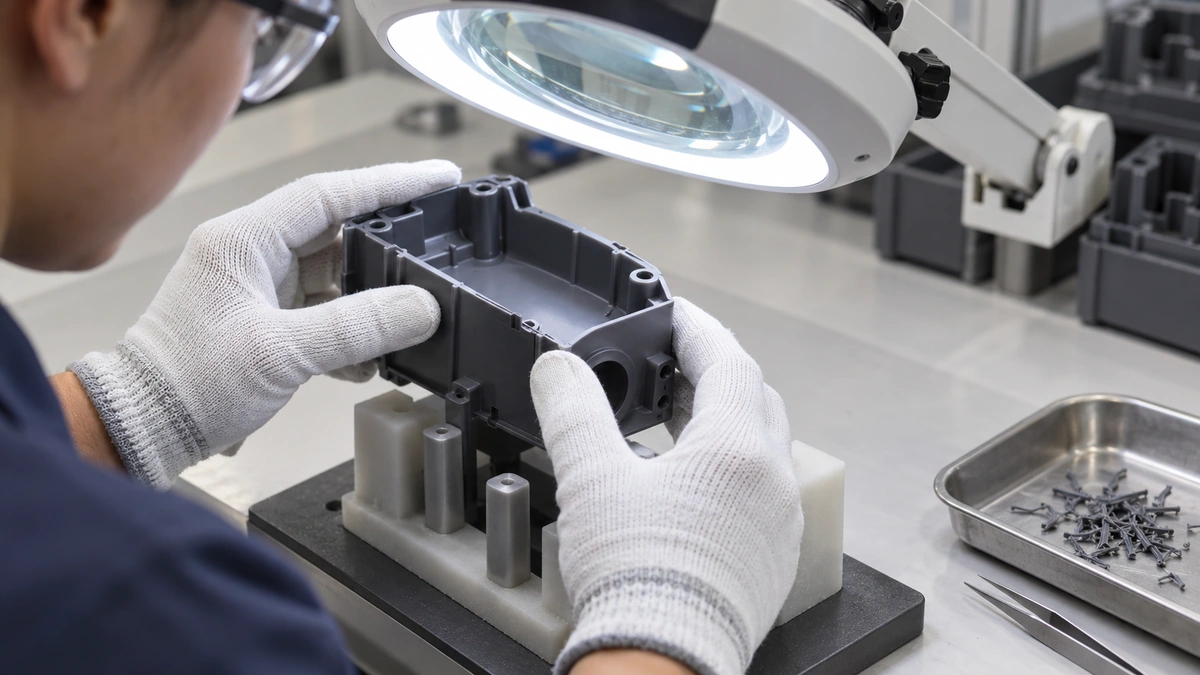
Remove the flash—not the working edge
An edge that looks clean can still be functionally wrong if processing rounds a sealing land or reduces a retaining feature. Start with a marked drawing showing the permissible residual flash, protected dimensions and cosmetic zones. A sample showing an acceptable edge is useful when a numerical requirement does not fully describe appearance.
Deflashing should also be distinguished from gate removal. Flash is unintended material escaping a shut-off; a gate is a planned connection to the runner. They may need different tools, fixtures and acceptance limits.
Selecting a controlled removal route
| Part condition | Route to evaluate | Main concern |
|---|---|---|
| Accessible local flash | Supported manual or fixture-guided cutting | Gouging the parent surface |
| Repeated fine peripheral flash | Suitable media-based treatment | Rounding, media retention and surface change |
| Temperature-sensitive or flexible details | Material-specific process trials | Distortion, cracking or changed flexibility |
A batch process is not automatically suitable for every resin or geometry. Thin walls, deep pockets and small holes can behave differently from the exposed outer edge. Confirm the exact resin grade and filler content before approving a trial; do not transfer settings from a visually similar part.
A release plan based on the part’s function
- Characterize the incoming condition. Record where flash occurs and whether its thickness changes between cavities or production runs.
- Support and protect the component. Locate it without crushing flexible features, and shield surfaces that must retain their finish.
- Check after cleaning. Examine critical edges and trapped debris, then repeat the relevant fit or sealing check.
Questions before approving production
Can deflashing improve dimensional accuracy?
It can remove material that exceeds an edge requirement. It cannot correct an undersized feature, warpage or an out-of-position hole in the molded substrate.
Is a visually clean part ready for a fluid system?
Not necessarily. Agree on the cleanliness requirement and inspect hard-to-reach locations; visual edge inspection alone does not establish particle cleanliness.
Include edge requirements in the molding package
Coordinate edge treatment with plastic injection molding and the agreed quality-control plan. Send a drawing, resin grade, expected quantity and annotated sample images for a project review.