
Structural Foam Molding
Manufacturing large, thick-walled plastic enclosures and heavy-duty structural components without internal sink marks or thermal warpage requires low-pressure cellular processing. Structural foam molding introduces a blowing agent into the molten polymer, creating a rigid solid outer skin surrounding a lightweight micro-cellular foam core. At Jucheng Precision, an ISO 9001 and IATF 16949 certified contract manufacturer, we specialize in high-strength structural foam injection molding. Utilizing 35+ advanced injection presses up to 3000 tons and 25+ in-house 5-axis CNC machining centers, we reduce component weight by 10% to 30% while maintaining structural rigidity verified by Zeiss CMM inspection.
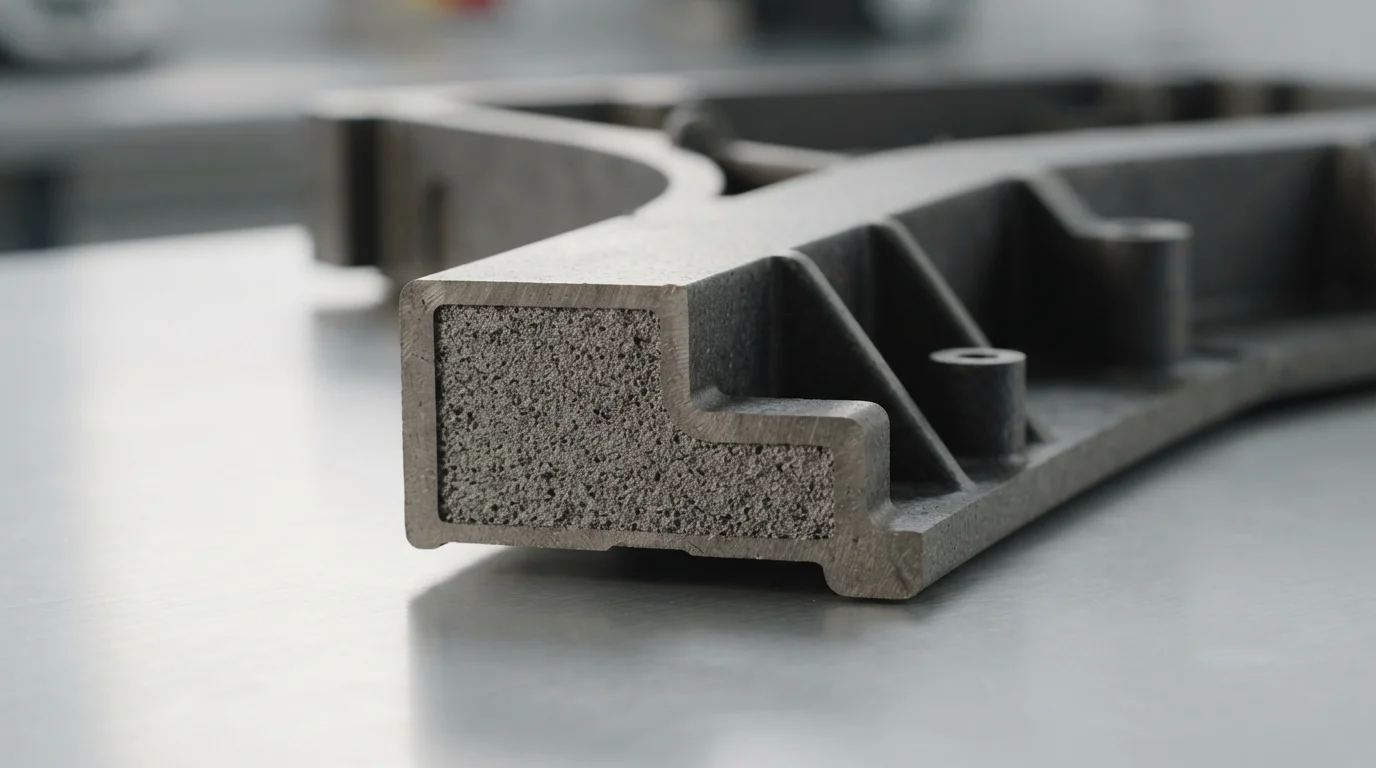
Structural Foam Molding vs. Solid Injection Molding Profile
Structural foam processing combines physical or chemical blowing agents with low-pressure Stampaggio a iniezione di plastica to yield lightweight, high-rigidity structural components:
| Engineering Property | Structural Foam Molding | Solid Plastic Injection Molding |
|---|---|---|
| Strength-to-Weight Ratio | Exceptional (Cellular core reduces weight by 10%–30%) | Standard (Solid polymer density throughout) |
| Thick-Wall Sink Marks | Zero Sink Marks (Internal gas expansion packs ribs) | Prone to sink marks on thick sections and wall-rib joints |
| Clamping Tonnage Requirement | Low Injection Pressure (Reduces required press tonnage) | High Hydraulic Pressure (Requires massive clamping tonnage) |
| Wall Thickness Envelope | 4 mm to 15 mm+ (Ideal for large structural frames) | 1.5 mm to 4 mm (Limited by sink marks and cycle times) |
Foamable Polymer Matrix & Density Reduction Matrix
Most engineering thermoplastics can be modified with physical (Nitrogen/Mucell) or chemical blowing agents:
| Resin Base Class | Blowing Agent Strategy | Target Structural Application |
|---|---|---|
| Polyolefins (Polipropilene (PP), Polietilene (PE)) | Physical nitrogen gas injection to achieve 15%–25% weight reduction while maintaining flexural stiffness. | Heavy-duty logistics pallets, agricultural crates, structural battery trays, and large automotive enclosures. |
| Engineering Resins (ABS, Policarbonato (PC), Poliammide (PA/Nylon)) | Endothermic chemical blowing agents combined with Fibra di Vetro (GF) reinforcement for high heat resistance. | Business equipment housings, medical monitor frames, industrial pump bases, and lawnmower decks. |
| Fire-Retardant Alloys (Ritardante di Fiamma (FR) Alloys) | Controlled gas dosing inside precision tools to maintain UL 94 V-0 safety standards on thick-walled structures. | High-voltage electrical cabinets, outdoor power supply boxes, and EV battery module enclosures. |
Structural Foam Manufacturing Blueprint: Low-Pressure Cellular Core Mechanics
Executing defect-free structural foam molding requires deep technical control over gas expansion and tool design:
1. Low-Pressure Injection & Nitrogen Gas Dosing
Inert nitrogen gas is injected into the plasticated melt under high pressure inside the barrel. When injected into the mold cavity at lower pressures, the dissolved gas expands, pushing the polymer against cavity walls to form a solid outer skin surrounding a porous cellular core.
2. Complete Sink-Mark Elimination on Thick Ribs
In solid molding, thick wall intersections suffer from heavy volumetric shrinkage, causing deep sink marks. In structural foam, the internal micro-cellular gas expansion provides continuous internal packing pressure as the part cools, completely eliminating sink marks on heavy structural ribs.
3. Reduced Clamping Tonnage & Produzione di stampi personalizzati
Because the cavity relies on internal gas expansion rather than extreme machine pack pressure, cavity pressures drop significantly (typically 20 to 40 bar). This allows us to mold massive structural parts on lower-tonnage presses, reducing tool wear and tooling costs.
4. Post-Molding Surface Finishing & Swirl Management
Gas expansion creates a characteristic swirl pattern on unpainted part surfaces. Jucheng offers turnkey secondary Finitura superficiale—including high-build primers, textured painting, and powder coatings—to deliver pristine, smooth exterior aesthetics.
Key Application Fields for Structural Foam Molded Components
- Heavy Industrial & Logistics Equipment: Structural material-handling pallets, large logistics totes, underground utility enclosures, structural agricultural bins, and chemical pump bases.
- Automotive & Commercial Vehicles (IATF 16949): Heavy truck door inner frames, EV battery module structural housings, spare tire covers, floor panels, and bumper supports.
- Business Equipment & Medical Systems: Large medical diagnostic analyzer chassis, commercial printer bases, server rack enclosures, and Gas-Assisted Injection Molding handles with Post-Molding & Assembly.