
Runner imbalance appears when cavities in a multi-cavity mold fill at different rates or reach different pressure and temperature histories. The symptom may be uneven part weight, short shots in some cavities, or inconsistent packing—not necessarily a single “bad runner.” A useful review traces the complete flow path from the sprue through each branch to the gates and checks it against the parts’ geometry and process window.
This is a layout and validation topic within custom mold making. It is distinct from choosing a hot or cold runner: either system can be balanced well or poorly.
In this guide:
- Recognize imbalance
- Review the flow layout
- Validate cavity-to-cavity behavior
- Balance against cost and scrap
- FAQ
What does runner imbalance look like in production?
Compare cavities rather than treating the mold as one output. If one cavity fills or packs ahead of another, parts can differ in weight, dimensions, sink, flash, or surface appearance. A cavity that repeatedly short-shots while another flashes suggests a distribution problem, but the root cause may also involve gate restriction, venting, cooling, or cavity-to-cavity differences.
Record cavity identity on samples and compare short-shot progression, part weight, and critical dimensions. A single mixed bin hides the pattern. Keep resin, machine settings, and sampling conditions consistent during the comparison so the evidence can isolate the mold behavior.
How should a runner layout be reviewed?
Begin with flow length and branch geometry. A naturally balanced layout gives each cavity a comparable path from the source, but equal geometric length alone does not guarantee equal filling. Turns, cross-section changes, gate dimensions, wall thickness, and the parts’ flow resistance all matter.
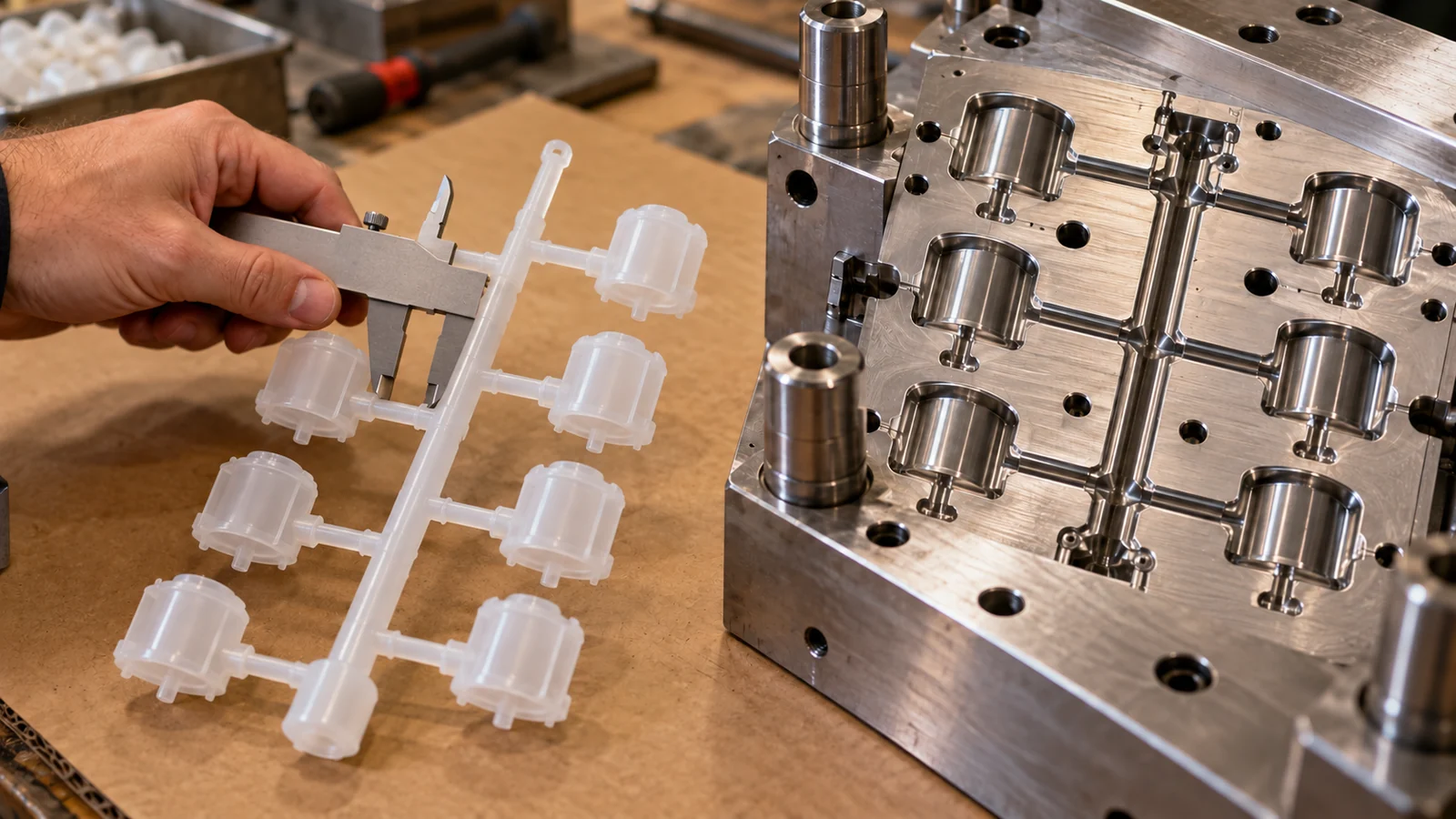
Review runner and gate dimensions together. A restrictive gate may dominate the pressure loss even when the upstream branches look symmetric. Conversely, oversizing the runner to compensate for one cavity can increase material use and cooling burden. The goal is controlled, repeatable filling—not the largest possible passage.
For a family mold with different part sizes, perfect natural balance may be impractical. The design then has to account for the relative flow demand and the acceptable operating window for each component. Do not assume that a shared shot guarantees that unlike parts will pack correctly.
How can cavity-to-cavity balance be validated?
Use a structured trial. Short-shot samples can show the order in which flow reaches cavities; complete parts can then be compared for weight, dimensions, and visible defects. Where available, pressure or temperature data can help explain a difference, but readings must be tied to cavity identity and a repeatable setup.

- Label every sample by cavity and trial condition.
- Compare short-shot fill progression before changing multiple settings.
- Measure part weight and critical dimensions across several cycles.
- Separate runner effects from venting, cooling, and gate-freeze behavior.
- Document any intentional process adjustment and its effect on all cavities.
Change one variable at a time where practical. If an adjustment fixes one cavity but pushes another out of specification, the system has not reached a robust balance.
What tradeoffs matter when correcting imbalance?
Possible changes include runner cross-section, branch layout, gate dimensions, or local restrictions. Each can affect pressure demand, cycle time, material consumption, vestige, and rework risk. A hot-runner system adds its own thermal and control considerations; compare it with cold-runner options in the context of the actual production plan rather than treating it as an automatic cure.
Before steel changes, verify that the observed variation is repeatable and that the cavities themselves are consistent. Tooling mismatch, worn gates, contamination, or unstable molding conditions can mimic a layout problem. The correction should address the measured cause and preserve a usable process window.
Questions buyers ask about runner balance
Does equal runner length guarantee balanced filling?
No. Cross-section, turns, gate restriction, part geometry, resin behavior, and thermal conditions also affect flow.
Can process settings fix every imbalance?
No. Settings may compensate for some differences, but a narrow or conflicting window across cavities can indicate that the runner or gate design needs review.
Should a multi-cavity mold always use a hot runner?
No. The choice depends on volume, material, gate requirements, scrap tolerance, and project economics. Runner balance is a separate design and validation question.