
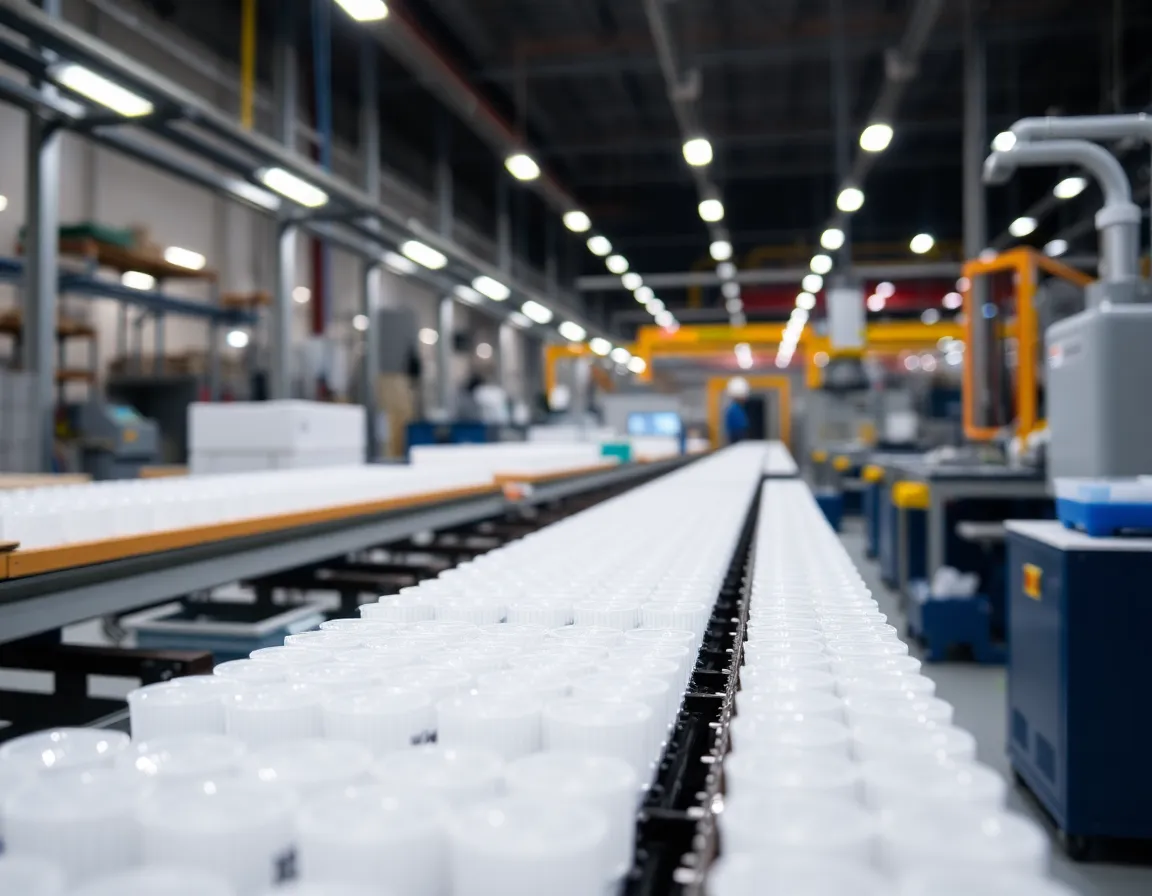
The Journey Begins: Understanding End-to-End Plastic Manufacturing
In the modern industrial landscape, plastic is ubiquitous—from the casing of your smartphone to the sterile packaging in a hospital. Yet, few people understand the complex, multi-stage process that transforms tiny resin pellets into finished, functional products. End-to-end plastic manufacturing refers to the complete, vertically integrated workflow that encompasses everything from raw material selection and compounding to molding, finishing, and quality assurance. Unlike fragmented approaches where different vendors handle separate steps, an end-to-end model places all these operations under one roof or under one tightly managed supply chain. This holistic strategy is not merely a logistical preference; it is a critical driver of cost efficiency, quality control, and innovation in an industry that produces over 400 million tons of plastic annually.
To truly appreciate the sophistication of this process, one must visualize the journey of a single polymer granule. It begins as a fossil-fuel derivative or a bio-based monomer, undergoes polymerization, and is then extruded into uniform pellets. These pellets—often no larger than a lentil—are the blank canvases of the manufacturing world. The end-to-end philosophy ensures that from the moment those pellets enter a facility, every subsequent action is optimized for the final application. This article will dissect the inner workings of this vertical integration, explore its undeniable benefits, examine its diverse applications, and outline the best practices that separate world-class manufacturers from the rest.
Stage One: Material Sourcing and Compounding—The Alchemy of Additives
The first critical phase in end-to-end manufacturing is not the molding, but the formulation of the material itself. Raw polymers—such as polyethylene (PE), polypropylene (PP), polyvinyl chloride (PVC), or engineering plastics like acrylonitrile butadiene styrene (ABS)—arrive at the facility in their base form. However, these base resins rarely possess the properties required for a specific product. This is where compounding takes center stage.
The Role of Additives and Masterbatches
Compounding is the process of melting the base polymer and thoroughly mixing it with a cocktail of additives. These additives are the secret ingredients that dictate a product's performance. For instance, UV stabilizers prevent degradation from sunlight for outdoor furniture, while flame retardants are essential for electronic housings. Colorants, or masterbatches, are added to achieve the precise brand hue, and plasticizers are introduced to increase flexibility in products like tubing or cable insulation.
In an end-to-end setup, this stage is tightly controlled. The manufacturer does not rely on a third-party compounder who might use inconsistent ratios. Instead, they operate their own twin-screw extruders, which melt and shear the polymer at precise temperatures (often between 200°C and 300°C) to ensure homogeneous dispersion of additives. The output is then re-pelletized or fed directly via a hot melt system into the molding machines. This direct transfer eliminates the risk of contamination that occurs when pellets are bagged, shipped, and stored.
Stage Two: The Transformation—Injection Molding and Extrusion
Once the material is perfectly formulated, the next phase is shaping it. While there are several methods—blow molding, rotational molding, and thermoforming—injection molding および extrusion are the workhorses of the industry, and both are integral to the end-to-end model.
Injection Molding: Precision Under Pressure
Injection molding is a high-pressure, high-speed process used to create complex, three-dimensional parts. The compounded plastic is fed into a heated barrel, where a reciprocating screw melts it into a viscous liquid. This molten polymer is then injected at immense pressure (ranging from 500 to 30,000 psi) into a tightly clamped metal mold. Inside the mold, the plastic cools rapidly, solidifying into the exact inverse shape of the cavity.
The end-to-end advantage here is profound. Because the manufacturer controls the mold design in-house (or with a dedicated partner), they can optimize gate locations and cooling channels to reduce warpage and cycle times. Furthermore, they can implement automated robotic part removal immediately after ejection. This is not merely about speed; it is about consistency. A part that is handled by a robot seconds after ejection retains its dimensional integrity, whereas human handling might cause micro-deformations while the plastic is still warm.
Extrusion: Continuous Profiles and Sheets
For products that are continuous in length—such as pipes, window frames, films, and plastic sheets—extrusion is the method of choice. Unlike injection molding's cyclical nature, extrusion is a continuous process. The molten plastic is forced through a die, which shapes it into a long profile. This profile is then cooled in a water bath or via air cooling and cut to length.
In an end-to-end environment, extrusion lines are often coupled with downstream equipment like printers and laminators. For example, a manufacturer creating flexible packaging can extrude a film, corona-treat it to increase surface energy, print the label graphics, and laminate it with a barrier layer—all in one continuous, uninterrupted pass. This eliminates the need to re-heat the film later, saving significant energy and reducing the risk of web breaks during secondary processing.
Stage Three: Secondary Operations and Surface Finishing
The raw molded part is rarely the final product. Most plastic goods require secondary operations to meet functional or aesthetic requirements. This stage, often overlooked in simpler manufacturing models, is where the end-to-end approach yields its highest quality dividends.
Decoration and Joining Techniques
Common secondary operations include pad printing, in-mold decoration (IMD), ,および 超音波溶着. In a fragmented model, a molded part might be shipped to a paint shop, then to a printing facility, and then to an assembly plant. Each shipment introduces the risk of scratches, dust contamination, and geometric distortion.
Conversely, an end-to-end facility integrates these cells directly adjacent to the molding machines. For instance, after a medical device housing is molded, it can be immediately transferred via conveyor to a cleanroom where it undergoes plasma treatment to improve adhesion, followed by solvent-free UV printing. For multi-component assemblies, overmolding is used—a process where a soft thermoplastic elastomer (TPE) is injected directly over a rigid plastic substrate to create a seamless, ergonomic grip. This eliminates the need for adhesives or mechanical fasteners, resulting in a stronger, more durable bond.
Quality Assurance and Metrology
Perhaps the most critical secondary operation is inspection. End-to-end manufacturing mandates a closed-loop quality control system. This involves using coordinate measuring machines (CMM), laser scanners, and automated vision systems to inspect parts immediately after production. If a dimension drifts outside of tolerance—say, a 0.05mm variance in a connector pin—the system provides real-time feedback to the injection molding machine, automatically adjusting the holding pressure or temperature.
This is a stark contrast to the "batch inspection" method, where a batch of 10,000 parts is made, and only after completion is a sample checked. If that sample fails, the entire batch is scrapped. End-to-end quality control catches defects at part number 5, not part number 5,000, dramatically reducing waste and ensuring that only conforming products move to the packaging stage.
The Strategic Imperative: Why Go End-to-End?
Adopting an end-to-end plastic manufacturing strategy is not a trivial decision. It requires significant capital investment in machinery, skilled labor, and facility space. However, the long-term strategic benefits consistently outweigh these initial hurdles for companies aiming for market leadership.
Unmatched Supply Chain Resilience
In the volatile global economy, the end-to-end model offers a powerful hedge against supply chain disruptions. By relying on a single accountable partner (or an internal division), manufacturers eliminate the "domino effect" of delays. There are no third-party bottlenecks, no disputes over who caused a defect, and no freight costs eating into margins. This vertical integration allows for agile response to demand spikes. If a client suddenly needs 20% more units, an end-to-end facility can adjust molding schedules and finishing shifts without having to coordinate with external logistics providers.
Total Cost of Ownership Reduction
While the unit cost of injection molding might be slightly higher in a fully integrated facility due to overhead, the total cost of ownership (TCO) is significantly lower. Consider the hidden costs of outsourcing: travel expenses to audit suppliers, customs duties on partially finished goods, packaging materials for inter-facility shipping, and the administrative burden of managing multiple purchase orders. End-to-end manufacturing consolidates these costs. Moreover, because the process is optimized from melt to final assembly, there is less energy consumption per unit due to the elimination of re-heating cycles.
Accelerated Time-to-Market
Innovation waits for no one. In industries like consumer electronics or automotive, being first to market with a new design can capture significant market share. An end-to-end manufacturer can compress the development timeline dramatically. When a design change is required, the tooling engineers, mold makers, and production staff are all in the same building. They can collaborate in real-time to modify a mold insert and run a trial shot within hours, whereas a fragmented approach might take weeks to coordinate across different time zones and corporate bureaucracies. This rapid prototyping and iteration capability is a decisive competitive advantage.
Applications Across Critical Industries
The versatility of end-to-end manufacturing has made it the gold standard in several high-stakes sectors where failure is not an option.
- Medical Devices: From insulin pens to surgical staplers, these products require ISO 13485 certification and strict cleanroom conditions. End-to-end facilities can maintain a sterile environment from resin drying to final packaging, preventing any microbial contamination. The ability to trace every pellet back to its source batch is crucial for FDA audits.
- Automotive & E-Mobility: Under-the-hood components and battery housings require high heat resistance and precise dimensional stability. End-to-end manufacturing allows for the integration of metal inserts during molding and the application of EMI shielding paints in the same facility, ensuring the complex tolerances required for electric vehicle drivetrains.
- 家庭用電化製品: The sleek, seamless casings of laptops and smartphones are produced via end-to-end processes that combine injection molding with in-mold laser etching and anti-fingerprint coatings. This ensures a flawless cosmetic finish with zero dust particles trapped between layers.
- Industrial Packaging: Large containers, pallets, and intermediate bulk containers (IBCs) benefit from structural foam molding and multi-layer extrusion that must be perfectly fused. End-to-end control ensures that the recycled content in the core layer is consistently encapsulated by the virgin outer layer, maintaining both strength and food-safety standards.
Best Practices for Modern End-to-End Facilities
To excel in this demanding field, manufacturers must adopt a culture of continuous improvement and technological vigilance. The following best practices are non-negotiable for those seeking operational excellence.
Implementing Industry 4.0 and Digital Twins
Modern end-to-end manufacturing is data-driven. Every molding machine, drying hopper, and robot is equipped with IoT sensors. These sensors feed data into a central Manufacturing Execution System (MES). By creating a digital twin—a virtual replica of the physical production line—engineers can simulate process changes without halting production. For example, they can test a new cooling profile virtually to see if it will reduce cycle time by 3% before implementing it on the actual machine. This predictive optimization reduces downtime and energy usage.
Closed-Loop Recycling and Sustainability
One of the harshest criticisms of the plastic industry is its environmental impact. End-to-end manufacturing is uniquely positioned to address this through in-house closed-loop recycling. Sprues, runners, and defective parts are rejected at the molding machine and immediately ground into regrind. This regrind is then precisely metered back into the virgin material feed at a controlled ratio (e.g., 20% regrind) without losing mechanical properties. This drastically reduces the carbon footprint of the product and moves toward a circular economy model. Furthermore, advanced facilities are now integrating post-consumer recycled (PCR) resins, using their in-house compounding expertise to re-stabilize these materials with additives to meet performance specs.
Total Preventative Maintenance (TPM)
In an end-to-end facility, a breakdown in one area halts the entire line. Therefore, proactive maintenance is critical. TPM shifts the mindset from "fix it when it breaks" to "prevent it from breaking." This involves daily cleaning and inspection of molds, regular calibration of temperature sensors, and vibration analysis on extruder motors. By scheduling maintenance during planned changeovers rather than during emergency downtime, manufacturers can achieve Overall Equipment Effectiveness (OEE) rates above 85%.
Conclusion: The Future of Plastic Production is Integrated
End-to-end plastic manufacturing represents the pinnacle of efficiency, quality, and responsibility in the polymer industry. It is a holistic discipline that treats the creation of a plastic part not as a series of disparate handoffs, but as a single, orchestrated symphony of mechanical, chemical, and thermal processes. From the precise blending of additives to the micron-level inspection of a finished component, every step is controlled, monitored, and optimized.
As the industry faces increasing pressure to reduce waste and lower carbon emissions, the end-to-end model emerges not as a luxury, but as a necessity. It enables the use of recycled content without compromising quality, it reduces energy consumption through streamlined logistics, and it ensures that products are built to last. For companies that choose to master this comprehensive approach, the future is bright. They are not merely molders of plastic; they are architects of material solutions, delivering tangible value from a simple pellet to a perfect product, all under one visionary roof.