
電気モビリティは、最適な航続距離と出力を達成するために、高エネルギー密度のバッテリー構成に依存しています。.
これらのバッテリーパック用の構造フレーミングコンポーネントを設計することは、極度の機械的および電気的課題をもたらします。.
エンジニアリング部門は、数百の個別バッテリーセルを絶縁、保護、および物理的に配置するための特殊なコンポーネントを必要としています。.
JUCHENG射出成形は、複雑な構造設計を再現性の高い成形部品に変換する、カスタム受託製造サービスを提供します。.
すべての生産ロットは、高電圧の電気的安全性と物理的堅牢性が維持されることを保証するために、高度なカスタム製鋼金型を使用しています。.
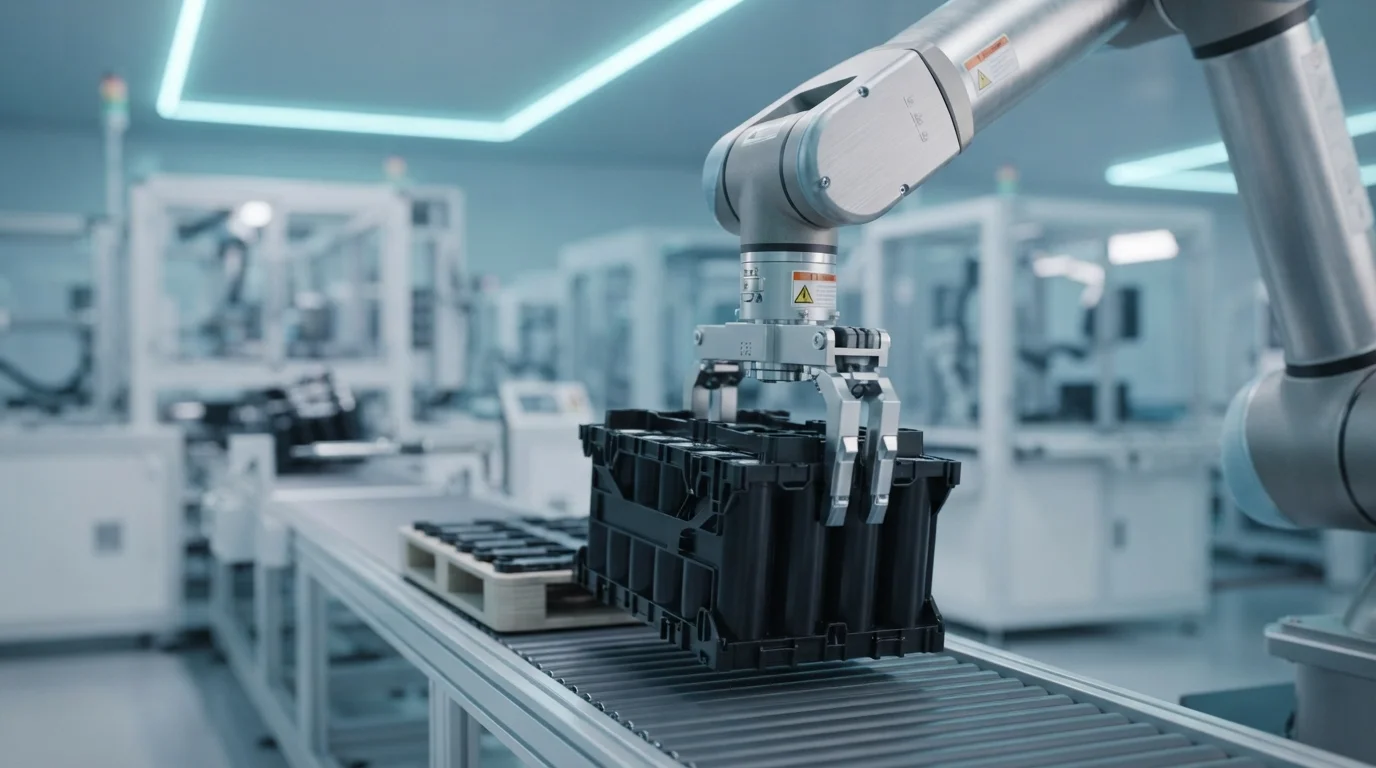
目次
カスタマイズされたセルキャリアフレームワークの設計課題
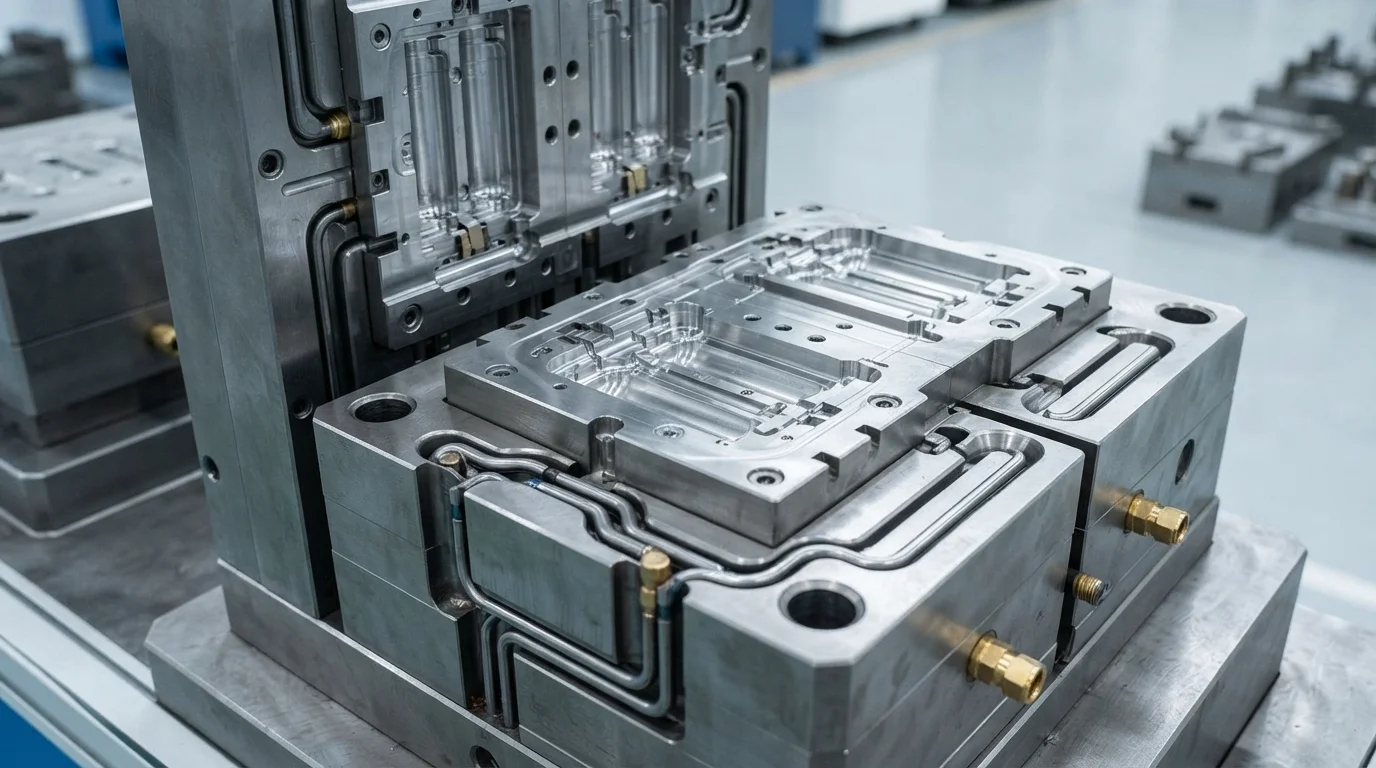
高精度の製造 電気自動車バッテリーセルホルダー すべての個々のポケットにわたって厳密な寸法一貫性が要求されます。.
円筒形または角形モジュールをサポートする場合でも、内径はセルの圧縮を避けながら過度の半径方向の動きを防ぐ必要があります。.
不適切なセルフィッティングは、高い接触抵抗、端子疲労、および熱放散経路の低下を引き起こします。.
その結果、当社の工具エンジニアは、非対称な収縮を防ぐために均一なプラスチックの流れを確保するマルチキャビティホットランナー金型を設計します。.
ポケットの位置合わせを維持するための主要な設計要件は次のとおりです。
- セルの位置決め—正確な半径方向の位置合わせを確保することで、車両の振動中に電気端子に負担がかかるのを防ぎます。.
- 振動減衰—機械的衝撃を吸収することで、プラスチックキャリアとセルスリーブ間の微細な摩擦を防ぎます。.
- 耐クリープ性—10年間の寿命にわたって構造的なたるみを防ぐことで、バスバーが完全に位置合わせされた状態を維持します。.
- 熱排気—ポケット間に冷却チャネルを統合することで、セル表面全体の受動的な空気の流れを最大化します。.
成形されたセルポケットの直径に対して±0.02 mmの厳しい公差を達成するには、 電気自動車バッテリーセルホルダー 金型温度と射出速度の細心の注意を払った制御が必要です。.
マルチキャビティレイアウトを使用すると、ポリマーが金型の異なる領域間で圧力の不均衡にさらされる可能性があります。.
聚成射出成形は、厳密な金型フロー解析を通じてゲート位置を最適化し、キャビティ圧力を正確にバランスさせることでこれを解決します。.
このようなエンジニアリングステップにより、重要な壁の特徴にバリやショートショットが形成されるのを回避し、すべてのセルに完璧なスライドフィットを保証します。.
Thin-wall structures are typical in these designs to save weight and maximize packing efficiency.
Reducing nominal wall thicknesses down to 1.0mm or 1.2mm compromises part structural strength unless structural ribs are perfectly placed.
Our team utilizes advanced DfM analysis to ensure that weld lines are directed away from mechanical stress concentration points.
This prevents structural failures during vehicle crash testing, where the cell carrier must survive high deceleration G-forces without cracking.
Material Compliance and Dimensional Stability
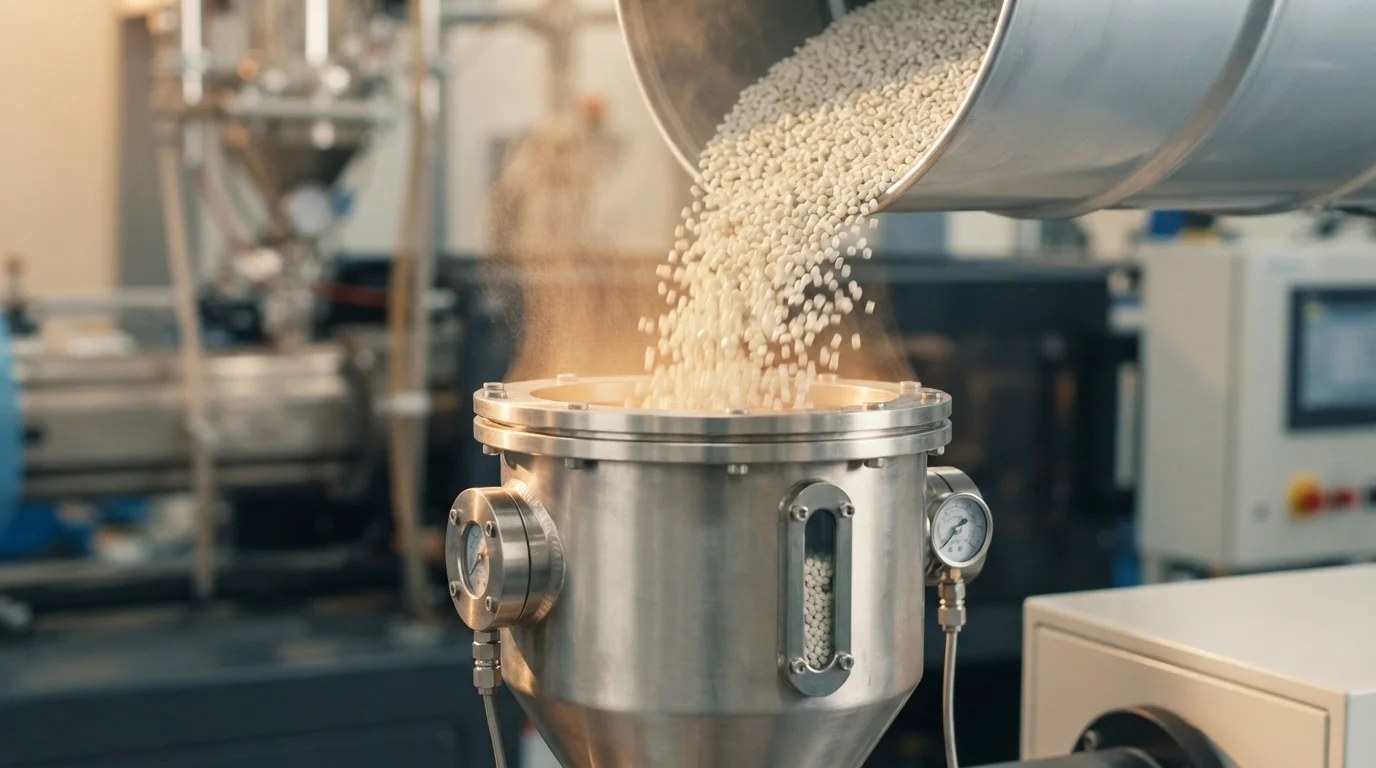
Material selection directly determines the mechanical longevity and electrical isolation characteristics of 電気自動車バッテリーセルホルダー.
Polymers inside EV battery modules face continuous exposure to high temperatures, environmental vibration, and chemical outgassing.
Selecting 30% glass fiber reinforced polyamide (PA66-GF30 FR) provides the structural stiffness needed to support heavy battery cell stacks.
This material delivers excellent heat deflection temperatures, remaining mechanically stable under continuous operating loads of 120°C.
Flame-retardant (FR) additives are mandatory for high-voltage compliance but often alter polymer shrinkage and melt viscosity.
Because polyamide absorbs atmospheric moisture, JUCHENG utilizes desiccant wheel hopper dryers to dry the resin to below 0.05% moisture content prior to molding.
This critical preparation step prevents hydrolytic degradation, maintaining the high dielectric strength required to insulate neighboring cells.
Additionally, the UL94 V-0 flame-retardant rating must be strictly preserved to prevent fire propagation in the event of local cell thermal runaway.
Dimensional stability over the product’s lifespan prevents cell terminals from experiencing mechanical stress.
Long-term polymer creep can cause cell displacement, leading to weld fracturing on the connected high-voltage busbars.
Our processing engineers counteract this by maintaining uniform holding pressures during the cooling phase, minimizing molded-in residual stresses.
Our strict raw material sourcing ensures that every batch is accompanied by an official Certificate of Analysis to guarantee chemical compliance.
Tooling Configuration & Zeiss CMM Inspection
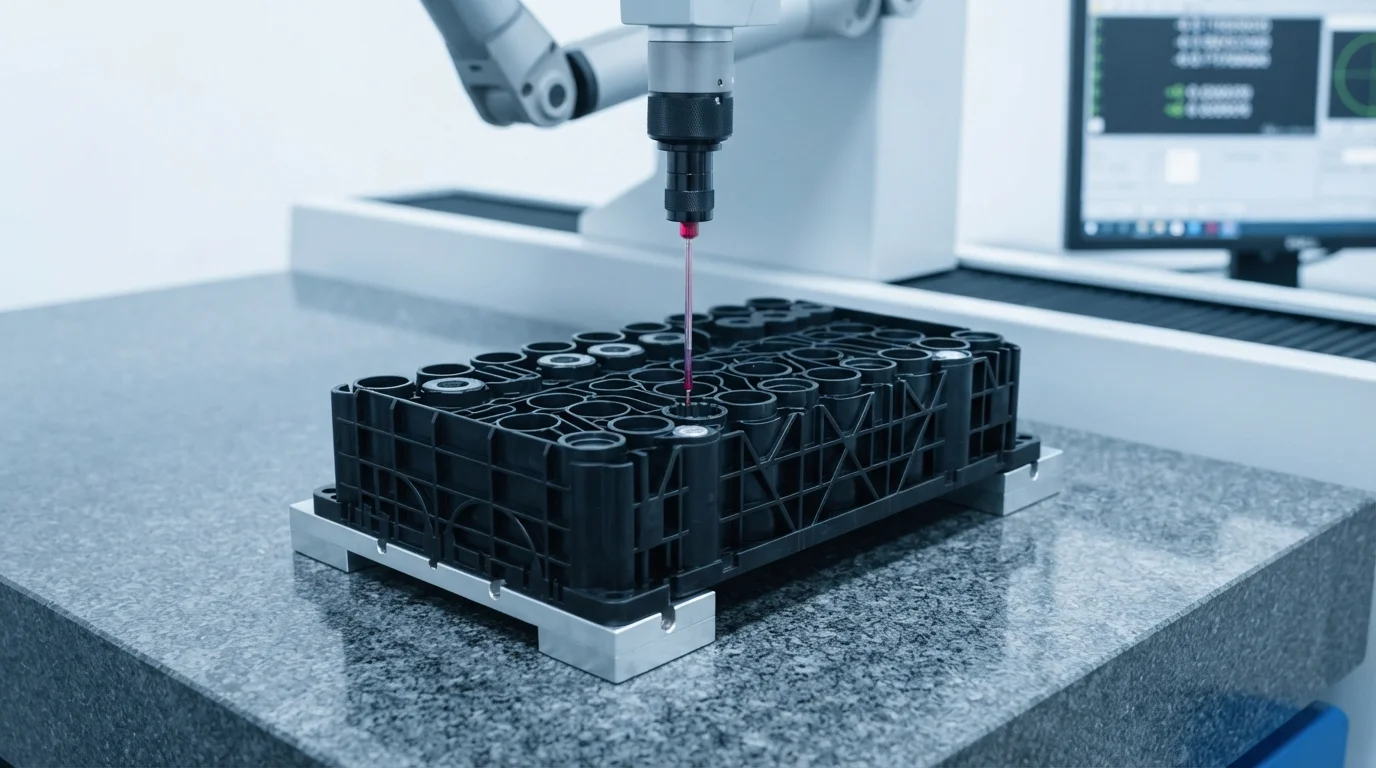
Complex mold tooling configuration optimized for mass-producing 電気自動車バッテリーセルホルダー utilizes advanced cooling networks and robust ejection mechanisms.
Glass-fiber filled materials are abrasive, meaning mold plates must be cut from hardened H13 tool steel with a hardness of HRC 48-52.
Our in-house tool shop utilizes 5-axis high-speed CNC milling and precision EDM to manufacture intricate mold cavities with perfect finish.
These features enable smooth part ejection and prevent core pins from bending during high-speed production cycles.
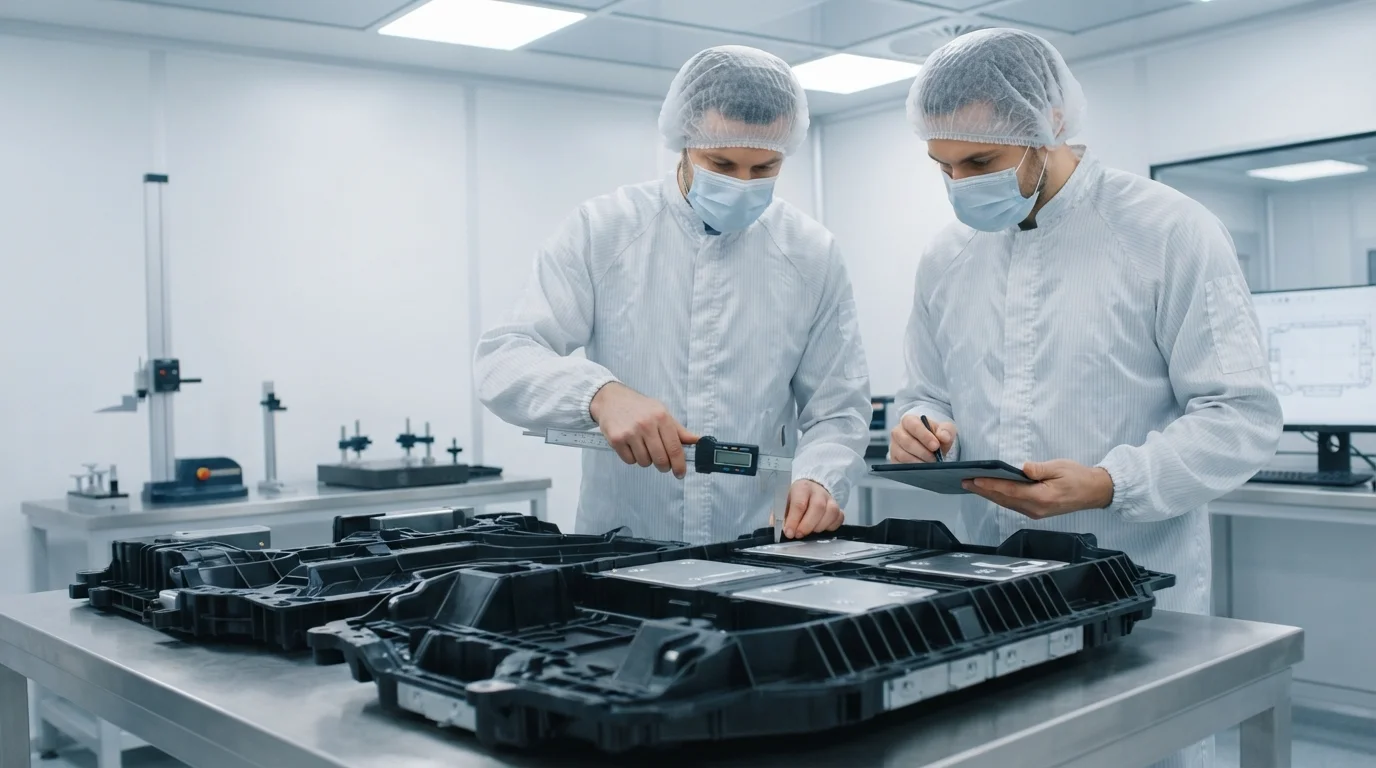
Quality verification inside our climate-controlled inspection laboratories follows a strict measurement sequence:
- Fixture calibration—Securing the molded cell carrier in a custom stress-free fixture ensures measurement repeatability.
- Multi-point scanning—Using a ruby-tipped probe on our Zeiss CMM captures the exact circularity of each cell pocket.
- Concentricity calculation—Computing the true position of cell-to-cell spaces confirms perfect terminal pitch alignment.
- SPC logging—Recording dimensional trends on statistical process charts allows real-time molding parameter tuning.
Ultimately, our rigid cell carriers are engineered to fit seamlessly inside our カスタムEV用プラスチックバッテリーハウジング to ensure high-voltage insulation.
This complete assembly approach minimizes tolerance stack-up issues between different suppliers, ensuring trouble-free automated pack assembly on your production lines.
By combining advanced tooling with IATF 16949-certified quality management, JUCHENG delivers a reliable manufacturing path for next-generation EV platforms.
よくある質問(FAQ)
How do you manage warpage in cell holders?
Shrinkage management involves balancing fiber orientation in glass-filled materials.
Glass fibers align parallel to the molten flow path, causing anisotropic shrinkage.
We resolve this by using multi-point hot runner valve gates to balance the filling pressure and align the glass fibers symmetrically, neutralizing residual post-mold warpage.
What tool steels are best for abrasive glass-filled PA66?
Mold plates require hardened tool steel such as S136 or H13, hardened to HRC 48-52.
Glass fibers and outgassing flame retardants are highly abrasive and corrosive.
Selecting premium hardened steels prevents localized cavitation and pocket erosion, ensuring critical tolerance consistency over long production lifespans.
Can you insert-mold battery sensors into the carriers?
Overmolding copper pins or packaging temperature sensors directly into the carriers is a standard capability.
This eliminates downstream manual wire-routing and optimizes the space profile.
Our robotic insert systems place the sensors within tolerances of ±0.05mm, preventing structural leakage and maintaining electrical clearance standards.