
Water can help form a hollow channel during molding without proving that the finished part will tolerate years of fluid service. Water assist injection molding materials must pass two separate screens: they must form the intended hollow geometry reliably, and they must retain the required performance in the product’s operating environment. Treating these as one question can approve a material that fills well but ages poorly, or reject a useful grade because a first trial used an unsuitable process window.
For a hollow handle, a duct, and a coolant-carrying component, the acceptance criteria are different. This guide focuses on selecting and validating a resin grade, not on buying a water-injection system or assuming every hollow plastic component is a pressure pipe.
Process water and service fluid are different exposures
During water-assisted molding, water displaces part of the still-molten core and helps establish an internal channel. The contact occurs within a controlled forming and cooling sequence. In service, the same surface may see a fluid repeatedly or continuously, at a different temperature, pressure, chemistry, and exposure duration.
A component carrying a water-glycol coolant therefore needs evidence for that actual fluid and operating cycle. Brief contact with process water cannot establish resistance to long-term chemical or thermal aging. Equally, a hollow handgrip may never carry a fluid in use; its important checks could instead be bending, impact, fastener retention, and the effect of the remaining wall on local strength.
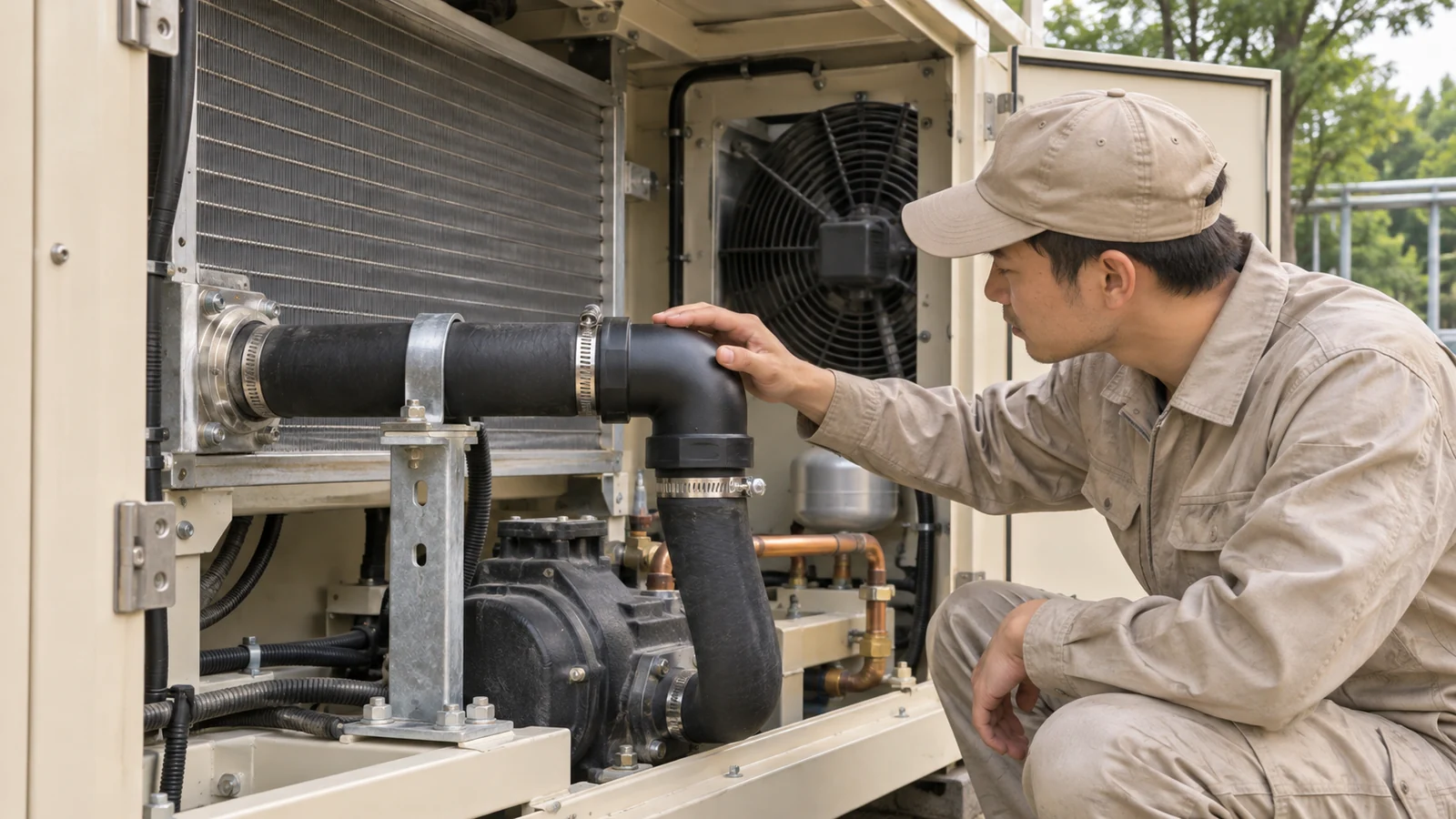
When selecting water assist injection molding materials, understanding how the channel is created is only the starting point. Material approval adds a different question: what must the hollow part continue doing after the forming water has been removed?
Separate research candidates from a purchasing shortlist
A polymer being investigated successfully in a study is not the same as a particular commercial grade being approved for your component. A Chang Gung University water-assisted molding research abstract reports investigations involving PS, PE, PP, and ABS. That establishes a research context, not a list of interchangeable pipe materials or a guarantee of suitability for pressurized use.
For an actual shortlist, obtain the current resin manufacturer’s information and ask whether the grade is intended or supported for the proposed process. BASF’s Ultramid product brochure identifies certain water-injection-related grades and discusses moisture-related material behavior. An older brochure is a starting reference; confirm the current designation, region, and documentation before specifying or purchasing a grade.
The following screening sequence prevents a family name from becoming an unsupported specification.
- Define whether the channel carries a service fluid or only reduces mass and changes the section.
- List operating loads, fluid chemistry where relevant, temperature cycles, and the required life assessment.
- Obtain processing guidance and grade-specific compatibility information from the resin supplier.
- Check whether the actual geometry can be molded and inspected with a stable remaining wall.
- Qualify representative parts against the agreed functional criteria.
The residual wall belongs in the material decision
The nominal outside dimensions do not describe how much material remains around an internal channel. Channel development, bends, changes of section, and process timing can alter the residual wall. A resin choice should therefore be assessed with the local geometry it produces, not only with the strength value printed on its data sheet.
Flow and cooling behavior matter because the advancing water encounters a changing polymer state. A material that seems attractive for stiffness may produce an unacceptable channel shape in a particular tool and process. Conversely, a favorable first section does not establish consistency along the whole part or across repeated molding cycles.
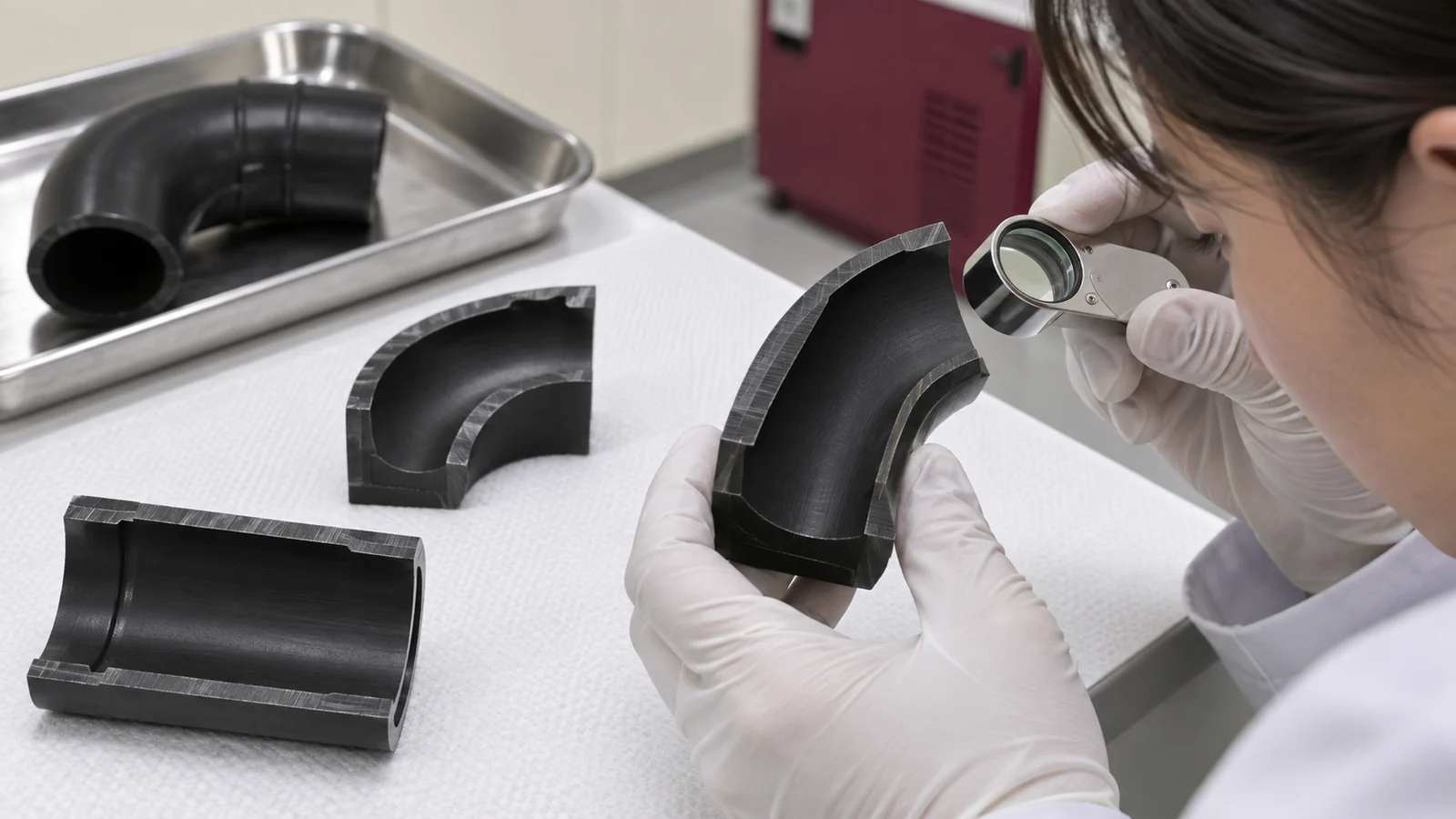
Compare water assist injection molding materials using section maps from representative trials. Select inspection locations around bends, transitions, branch regions if present, and functional connections. Destructive sections can reveal wall and channel shape; an appropriate nondestructive method may be useful where access or sample preservation matters. The measurement plan must state what it can actually resolve.
| Observed result | Material-related question | Evidence needed before approval |
|---|---|---|
| Uneven remaining wall | Does the grade’s flow and solidification behavior suit this geometry? | Sections at defined locations across a representative process range |
| Acceptable fresh part, later dimensional movement | Are conditioning and service exposure changing the relevant properties? | Measurements before and after specified conditioning or aging |
| Failure near a connection | Is local geometry, orientation, or assembly stress controlling failure? | Connection-level testing using the actual mating hardware |
| Rough or inconsistent internal surface | Is the resin/process combination meeting the fluid-path requirement? | Internal examination and the relevant functional flow or cleanliness assessment |
These observations do not diagnose a material problem on their own. Keep resin preparation, tool condition, and processing records available so that a geometry or process issue is not incorrectly attributed to the polymer family.
A reinforced grade brings more than stiffness
Glass reinforcement can make a grade worth considering where stiffness is important, but it also changes the molding problem. Fiber orientation, local flow, surface condition, and dimensional response must be evaluated in the hollow component. A higher reinforcement level is not an automatic improvement at every bend or attachment.
For polyamides, distinguish drying before processing from conditioning after molding. The first controls the state of the feedstock entering the process; the second describes the environment and moisture state of the finished sample. Record both rather than treating a freshly molded specimen and a conditioned assembly as equivalent.
Unfilled candidates also need grade-level scrutiny. The site’s polypropylene material overview can introduce that family, but neither the family name nor low moisture uptake alone establishes stiffness, aging resistance, surface quality, or pressure performance for a proposed hollow part. Keep the selection tied to the complete requirement.
Build the trial around the route to failure
Consider a hypothetical coolant elbow joined to two mating fittings. A visually smooth outside surface and an open bore establish only part of the picture. The elbow still needs its specified internal clearance, a sound wall at the bend, suitable connection behavior, and durability under the relevant fluid and thermal conditions.
Begin with the as-molded state: inspect channel continuity and wall distribution, then assess the actual connections. Next expose representative assemblies to the agreed service conditions and repeat the checks that matter. Where pressure integrity is a requirement, use a defined, safely controlled test procedure and product-specific acceptance limits; a generic screening article cannot supply those limits.
Use more than the single best sample. Include repeat parts and meaningful process variation in the mold trial and validation plan so that qualification does not depend on an unusually favorable molding cycle. Compare the before-and-after results with the material identity, conditioning history, and process settings attached. A failed specimen is useful only if the test allows its failure location and mechanism to be understood.
Specify what the material must do after molding
The final water assist injection molding materials specification should connect grade identity, process feasibility, and finished-part acceptance. Include the exact resin and permitted substitutions, preparation requirements from the supplier, critical wall and channel regions, and the functional tests needed after conditioning or aging.
Document the conditions that would trigger another review: a resin or color change, a new source of recycled content, a different channel geometry, revised mating hardware, or a changed service fluid. Those changes do not all have equal consequences, but none should pass unnoticed merely because the outside drawing remains similar.
For an initial technical review, provide the model and section requirements, what the channel does, the proposed resin if already selected, and the load or exposure conditions. The useful outcome is a defensible trial plan—not a promise that every grade within a familiar polymer family will work.
Questions about grade approval
Does hydrolysis resistance alone make a resin suitable?
No. It addresses one possible exposure mechanism. Geometry, processability, other chemicals, load, and the intended operating conditions still need evaluation at grade and component level.
Can a hollow part pass its outside dimensional inspection and still fail?
Yes. Outside measurements may not reveal a restricted channel, a thin local wall, or an internal feature that affects function. Choose inspection methods that address the internal acceptance criteria as well.
Is an established gas-assist grade automatically a water-assist grade?
No. The assisted medium and cooling interaction differ. Ask the material supplier about the proposed route and establish feasibility in a representative trial rather than transferring approval by analogy.