
A decorated control panel may look identical in two samples while requiring very different manufacturing routes. In mold decoration vs painting is a decision about the complete surface system: how the appearance is built, how it survives use, how designs change, and how accepted parts reach assembly. Neither route wins merely by removing or adding a process step.
For a stable, repeatable graphic, an in-mold film can be worth investigating. For a finish that must change frequently or cover surfaces difficult to decorate with the proposed film construction, post-mold painting may remain practical. Compare both on the same part and acceptance standard before committing the tooling and artwork.
Do you need a coating, a graphic, or both?
Separate the surface’s jobs. A solid color, decorative pattern, protected symbol, backlit area, and tactile finish are not equivalent requirements. Painting supplies a coating system; a graphic may need masking, printing, or another operation. In-mold decoration uses a defined decorative construction incorporated during molding, with the exact film or transfer method agreed with the supplier.
Do not assume that all processes called IMD leave the same layer stack on the part. Ask which layers remain, which face is exposed, and how the decoration bonds to the substrate. That description is essential when evaluating abrasion, chemicals, edges, and recycling claims.
A useful in mold decoration vs painting review begins with the required plastic surface finish rather than a preferred acronym. Mark visible areas, functional openings, graphic boundaries, and areas that must remain uncoated on the CAD or drawing. A flat artwork file alone does not define those relationships.
The edge and opening often decide more than the broad face
A broad, shallow front face is a different decoration problem from a deep recess, compound curve, or closely spaced set of openings. Film forming and placement can affect graphic registration and local appearance. Paint can reach a different set of surfaces, but masking, coverage, and handling introduce their own restrictions.
Review the actual in-mold decoration construction against the proposed geometry. Identify where artwork is stretched, where a layer terminates, and how it meets a button aperture or assembly seam. Avoid approving a route using a sample that excludes the difficult part of the production design.
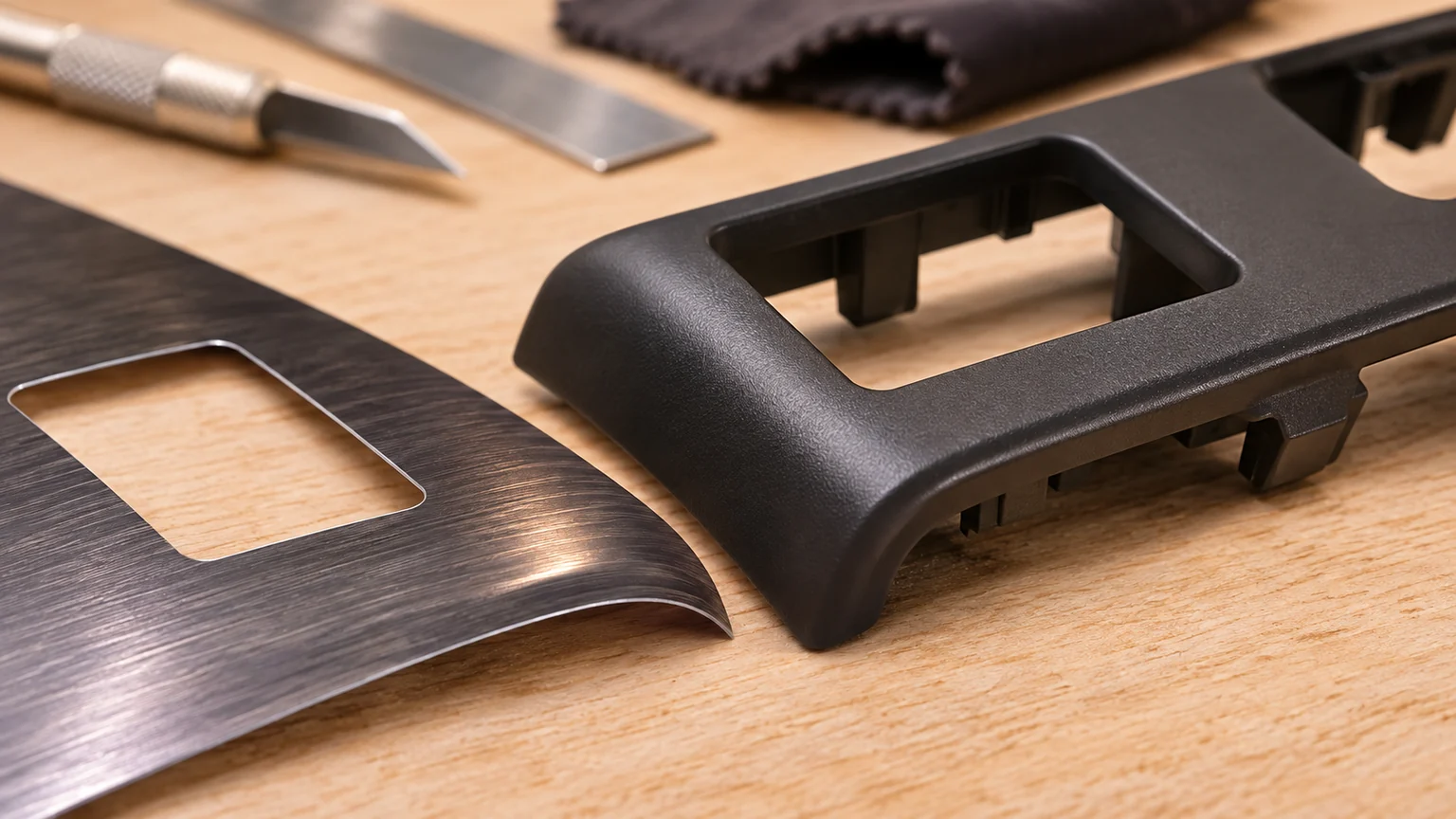
| Part feature | In-mold route review | Paint route review |
|---|---|---|
| Curved graphic face | Forming, print distortion, and placement | Graphic application method and repeatability after coating |
| Holes and windows | Registration, layer termination, and exposed edges | Masking, coverage, and clear boundary control |
| Deep returns or hidden faces | Feasibility of the selected decorative construction | Application access and film-build consistency |
| Assembly contact | Layer protection and fit at mating interfaces | Coating thickness and risk of handling damage |
The table is a review sequence, not a claim that one route can always reach a difficult feature. A geometry adjustment may improve both options. Resolve that adjustment before one process is rejected solely because it was tested on a less suitable version of the part.
Follow one artwork change through the entire route
Imagine an illustrative appliance panel whose button positions remain fixed but whose graphics vary by market. An in-mold route may allow artwork variants, yet each version still needs controlled identification and compatibility with the approved construction. Painting a common substrate may provide another form of flexibility, but any symbols and masks also need revision control.
Now change the position of a window rather than its printed label. The consequences may extend to the mold, film forming, trimming, masking, inspection fixtures, and assembly. The cost of a change depends on what changes, not only which decoration process was originally chosen.
Ask both suppliers to describe an actual revision scenario from the proposed drawing. Include obsolete stock, work in progress, new samples, and renewed testing where relevant. This does not require an invented percentage saving; it reveals which commitments must remain stable for each route to make sense.
Test the finished surface system, including its boundaries
Do not infer service durability from the word “integrated” or from a coating’s generic description. The resin, film or coating, inks, preparation, layer thickness, and processing history can all affect the result. Choose tests that represent contact, cleaning, sunlight, temperature, or other relevant exposure.
Serigraph’s IMD guide identifies requirements such as chemical, abrasion, heat, and UV resistance and asks for CAD and appearance specifications when assessing feasibility. Use those categories to define evidence for the actual part, not as proof that every decorated construction meets them.
For painting and coating, agree substrate preparation, masking, the complete coating system, and the finished-part checks. For an in-mold route, check relevant formed areas, interfaces, and cut or exposed boundaries. Testing only an undisturbed center area can miss the surface region most likely to be touched or damaged.

Define acceptance after exposure: appearance, adhesion where applicable, graphic legibility, color, or function. Avoid a vague requirement to “pass a chemical test” without identifying the chemical, concentration, contact method, duration, and relevant service conditions. Obtain the appropriate test method and interpretation from the responsible specialists.
Count accepted decorated parts, not just process steps
Combining decoration with molding may remove some post-mold operations, but the total route still includes artwork preparation, decorative materials, handling, tooling, sampling, and inspection. Painting includes its own preparation, application, curing where required, masking, and handling. Which is economical depends on the actual specification and production plan.
Use a common quotation boundary. Ask whether the price includes approved artwork, all visible surfaces, inspection, protective packing, and delivery to the same assembly stage. Separate tooling and qualification costs from recurring accepted-part cost. Also identify the commercial treatment of rejects and rework rather than assuming either route can recover every imperfect part.
A defensible in mold decoration vs painting choice can be made with a short decision record:
- Define the required appearance and surface function on the same geometry.
- Confirm each supplier’s actual layer construction and manufacturing sequence.
- Review the most difficult edges, openings, and curved graphic regions.
- Compare representative samples after relevant service tests.
- Price the same accepted, protected component and a realistic revision scenario.
If neither route can demonstrate the critical appearance or durability requirement, keep the design open. Changing a graphic boundary or surface geometry before tooling commitment may be more useful than arguing which process is inherently superior.
Questions when two decorated samples look equally good
Does in-mold decoration always cost less than painting?
No. Compare tooling, artwork, decorative materials, qualification, yield, handling, and the recurring accepted-part cost. Removing an operation does not establish the total economics of a specific design.
Can paint hide an unsuitable molded surface?
Do not assume it can. Some defects remain visible or compromise the coating route. Agree the incoming molded-surface standard and evaluate representative parts before relying on a finish to correct an upstream problem.
Which route is better for frequent design changes?
It depends on whether the change affects color, artwork, geometry, or the functional surface. Trace a realistic revision through both manufacturing sequences and include new samples and testing where needed.