
A prototype can assemble perfectly and still tell you little about the final product’s durability. Prototype injection molding materials should be chosen for the decision the test must support: fit, repeated movement, chemical exposure, optical performance, or sustained load. Use the intended production grade when that decision depends on its behavior. A substitute can be useful for an early check, but the test report must identify what the substitution leaves unproven.
For a product engineer preparing a molded housing, clip, or fluid-handling component, the useful deliverable is not a universal ranking of resins. It is a material-and-test plan that connects each sample to a requirement. The following method separates a convenient sample material from evidence that can justify a design release.
Write the test question before naming a polymer
Start with a sentence such as: “The latch must remain engaged after repeated opening in the specified environment.” That sentence identifies a failure condition, not just a desired property. It prompts questions about deflection, loading rate, temperature, contact chemicals, and the condition in which the sample will be tested.
A dimensional mock-up has a different purpose. It may establish access for a screwdriver, cable routing, or whether the lid clears a neighboring component. A substitute resin may answer those questions if its dimensional behavior is adequate and the result is not presented as proof of strength or life. Label the sample by its purpose so that a fit check does not quietly become a durability approval.
A review of prototype injection molding materials should therefore begin with the intended test and the later production specification. Agree which decisions can be made now, which need the final grade, and which must be repeated after the production tool is available.
Build a shortlist around the part’s job
Common resin families are starting points, not interchangeable alternatives. A cosmetic enclosure, a repeatedly flexed hinge, and a loaded bracket may have similar overall dimensions but need very different behavior. Compare candidates against the failure that matters, including the environment in which that failure could occur.
The table below is a screening aid. It deliberately avoids universal temperature limits or strength values: those belong to the exact grade, test method, and application condition.
| Prototype task | Possible starting family | What still needs checking |
|---|---|---|
| Cosmetic rigid enclosure and assembly | ABS or an appropriate PC/ABS grade | Impact requirement, finish, cleaners, and stress at fasteners |
| Transparent cover or light-transmitting part | PC or PMMA, selected for the optical function | Distortion, surface damage, assembly stress, and actual cleaning exposure |
| Repeated flexing or an integral hinge | A suitable PP grade | Hinge geometry, flow direction, cycling conditions, and grade-specific fatigue behavior |
| Loaded mechanical feature | PA, POM, or another engineering resin justified by the requirement | Creep, friction where relevant, moisture state, and dimensional stability |
| Stiffness-driven reinforced part | A specified glass- or mineral-filled grade | Orientation, local weakness, warpage, and the tool’s ability to fill the geometry |
Do not choose a stronger family simply to make a prototype pass. If the intended product uses a ductile unfilled resin, testing a stiffer reinforced substitute may hide the deflection that actually needs redesign. Conversely, a brittle failure in a convenient substitute may say little about the intended grade. Record the reason for every candidate and the reason for rejecting it.
The polymer name is not the material specification
“Nylon” or “polycarbonate” is not enough to reproduce a trial. Specify the manufacturer, complete grade designation, reinforcement, color system, and any required regulatory documentation. Flow behavior, impact modification, stabilizers, and additives can differ within the same family. A color change can also require review rather than an automatic carryover of the original result.
Compare data sheets under compatible conditions. A dry-as-molded polyamide result and a moisture-conditioned result describe different material states. BASF’s grade-specific polyamide documentation, for example, distinguishes those conditions and identifies its values as guidance from sample testing. It does not turn a typical specimen value into a guarantee for a finished component.
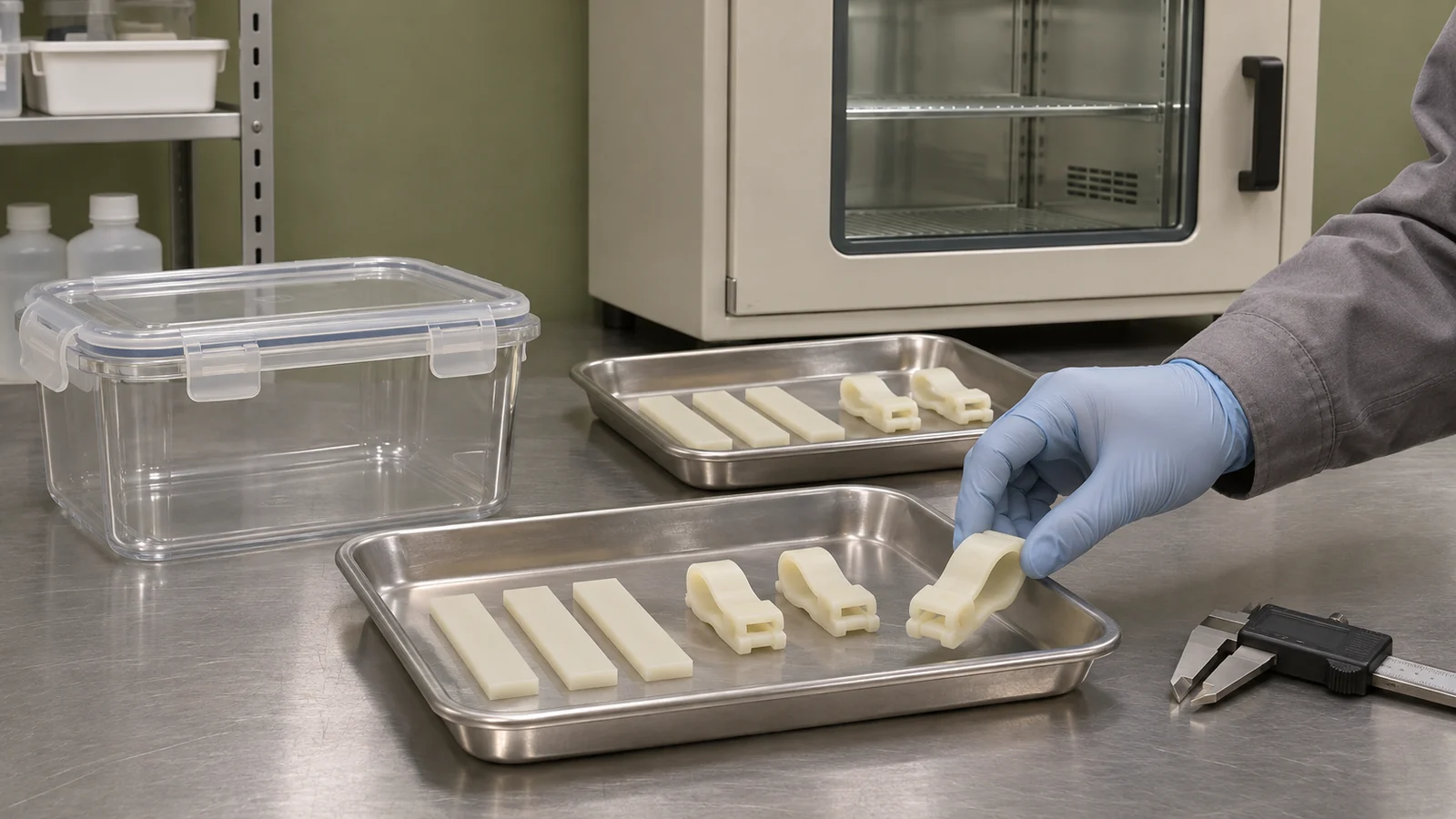
The purchasing record should also address material substitution. “Equivalent resin permitted” is too broad when a test is meant to approve impact resistance or dimensional stability. Name who can authorize a substitution, what evidence they need, and which tests must be repeated. Retain material lot identification with the sample results.
What changes when the prototype tool changes?
Molding the intended resin improves relevance, but it does not make every prototype identical to production. Gate location, cavity geometry, cooling, venting, surface condition, and processing history affect the molded part. A prototype tool with a different gate can place a weld line somewhere else, changing the result at a loaded feature.
Reinforced resins make this distinction especially important. Their behavior depends on how material flows through the actual geometry. Testing a plaque or a conveniently gated prototype cannot establish every property of a later molded bracket. Treat differences in flow path and local wall transitions as questions to investigate, not as paperwork details.
Use injection molding DFM analysis to identify features that could make the sample unrepresentative: abrupt thickness changes, sharp latch roots, unsuitable bosses, or an inaccessible gate witness. Then decide whether the prototype tool should reproduce those features closely or whether the trial has a deliberately narrower purpose.
A clip that fits once has not passed a life test
Consider a hypothetical instrument cover with two snap clips and a screw boss. An early sample made in an available resin closes smoothly at room temperature. That is useful assembly evidence. It does not establish retention after repeated opening, resistance to the intended cleaner, or long-term deformation around the screw.
The next trial should separate these questions. Check the clip’s engagement and deflection using the intended grade, then cycle it under an agreed procedure. Examine the clip root for whitening or cracking and measure retention in the relevant condition. Evaluate the screw boss with the proposed fastener and assembly method rather than judging it by appearance alone.
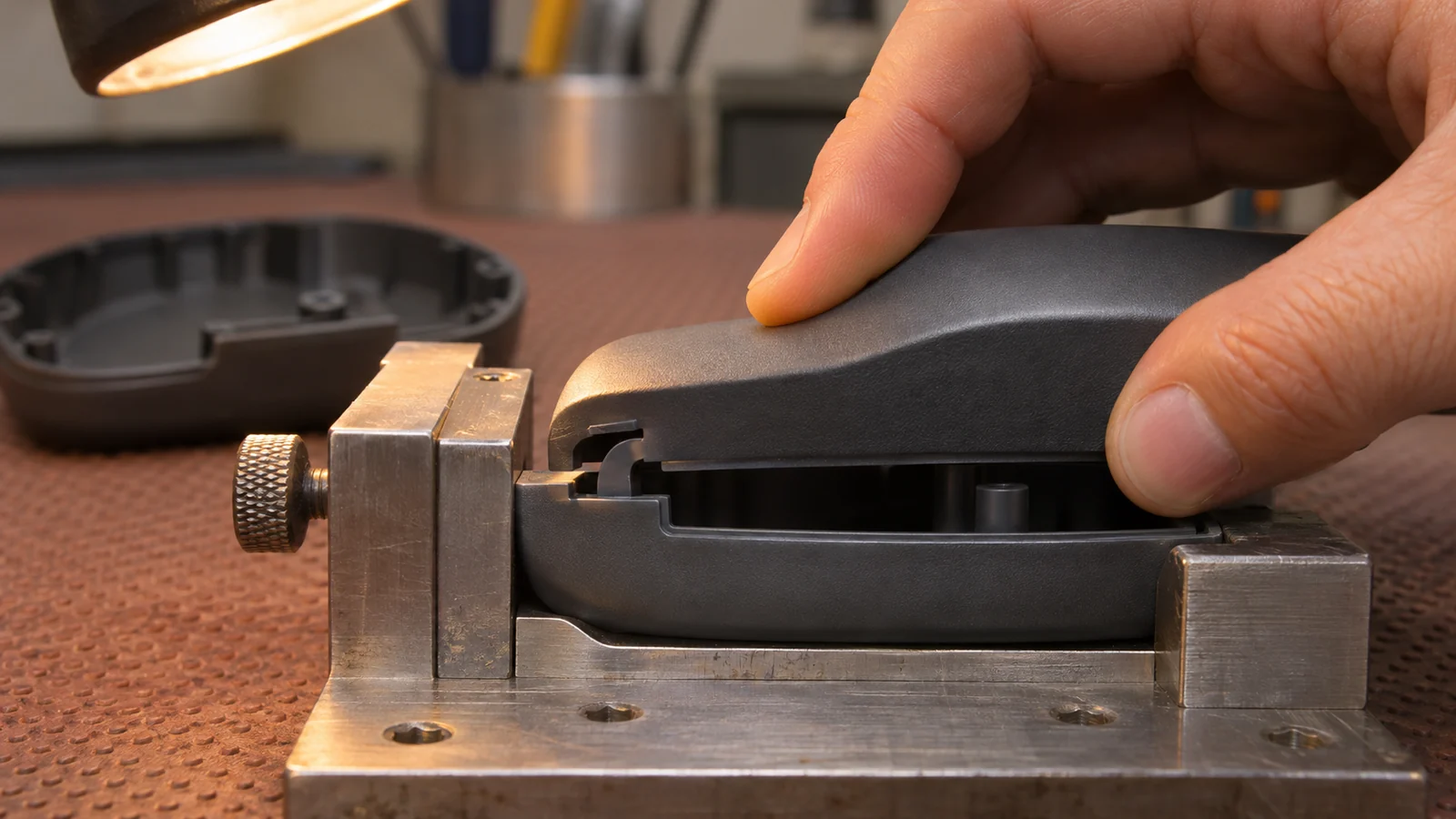
If production will use a conditioned polyamide, a freshly molded dry sample may not represent the later assembly state. If it will use a transparent PC cover, stresses from the screw and exposure to a cleaner may need to be considered together. The point is not that either family is unsuitable; the test must reproduce the interaction that could cause failure.
- Record the material and conditioning state for every sample group.
- Keep geometry and assembly variables controlled when comparing resins.
- Inspect the critical location, not only the part’s overall appearance.
- Report a pass against a named test condition, not an undefined claim of durability.
Carry the evidence forward without overclaiming
A useful prototype injection molding materials decision ends with a record of what was learned and what remains open. Keep the drawing revision, grade and lot, tool configuration, processing record available from the trial, conditioning procedure, assembly method, and acceptance criteria together. Otherwise a later team may unknowingly compare different samples as if they were equivalent.
Plan the transfer to production before closing the prototype stage. Identify which critical tests need repeating if the gate, cavity count, resin source, or manufacturing condition changes. The mold trial and validation stage is where the production configuration must demonstrate the relevant requirements; prototype success is an input, not a waiver.
Before ordering samples, prepare the CAD model and drawing alongside a short test brief: what the part must do, which failure is unacceptable, the intended environment, and the exact material where already specified. That gives the trial a purpose and keeps a quick fit check from being mistaken for a completed material qualification.
Questions before ordering samples
Can regrind be used for early prototypes?
Only if it is agreed and consistent with the trial’s purpose. Record its source and permitted proportion where applicable. A sample with unknown material history is weak evidence for a production specification that requires controlled virgin or recycled content.
Does a flame-retardant grade approve the finished enclosure?
No. Material documentation is only one part of the assessment. The product’s required evaluation may depend on wall thickness, color, assembly, and other conditions. Confirm the applicable requirements rather than transferring a material designation to the whole product.
Should both candidate resins be molded in the same tool?
It can help control geometry, but confirm that the tool and process are suitable for both grades. Different shrinkage or processing requirements can change dimensions and test relevance. The comparison should state whether it evaluates materials in identical geometry or two designs adjusted for their respective materials.