
Co injection molding applications make sense when the surface and interior of a plastic part need different functions. A controlled skin can provide the required exposed surface while a core serves a separate material, structural, or barrier-related purpose. The extra complexity is justified only if that layered construction solves a product requirement better than a single-material part.
That is a more useful starting point than a list of industries. An automotive component is not automatically a good candidate, and a lower-priced core is not automatically a lower-cost finished part. For an engineer or buyer evaluating a proposed skin/core component, the real questions concern where the layers must remain, what happens at edges and openings, and how the product will be qualified.
Give the skin and core separate jobs
In a conventional sandwich co-injection concept, the material sequence is controlled so that a skin surrounds a core within the molded section. This differs from placing a soft grip over a previously molded rigid handle: the required geometry and distribution are not the same. Define the intended cross-section before using “two-material molding” as a purchasing description.
Write two functional statements. The skin might need a controlled appearance or an agreed contact surface. The core might need to incorporate qualified recycled material or provide another justified internal function. Then ask whether those requirements genuinely benefit from being separated. If the whole section can use one suitable resin, layering may add a problem without adding value.
The site’s broader guide to co injection molding applications introduces the economic context. Here the focus is narrower: deciding which product functions require a skin/core construction and what evidence could disqualify it.
Three application patterns worth evaluating
A controlled surface around a qualified recycled core
A housing or non-contact structural component may be considered where the exposed surface needs a controlled resin while a documented recycled core is acceptable internally. The attraction is separating surface requirements from internal material use. It is not permission to put an unknown feedstock inside a cosmetically acceptable shell.
The recycled material still needs traceability and control of properties relevant to the component. Consider lot variation, contamination, odor if relevant, and whether the skin remains adequate at the critical locations. The product specification must say what happens at machined openings, trimmed gates, and other locations where core material could become accessible.
Barrier-focused packaging and closures
Containers can have functions beyond appearance and stiffness. Mold-Masters documents co-injection barrier applications involving preforms, containers, and closures. Those examples show why layer continuity can be a functional requirement rather than a cosmetic preference; they do not establish a universal barrier result or this site’s qualification for regulated packaging.
A package must be evaluated as a system, including its closure, sealing interface, contents, and storage conditions. A successful resin-pair trial does not by itself establish shelf life, food-contact compliance, or a recycling claim. Those outcomes require the relevant product evidence and applicable evaluation.
A surface requirement combined with an internal mechanical role
A part may be proposed with a surface chosen for appearance and a core chosen for a different mechanical objective. Assess the whole layered section under the real load. A stiff core does not automatically improve every feature: a thin region may contain little core, and failure may begin at a weld line, attachment, or interface rather than in the broad panel.
This route deserves evaluation only when the load path and layer distribution support the objective. If the requirement is a localized soft seal or a second material placed in a distinct region, another multi-material route may be more appropriate than a sandwich construction.
| Proposed application | Potential reason for layers | Question that can stop the project |
|---|---|---|
| Controlled-surface housing | Separate the exposed resin from a qualified internal core | Will the core appear at an opening, connection, or visible surface? |
| Barrier container or closure | Use an internal layer for a defined barrier function | Can the required continuity and whole-package performance be demonstrated? |
| Load-bearing molded section | Combine surface requirements with an internal mechanical role | Does the actual layer distribution support the critical load path? |
These are application patterns to investigate, not an approved product catalog. Geometry, grade pairing, tooling, and qualification requirements determine whether a specific part belongs in any of them.
Map the layers onto the features that matter
A clean cross-section through the center of a panel is not enough. The layer map needs to address the places where the part works: bosses, ribs, snaps, holes, sealing lands, gate regions, and the last areas to fill. A nominal overall skin/core ratio cannot describe every one of those locations.
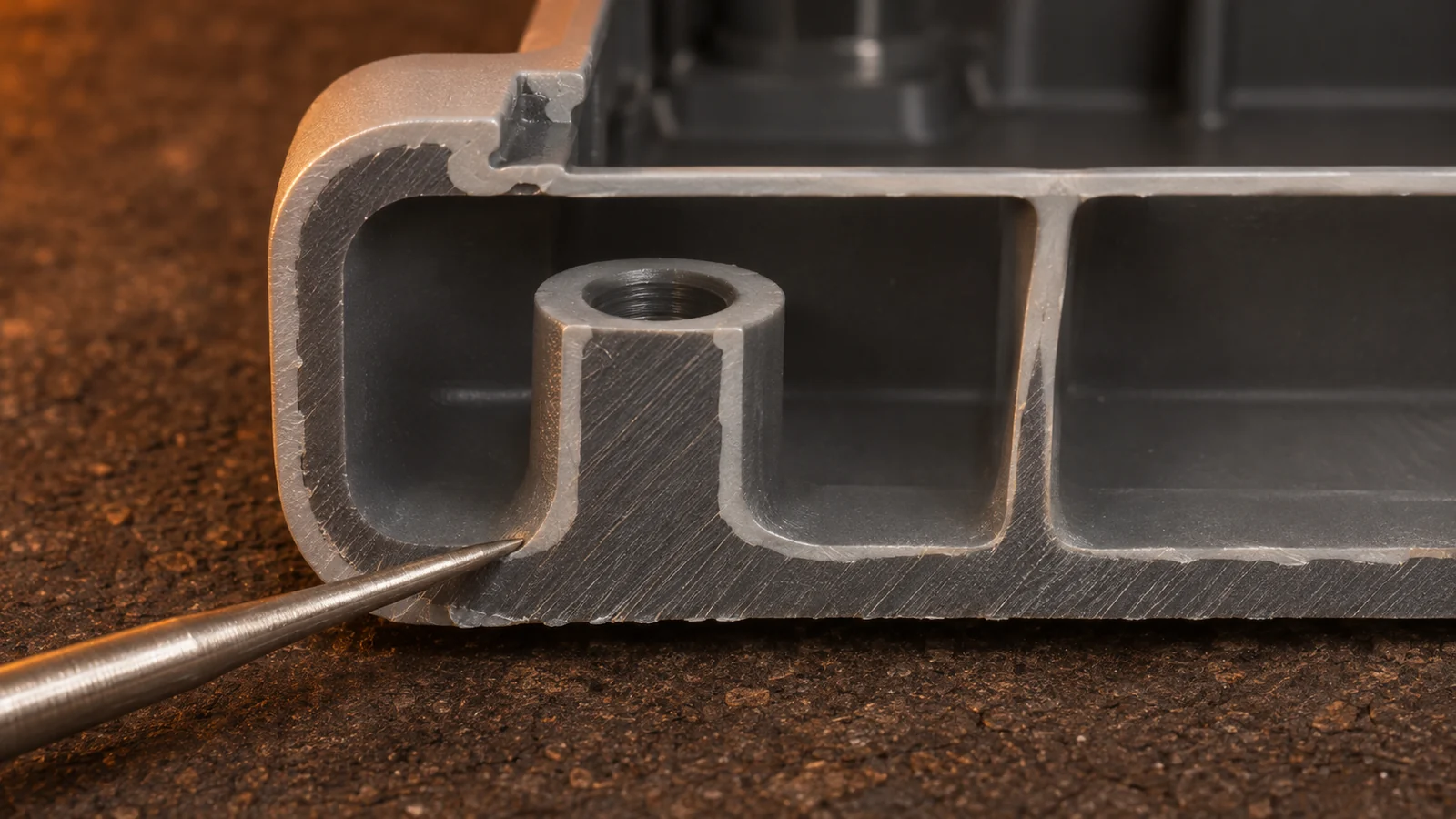
Autodesk’s explanation of co-injection core surfacing identifies material sequence and skin availability as concerns when core material reaches the surface. For application planning, the practical lesson is to inspect where breakthrough would be unacceptable rather than relying on one average material percentage.
Review post-molding operations as well. A drilled port or trimmed feature can expose a layer that was initially enclosed. Specify whether that exposure is permitted and how it affects contact, appearance, bonding, or sealing. Early DFM review of the molded features can separate a manageable design detail from a fundamental mismatch between the product and the proposed process.
A housing review can rule the process out early
Consider a hypothetical outdoor control-box housing proposed with a controlled outer resin and a recycled inner core. Its main panel may look like a promising candidate, but the product also has screw bosses, cable entries, a gasket groove, and a removable lid. Each of those features introduces a different acceptance question.
At the cable entry, determine whether machining or assembly will expose the core. At the gasket groove, inspect both geometry and surface condition; a nominally intact skin cannot compensate for a warped sealing interface. At the bosses, assess the fastening method and local loading instead of extrapolating from a flat-panel test.

If the customer requires the same documented material throughout every exposed edge, the skin/core concept may not meet the brief. If qualified core exposure is acceptable in specified noncritical locations, the design may remain worth trialing. Making that decision before tooling is more useful than discovering after sampling that the product specification never allowed the proposed construction.
Qualify the layered part, not just its ingredients
A shortlist of co injection molding applications should be filtered by the evidence available for the complete part. Material data supports the review, but finished-component behavior depends on distribution, interface behavior, geometry, and the production process. An unqualified claim that the skin “protects everything inside” skips those dependencies.
Use the qualification plan to connect each functional requirement to a location and a test. Where layer continuity matters, select sections or another suitable inspection method at the relevant positions. Where mechanical performance matters, test the actual connection or load path. Where barrier or contact performance matters, use the required product-level evaluation rather than a visual check alone.
- Freeze the functional reason for each material and identify unacceptable exposures.
- Document the grades, material history, and permitted changes.
- Establish how layer distribution will be checked in critical regions.
- Run the relevant assembled-part tests, including environmental exposure where required.
- Repeat the necessary checks when geometry, material source, or processing conditions change materially.
The mold trial and validation plan should therefore cover more than an attractive first sample. Before requesting an assessment, prepare the model, proposed skin/core functions, allowed exposure locations, expected quantity, and acceptance requirements. Those details reveal whether the application has a defensible reason to use layers at all.
Application questions that remain
Can the core percentage be specified as a universal target?
No. Achievable distribution depends on geometry, the material pair, tooling, and processing. Set functional limits for critical locations and establish a suitable range through the actual design and trial.
Does a virgin outer layer automatically allow recycled material in a regulated product?
No. The applicable rules and product evidence still govern the whole construction, including possible exposure and migration considerations. Do not infer approval solely from the appearance of the outer layer.
Is every two-color part a co-injection application?
No. Visible color regions may be made by other multi-material molding routes. Supply the intended cross-section and surface arrangement so the proposed process can be evaluated against the actual requirement.