
Flawless light transmission in optical lenses, light pipes, and sensor covers requires strict control over polymer purity and molding thermal dynamics. Microscopic airborne dust particles, surface splay marks, or internal stress-induced birefringence cause light scattering and optical distortion. Manufacturing high-transmittance polymer components relies on cleanroom processing, high-polish mold cavity steels, and precise melt temperature profiling. JUCHENG operates specialized particle-controlled manufacturing cells, producing high-clarity plastic optics strictly according to customer technical drawings.
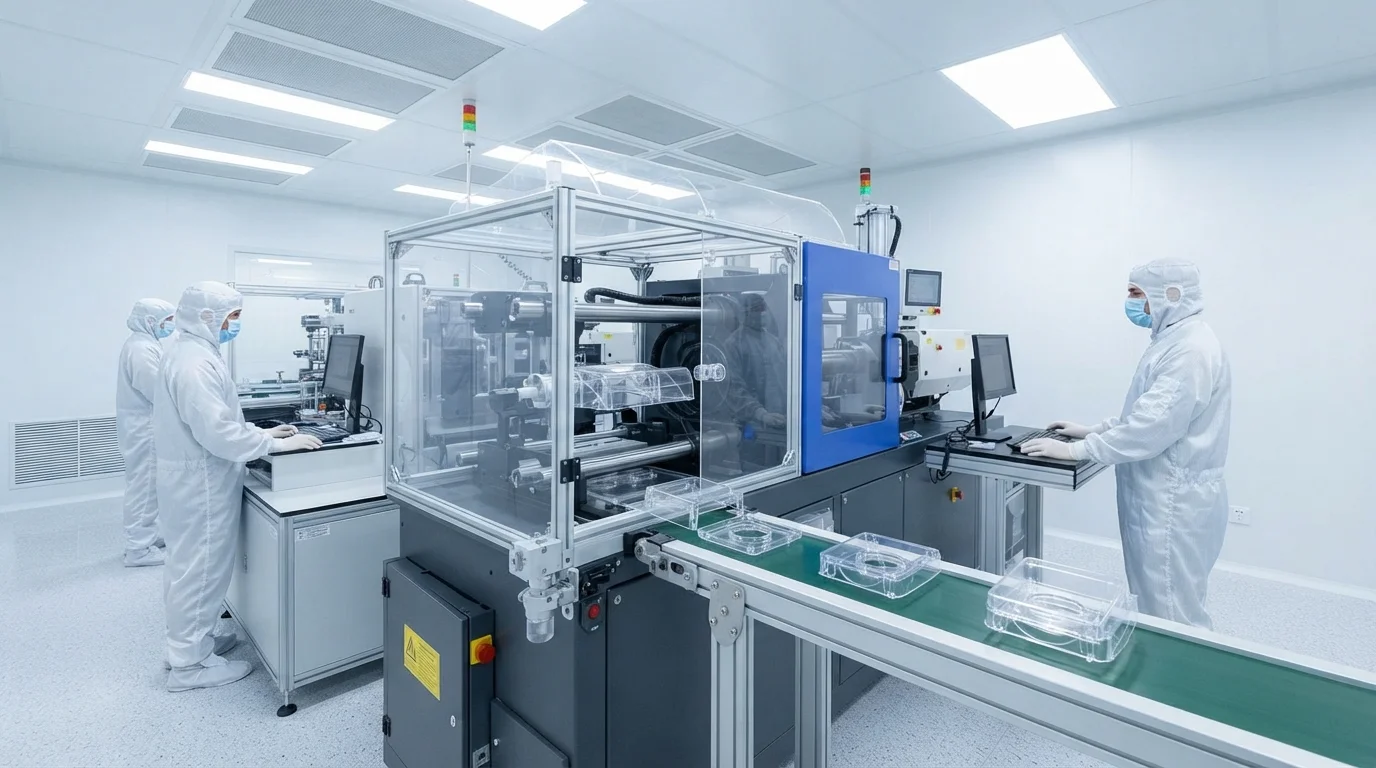
Table of Contents
Birefringence Control & Residual Stress Reduction in PMMA/PC
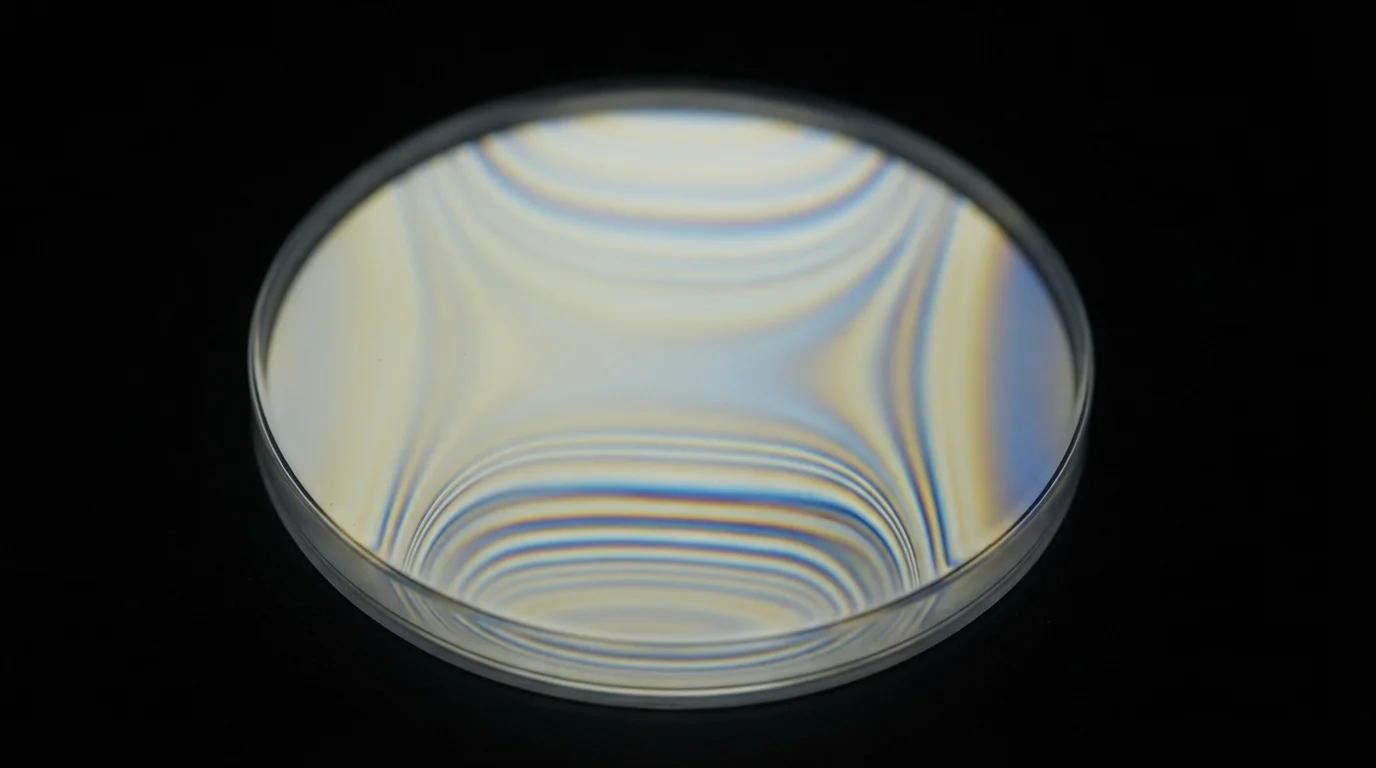
Managing molecular orientation and reducing residual stress during optical clear plastic molding requires a process suited to the selected resin and part geometry. Residual stress and frozen-in molecular orientation can make the refractive index depend on the polarization direction. Process changes may reduce this birefringence; verify the finished lens against its specified optical test and acceptance limits. Slowing down injection velocity near the gates further reduces localized shear stresses, eliminating gate blush and optical haze.
High-Transmittance Polymer Resins (PMMA, Optical PC, COC, COP)
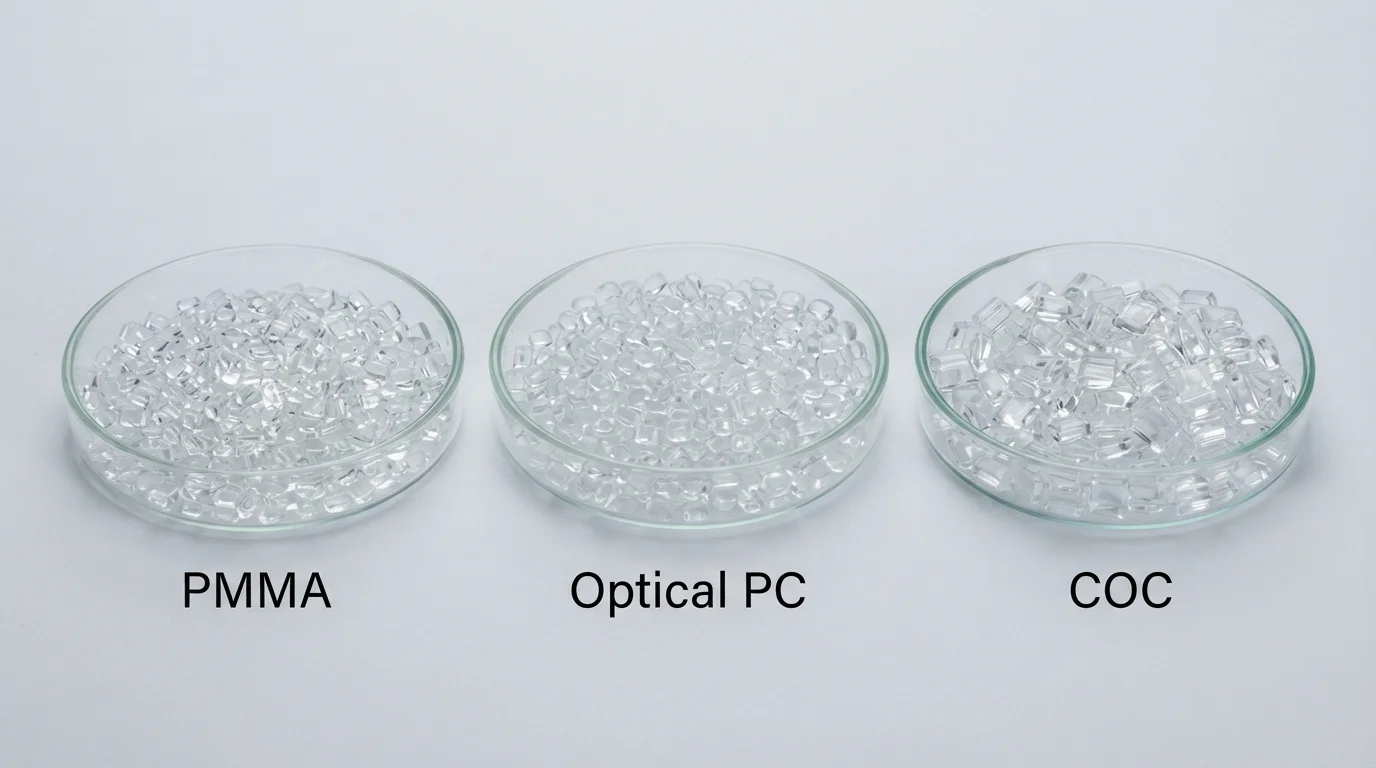
The table gives typical supplier values for specific PMMA (acrylic), polycarbonate (PC) and COC grades, not guarantees for finished lenses. Röhm reports PLEXIGLAS 8N transmittance with D65 under ISO 13468-2; Covestro uses ISO 13468-2; TOPAS reports the listed 2 mm result under ISO 13468-1. Compare grades at the same thickness and test conditions. For COC or COP in fluorescence-sensitive optics, verify background fluorescence for the actual grade and molded part at the intended excitation and detection wavelengths.
| Optical Polymer Resin | Luminous Transmittance (%) | Refractive Index | HDT (°C, ISO 75 at 0.45 MPa) | Example Application |
|---|---|---|---|---|
| PMMA (Plexiglas 8N) | 92% (D65) | 1.49 | 103°C | Automotive light guides & HUD displays |
| PC (Makrolon 2407) | 89% (2 mm); 88% (3 mm) | 1.584 | 136°C | Protective covers |
| COC (TOPAS 5013S-04) | 91.4% (2 mm) | 1.533 | 127°C | Optical parts & microfluidic windows |
SPI A-1 Mirror Polish & S136 Hardened Stainless Steel Molds
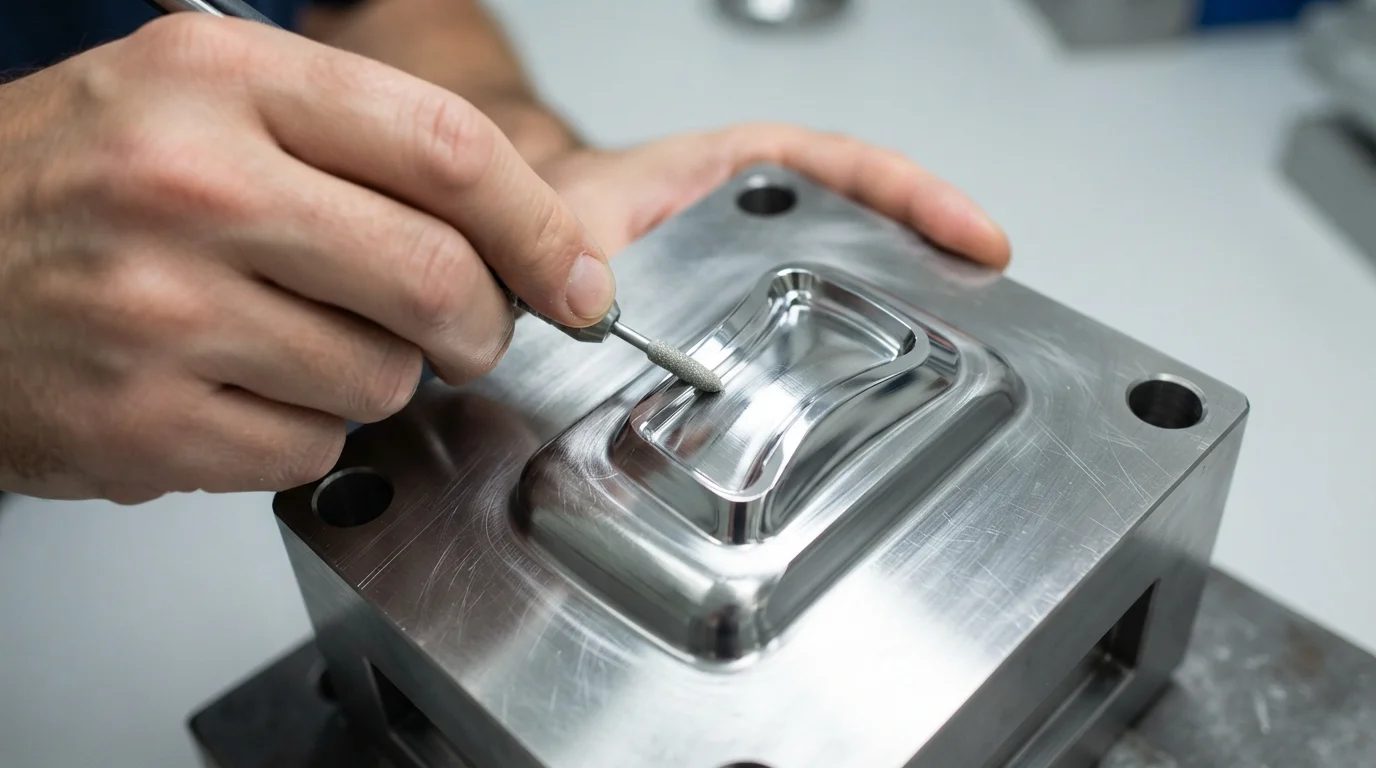
Machining high-polish cavity steels for optical clear plastic molding demands specialized toolmaking protocols. Cavity surfaces must be machined from premium S136 stainless steel, heat-treated to HRC 48-52 to resist corrosion and microscopic scratching. Achieving an SPI A-1 mirror polish requires progressive hand-polishing using diamond paste compounds down to 3-micron particle sizes. Mirror-polished tool cavities eliminate surface micro-roughness, ensuring clean mold release without requiring liquid internal lubricants.
Optical toolmaking standards include:
- S136 stainless steel selection—Using high-chrome stainless steel prevents micro-pitting caused by ambient moisture or outgassing.
- Progressive diamond polishing—Lapping cavity surfaces with diamond paste achieves an SPI A-1 optical mirror finish.
- Electro-discharge machining optimization—Fabricating EDM electrodes with fine grain graphite ensures smooth cavity textures prior to hand polishing.
- Conformal cooling channel layout—Configuring water lines close to the optical cavity surfaces maintains uniform mold core temperatures.
Cleanroom Environment to Eliminate Dust and Black Specs
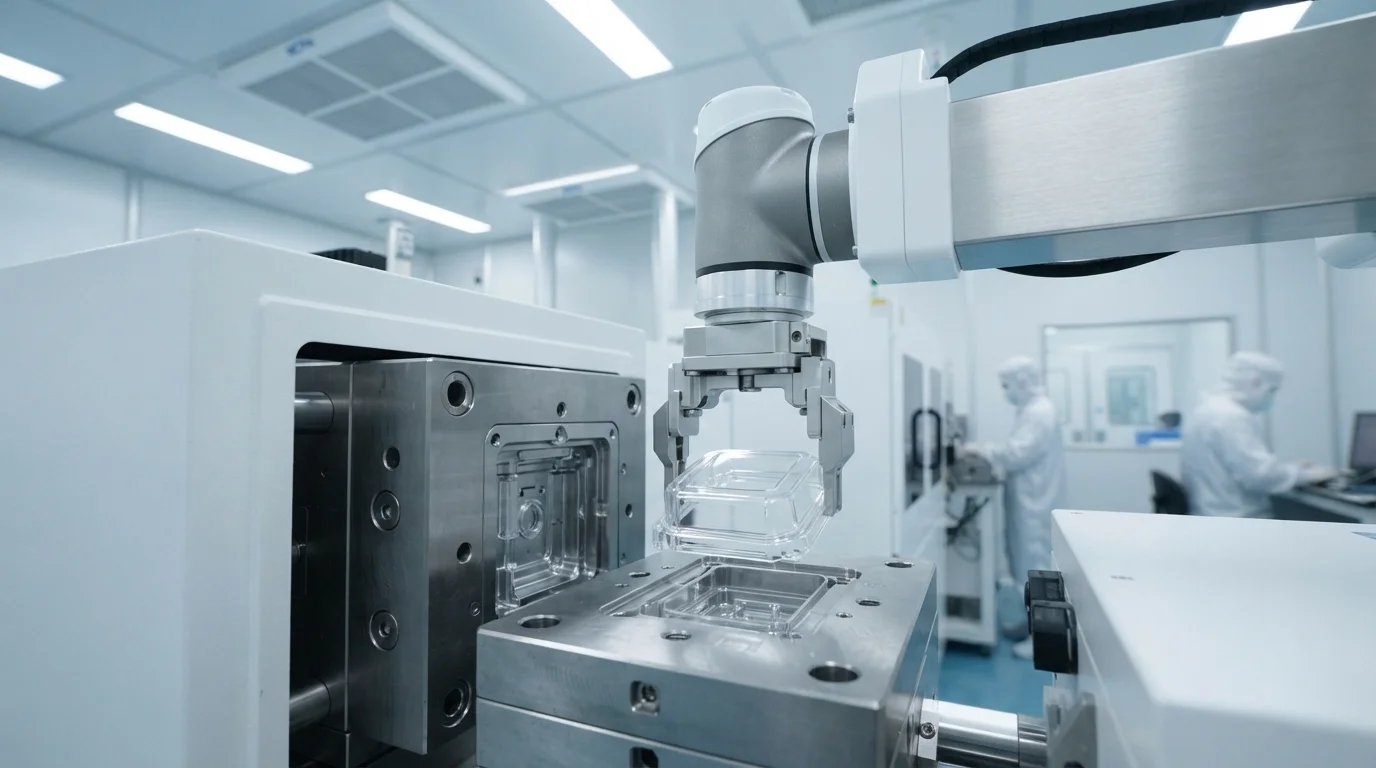
Executing optical clear plastic molding inside particle-controlled environments prevents airborne dust from embedding into hot polymer melt. Single microscopic dust particles landing on a warm lens surface create black specs, causing total optical part rejection. Operating positive-pressure cleanroom molding cells with multi-stage HEPA filtration maintains pristine air quality during plasticization and drop-packaging. Automated three-axis robots handle molded lenses directly, eliminating manual handling risks and skin oil transfers.
Frequently Asked Questions (FAQs)
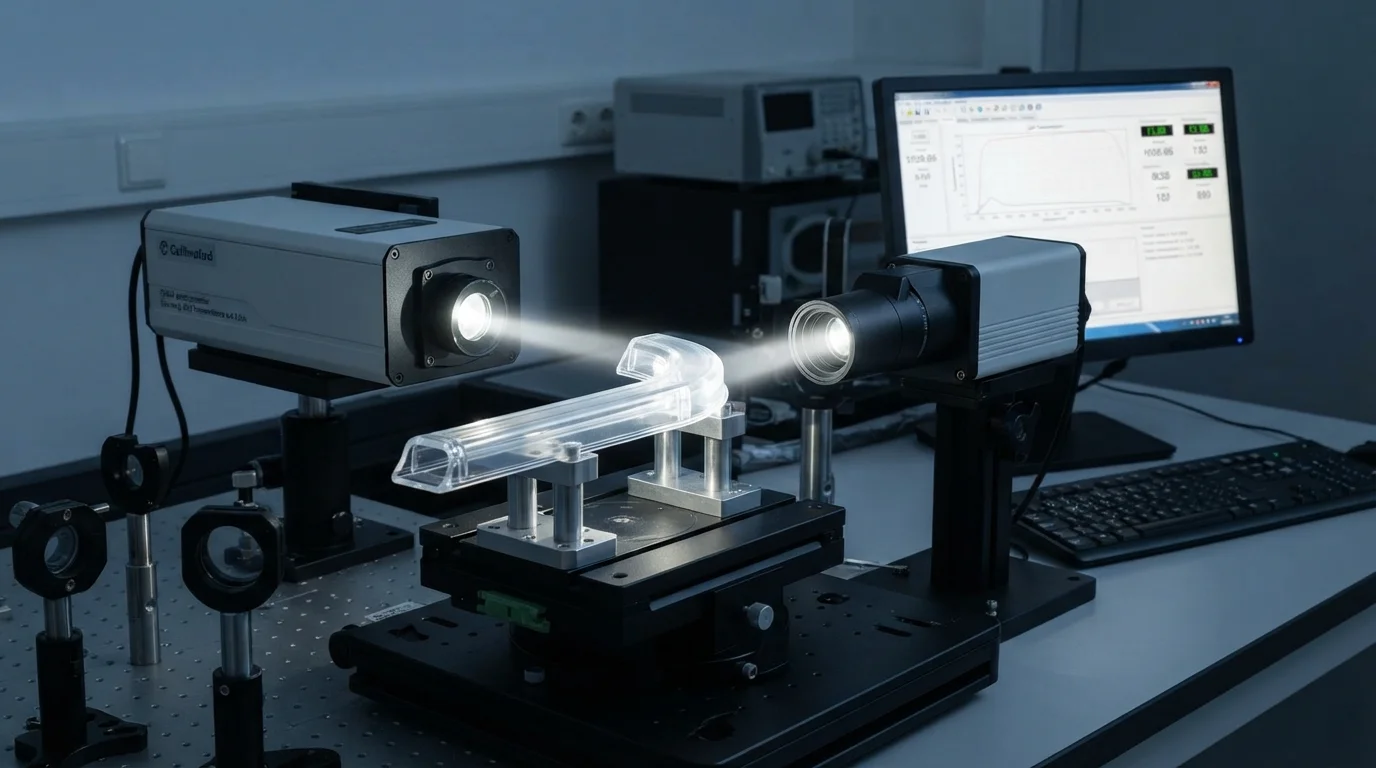
What causes birefringence in optical plastic molding?
Frozen-in molecular orientation and residual stress can contribute to birefringence in molded optics. Appropriate changes to molding conditions may reduce it, but cannot be assumed to eliminate double refraction. Measure the finished part against the specified optical acceptance limits.
What is the difference between SPI A-1 and SPI A-2 mold finishes?
SPI A-1 polish represents the highest optical mirror finish, polished with 3-micron diamond paste on hardened steel. SPI A-2 polish uses 6-micron diamond paste, leaving micro-scratches that are unacceptable for high-transmittance optical lenses.
Why is PMMA preferred over PC for light guide applications?
PMMA can be a good light-guide candidate when clarity matters; PC can be considered when impact resistance or heat performance is important. Compare candidate grades at the same thickness and optical test conditions, compare HDT at the same load, and verify light-guide performance on representative molded parts.