
LCP-Celanese Vectra E130i
Withstanding lead-free reflow soldering temperatures up to 280°C while maintaining sub-millimeter structural flatness down to 0.1mm thickness requires a specialized self-reinforcing polymer, which Celanese’s Vectra E130i delivers through its 30% glass fiber reinforced Liquid Crystal Polymer (LCP) matrix. Boasting a density of 1.62 g/cm³ and a melting point of 340°C, this high-flow grade provides an exceptional tensile modulus of 15,000 MPa alongside outstanding low-warp dimensional stability. Jucheng Precision, under ISO 9001 and IATF 16949 frameworks, specializes in micro-molding Vectra E130i for high-density 5G telecommunication and connector assemblies. Using our 5-axis CNC-machined H13 tooling, we control its anisotropic shrinkage and optimize weld-line strength, delivering defect-free parts verified by Zeiss CMM.
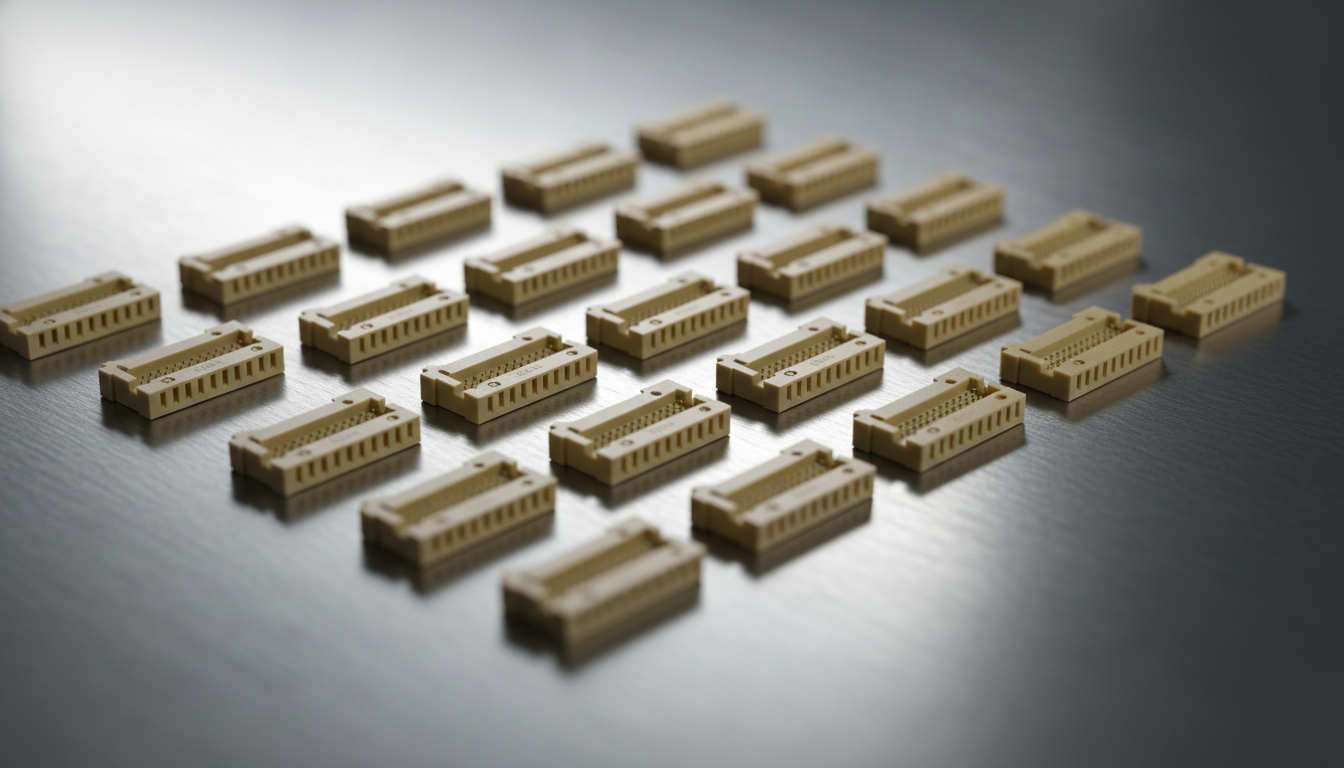
Vectra E130i Structural Mechanics & Anisotropic Shrinkage Profile
Celanese™ Vectra® E130i is a 30% glass fiber reinforced Liquid Crystal Polymer (LCP) resin, certified to deliver unmatched mechanical stiffness, ultra-thin flowability, and low-warpage properties under ISO/ASTM standards:
| Structural/Physical Parameter | Vectra E130i Tested Spec | 5G & Connector Advantage |
|---|---|---|
| Tensile Modulus | 15.0 GPa (15,000 MPa) (ISO 527-1,2) | Provides extraordinary, metal-like structural stiffness, preventing part deflection during dynamic multi-pin automated terminal insertions. |
| Flow Shrinkage | Nearly Zero (0.02% to 0.05% parallel) | Highly oriented polymer chains align along the flow direction, eliminating linear thermal shrinkage and ensuring precise dimensional stability. |
| Heat Deflection (HDT) | 275 °C (DAM @ 1.80 MPa) | Maintains unbending mechanical stiffness under high-heat SMT lead-free reflow (melting point 340°C), preventing pin alignment drift. |
Ultra-Thin Wall Process Adaptability for Vectra E130i
With its ultra-low melt viscosity and high self-reinforcing crystallinity, Vectra E130i processes predictably inside sub-millimeter cavities:
| Component Category | Molding Process Focus |
|---|---|
| Fine-Pitch Board-to-Board (B2B) Connectors | Excellent. The primary process for Vectra E130i. Optimized for multi-cavity, ultra-thin-walled connector grids with wall thicknesses down to 0.1mm. |
| High-Speed SMT Assemblies | Excellent. Resists blistering during high-temperature surface mount technology (SMT) reflow, ensuring flawless flat surfaces. |
| Advanced Camera Module Carriers | Good. Outstanding dimensional stability, low outgassing, and excellent flow properties prevent structural warping in delicate smartphone lenses. |
LCP-Celanese Vectra E130i Tooling & Knit-Line Management Blueprint
Molding an ultra-high flow, semi-crystalline polymer like Vectra E130i requires strict weld-line optimization and anisotropic shrinkage compensation:
Compensating for Anisotropic Shrinkage
Vectra E130i exhibits almost zero shrinkage in the flow direction (0.02%–0.05%) but significantly higher shrinkage perpendicular to the flow (0.35%). Our in-house tooling division uses 5-axis CNC machines to cut precise mold cavities and balance cooling paths, preventing uneven thermal contraction and part warping.
Optimizing Weak Weld Lines (Knit Lines)
LCP molecules align heavily along the flow direction. This orientation causes weld lines (where two flow fronts meet) to be mechanically weak. Jucheng’s tooling engineers conduct detailed Moldflow simulations during our free 24-hour DFM phase to position gates strategically, shifting weld lines away from high-stress zones.
S136 Mirror-Polished Tooling (Purity Preservation)
Due to the extreme clamping pressures and melt velocities of LCP E130i, Jucheng’s tooling division uses hardened, corrosion-resistant S136 stainless steel molds. We heat-treat cavities to 52 HRC and design generous draft angles (minimum 1.5° to 2.0°) to ensure clean part release.
Extended Desiccant Pre-Drying Protocol
While LCP absorbs minimal water, moisture causes hydrolytic splay and weld line degradation. We desiccant-dry Vectra E130i resin at 150°C (302°F) for 4 hours, keeping internal moisture below 0.01% to secure optimal molecular bonds.
Key Application Fields for LCP-Celanese Vectra E130i
- 5G Telecommunications & High-Density Electronics: Fine-pitch board-to-board connectors, USB Type-C plugs, SIM card slots, CPU sockets, camera module frames, and high-frequency RF connectors.
- Automotive Powertrains & Sensors (IATF 16949): Ignition coil bobbins, transmission sensors, powertrain control modules, LED lamp sockets, and electric water pump sensors.
- Medical Instruments (ISO 13485 Compliant): Minimally invasive surgical tips, high-end medical connectors, diagnostic cartridge bobbins, and catheter components requiring SMT soldering.
Properties
| Density | 1.62 g/cm³ |
| Tensile Modulus | 15,000 MPa |
| Tensile Strength at Break | 190 MPa |
| Tensile Elongation at Break | 1.9 % |
| Flexural Strength | 240 MPa |
| Flexural Modulus | 14,000 MPa |
| Charpy Notched Impact Strength (23°C) | 11 kJ/m² |
| Izod Notched Impact Strength (23°C) | 110 J/m |
| Melting Temperature | 340 °C |
| Heat Deflection Temperature (HDT @ 1.80 MPa) | 275 °C |
| Linear Mold Shrinkage (Flow Direction) | 0.02 - 0.05 % |
| Linear Mold Shrinkage (Cross Direction) | 0.35 % |
| Dielectric Strength (1.5mm) | 35 kV/mm |
| Volume Resistivity | 1.0E+16 Ohm-cm |
| Maximum Part Size | 600 x 400 mm |
| Minimum Part Size (Micro Molding limit) | 0.1 x 0.1 mm |