
Vectra E130i LCP for Custom Injection Molding
Vectra E130i is a 30% glass-fiber reinforced LCP grade. Celanese reports a 15,000 MPa tensile modulus and 0.1% parallel/normal test-plaque molding shrinkage (ISO 294-4). For custom injection molding, send the exact grade, drawing, quantity and part-level test requirements. Material data do not certify a finished connector.
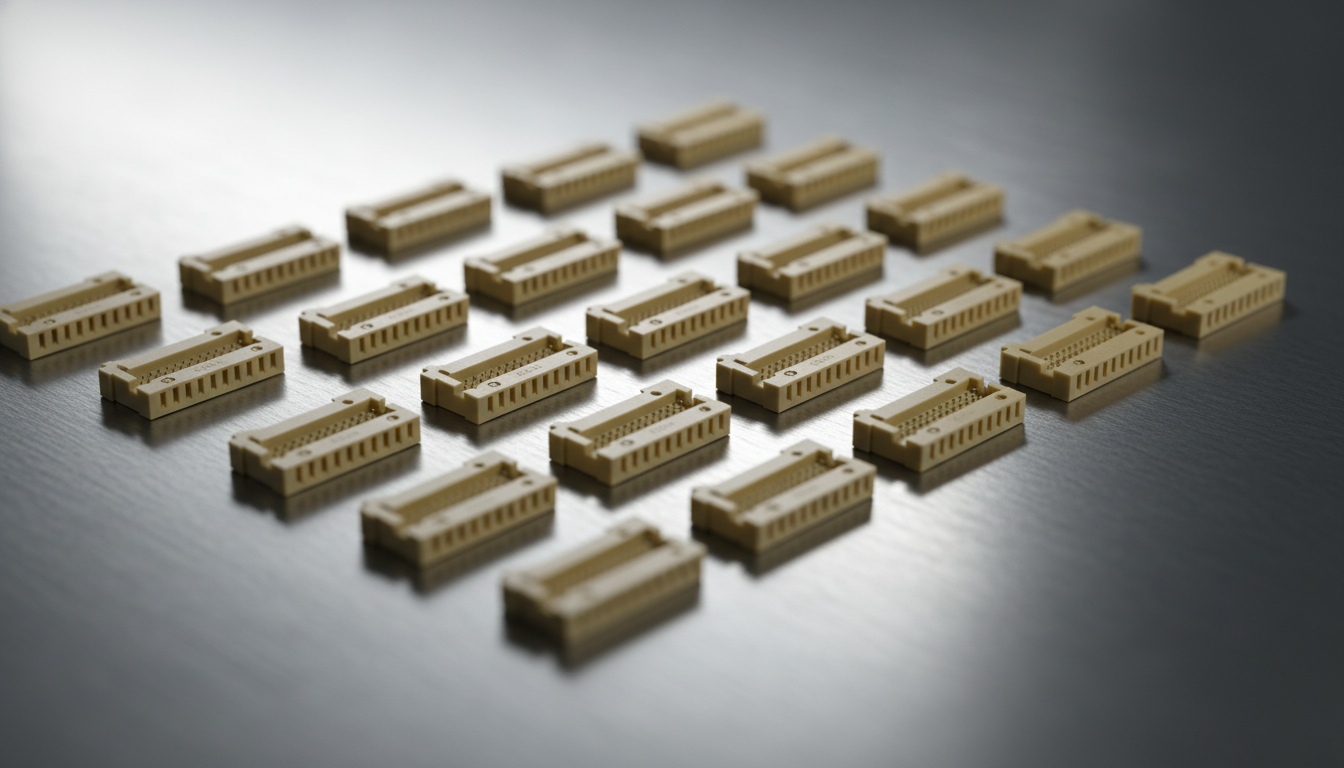
Celanese Vectra E130i is a 30% glass-fiber reinforced liquid crystal polymer (LCP) grade used for precision injection-molded components. The grade’s published material data can help with an initial selection, but a finished connector or other part must be evaluated against its own drawing, operating conditions and acceptance tests.
What the manufacturer reports for this grade
Celanese’s Vectra short-term properties guide lists 30% total filler for E130i, a density of 1.61 g/cm3, tensile stress at break of 150 MPa, tensile modulus of 15,000 MPa, and a heat deflection temperature of 276°C at 1.8 MPa. The guide reports molding shrinkage of 0.1% both parallel and normal to flow under its stated ISO 294-4 method. These are standardized specimen values, not a guarantee for every wall thickness, gate or molded part.
Where this grade may fit
Liquid crystal polymers are considered for small, detailed electrical and electronic components where material stiffness, heat response and dimensional behavior matter. The specific part design still determines whether E130i is appropriate. Connector performance also depends on metal contacts, plating, assembly and electrical testing; an LCP material property alone does not establish a connector’s rating or compliance.
Tooling and molding checks for an E130i part
- Geometry and fill: identify thin sections, flow length, ribs and gate-sensitive features on the actual design. Do not assume a minimum wall thickness from a generic web claim.
- Flow and joining: review potential weld lines at critical features and the likely fiber orientation. Confirm the proposed gate and acceptance tests on the part.
- Dimensions: use the manufacturer shrinkage data as an initial reference, then measure molded samples. Record the flow direction, conditioning and measurement method.
- Heat and electrical requirements: specify the actual exposure profile and final-assembly tests. A resin’s HDT, melting point or dielectric measurement is not a finished-product certification.
Request custom injection molding with Vectra E130i
For a project review, send the 3D model and controlled drawing, exact resin grade, intended quantity, critical dimensions, part-level performance requirements and any tool or test standards that apply. If a finish or assembly step is needed, include it in the requested scope. We can discuss a tooling and molding route for the documented requirements and identify what must be confirmed on samples. Browse the família de materiais LCP or our custom injection molding service for the broader process.
Source note: Property values above are from a Celanese technical guide. Before release, check the latest grade sheet and agree which test results apply to the supplied lot and finished part.
Propriedades
| Glass-fiber filler (Celanese guide) | 30 % |
| Density (ISO 1183) | 1.61 g/cm3 |
| Mold shrinkage, parallel (ISO 294-4) | 0.1 % |
| Mold shrinkage, normal (ISO 294-4) | 0.1 % |
| Tensile stress at break (ISO 527) | 150 MPa |
| Tensile strain at break (ISO 527) | 1.6 % |
| Tensile modulus (ISO 527) | 15000 MPa |
| Flexural strength (ISO 178) | 220 MPa |
| Flexural modulus (ISO 178) | 13500 MPa |
| Charpy unnotched, 23 C (ISO 179) | 43 kJ/m2 |
| Charpy notched, 23 C (ISO 179) | 22 kJ/m2 |
| Izod unnotched, 23 C (ISO 180) | 31 kJ/m2 |
| Izod notched, 23 C (ISO 180) | 20 kJ/m2 |
| Melting temperature (ISO 11357) | 335 C |
| HDT at 1.8 MPa (ISO 75) | 276 C |
| Electric strength (IEC 60243-1) | 32 kV/mm |