
PA-BASF Ultramid A3EG6
Undergoing continuous thermal degradation and high cyclic loading inside modern engine compartments requires extreme heat-aging resistance, which BASF’s Ultramid A3EG6 delivers through its 30% glass fiber reinforced, heat-stabilized polyamide 66 matrix. Boasting a dry-as-molded (DAM) tensile strength of 175 MPa and a heat deflection temperature (HDT) of 250°C, this high-performance nylon grade is engineered for heavy-duty structural components subject to thermal cycling. At Jucheng Precision, an IATF 16949 and ISO 9001 certified manufacturer, we specialized in high-stress molding of Ultramid A3EG6. Utilizing our in-house five-axis CNC-machined H13 tooling, we mitigate fiber orientation stresses and optimize crystallization, delivering structurally sound parts verified by Zeiss CMM inspection.
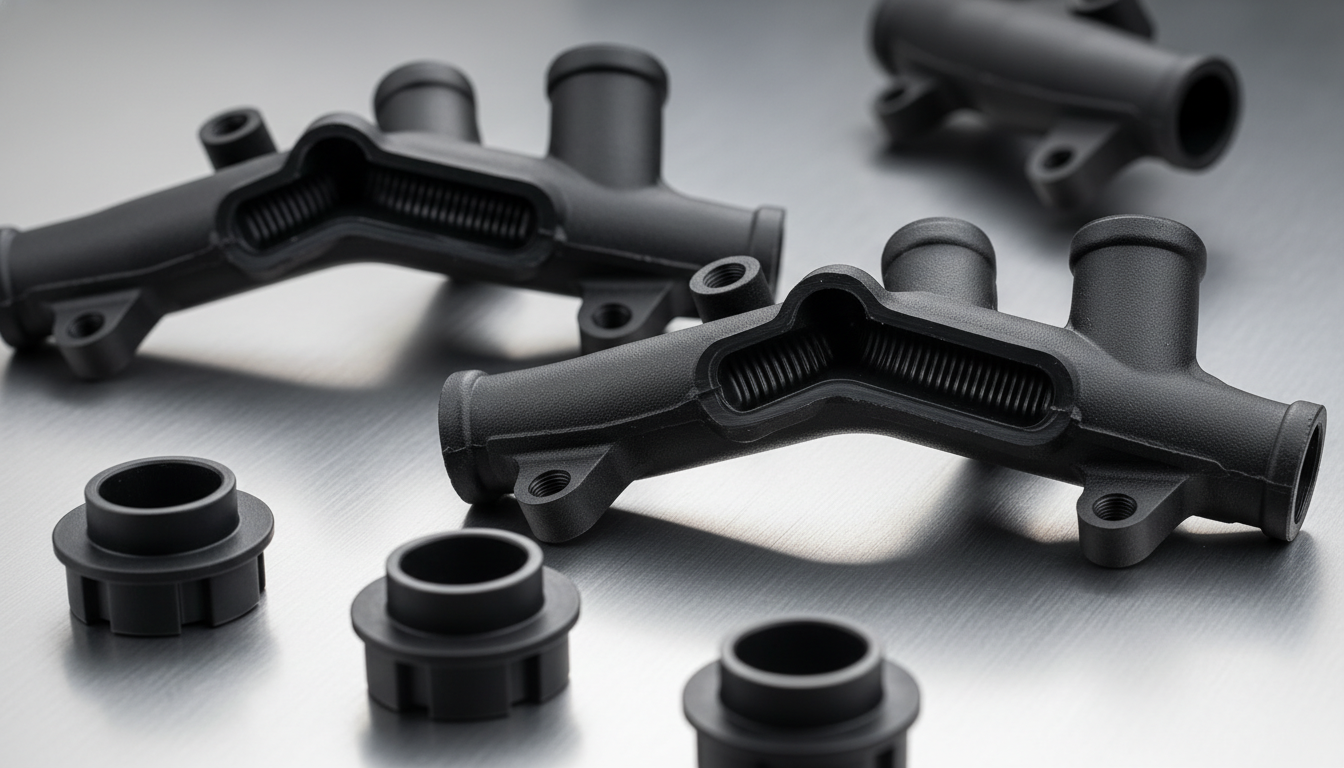
Ultramid A3EG6 Mechanical Toughness & Heat Aging Retention
BASF Ultramid® A3EG6 is an easy-flowing, heat-stabilized PA66-GF30 resin. This grade is optimized to retain robust mechanical properties under prolonged exposure to hot-air and fluid-cycling environments:
| Performance Metrics | Dry-As-Molded (DAM) Testing | Conditioned (50% RH) Testing |
|---|---|---|
| Elastic Tensile Modulus | 10,000 MPa | 7,000 MPa |
| Tensile Strength at Break | 175 MPa | 120 MPa |
| Deflection Temperature (HDT) | 250 °C (@ 1.80 MPa) | 250 °C (Uncompromised thermal threshold) |
Structural Component Process Configurations for Ultramid A3EG6
With its high crystallinity rate and thermal stabilizer package, Ultramid A3EG6 performs reliably under intense molding conditions:
| Target Assembly Class | Process Execution Criteria |
|---|---|
| Automotive Thermal-Cycling Components | Engineered for high-temperature coolant manifolds, radiator end tanks, thermostat covers, and powertrain fluid connectors subject to continuous oil aging. |
| High-Load Industrial Bobbins & Brackets | Ideal for heavy-duty electric bobbins, automated switchgear components, multi-pin electrical housings, and structural brackets requiring high creep modulus. |
Ultramid A3EG6 Scientific Molding Checklist
To secure optimal fiber distribution, eliminate surface splay, and protect tool integrity, we adhere to a strict processing matrix for BASF Ultramid A3EG6:
1. Abrasive Gate Eradication (HRC 52–54 Tooling)
Because 30% glass fibers erode gates under high injection velocities, Jucheng uses hardened H13 tool steel hardened to 52–54 HRC. We polish flow gates with PVD wear-resistant ceramic coatings to prevent rapid cavity wear and preserve parting line clearances.
2. Conformal Cooling Matrix (Warpage Control)
A3EG6 exhibits anisotropic shrinkage (0.50% parallel / 1.00% normal to flow). To avoid part twisting or warping, we use our in-house 5-axis CNC machines to mill uniform, balanced cooling circuits directly inside the mold inserts to stabilize shrinkage variables.
3. Particulate & Degassing Ventilation
Heat-stabilized PA66 produces volatile gases during high-melt runs. We cut precise venting slots (0.015mm depth) along the parting line to prevent gas trapping, ensuring zero burn defects on cosmetic rib tips.
4. Melt Shear & Drying Protocol
Raw polymer is dried in desiccant hopper dryers at 80°C–100°C (176°F to 212°F) for 4–6 hours to ensure moisture levels remain strictly below 0.10%. Barrel temperatures are profiled between 270°C and 290°C (518°F to 554°F).
Key Application Fields for PA-BASF Ultramid A3EG6
- Automotive Thermal Systems (IATF 16949): High-pressure cooling water pipes, radiator end chambers, oil separator covers, thermostat housings, and air intake grills.
- Industrial Power & Electronics: Heavy-duty electric motor bobbins, smart-grid circuit breakers, multi-pin electrical connectors, and din-rail switch boxes.
- Heavy Appliance Structures: Dishwasher structural brackets, washing machine vibration dampers, water pump impellers, and high-stiffness powertool casings.
Properties
| Density | 1.36 - 1.37 g/cm³ |
| Melting Temperature | 260 °C |
| Tensile Modulus (DAM) | 10,000 MPa |
| Tensile Modulus (Conditioned) | 7,000 MPa |
| Tensile Stress at Break (DAM) | 175 MPa |
| Tensile Stress at Break (Conditioned) | 120 MPa |
| Flexural Strength (DAM) | 260 MPa |
| Flexural Modulus (DAM) | 8,700 MPa |
| Charpy Notched Impact Strength (23°C) | 9 kJ/m² |
| Water Absorption (Equilibrium, 50% RH) | 1.9 % |
| Heat Deflection Temperature (HDT @ 1.80 MPa, DAM) | 250 °C |
| Linear Mold Shrinkage (Flow Direction) | 0.5 % |
| Linear Mold Shrinkage (Transverse Direction) | 1 % |
| Maximum Part Size | 1000 x 800 mm |
| Minimum Part Size | 1 x 1 mm |