
COP-Zeon Zeonor 1420R
Replacing optical glass and quartz in high-precision pre-filled syringes, diagnostic cuvettes, and microfluidic chips without introducing chemical extractables or leachables requires an ultra-pure amorphous polymer, which Zeon’s Zeonor 1420R Cyclic Olefin Polymer (COP) delivers. Featuring an extremely low density of 1.01 g/cm³ and a glass transition temperature (Tg) of 136°C, this USP Class VI and ISO 10993 certified resin provides 92% light transmittance, exceptionally low birefringence, and nearly non-existent water absorption (less than 0.01%). Jucheng Precision, under ISO 13485 certified medical frameworks, specializes in micro-molding Zeonor 1420R. Supported by certified ISO Class 7/8 cleanrooms and in-house 5-axis CNC-machined S136 stainless steel tooling, we guarantee zero-particulate contamination and pristine detail replication verified by Zeiss CMM.
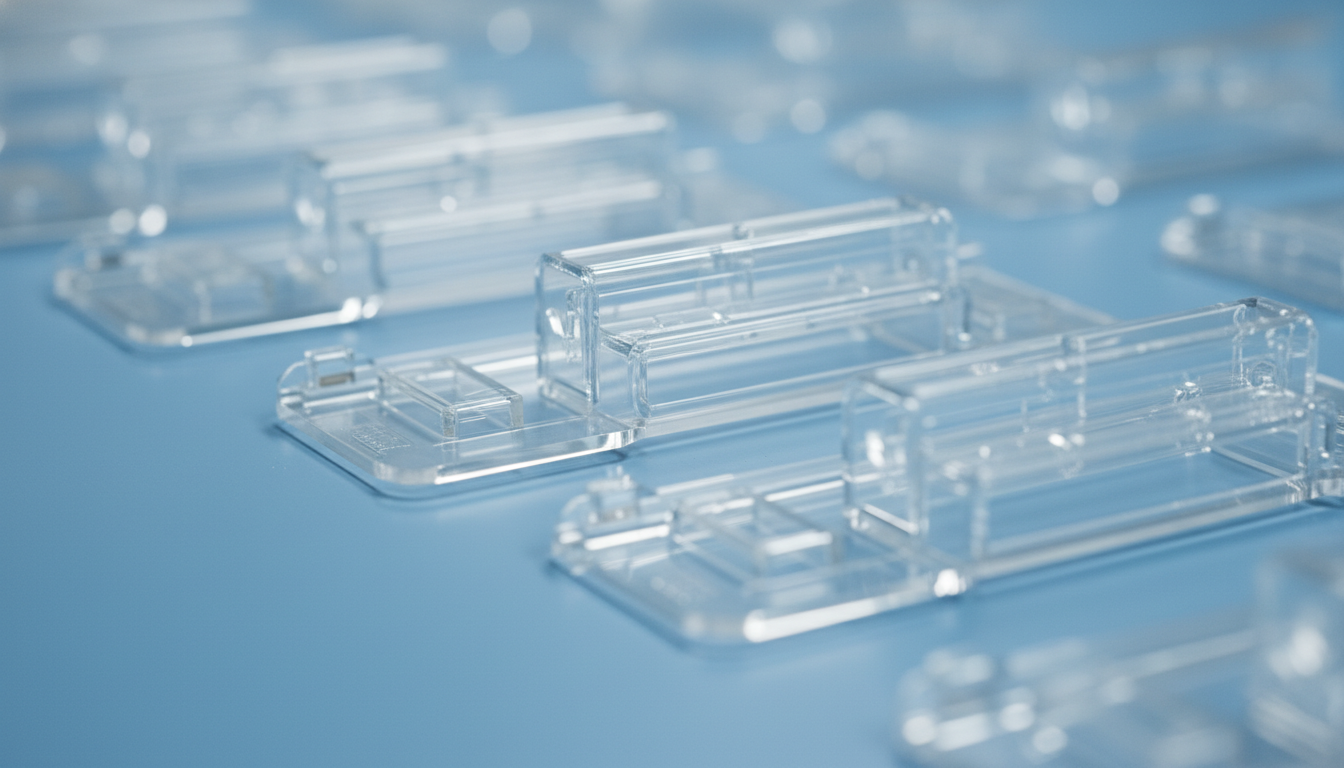
Zeonor 1420R Optical Purity & Biocompatibility Profile
Zeonor® 1420R is an unreinforced amorphous Cyclic Olefin Polymer (COP) resin engineered by Zeon Corporation, certified to deliver outstanding optical clarity, extreme purity, and low water absorption under ISO/ASTM standards:
| Clinical Quality Factor | Zeonor 1420R Value | MedTech Component Advantage |
|---|---|---|
| Optical Transmittance | 92.0% Light Transmission & Low Birefringence | Delivers glass-matching transparency directly from polished core cavities, preventing light diffraction errors in analytical diagnostics. |
| Ultra-Low Extractables | USP Class VI & ISO 10993 Certified | Highly purified amorphous matrix ensures zero toxic leachables, protecting sensitive pre-filled therapeutic drug storage. |
| Extreme Hydrophobicity | Water Absorption Less Than 0.01% | Virtually non-hygroscopic. Excludes environmental moisture swelling, preventing micro-volume microfluidic channel errors. |
Precision Micro-Molding Configurations for COP Zeonor 1420R
With its high-flow melt index and amorphous stability, Zeonor 1420R processes consistently inside precision cavities:
| Molding Process Category | Process Compatibility & Operational Details |
|---|---|
| Microfluidic Lab-on-a-Chip | Excellent. The primary process for Zeonor 1420R. Optimized for multi-cavity, ultra-thin-walled medical diagnostics and biochips down to 0.1mm channels. |
| Pre-filled Syringes & Vials | Excellent. High toughness, low outgassing, and excellent steam autoclaving resistance prevent dimensional distortion in medical syringes. |
| High-Fidelity Optical Lenses | Good. Outstanding dimensional stability, low outgassing, and ultra-low birefringence prevent structural warping in smart camera lenses. |
ISO 13485 Cleanroom Tooling & Processing Guide
Molding an amorphous high-purity medical-grade polymer like Zeonor 1420R requires strict control of parting lines to prevent flash, alongside cleanroom contamination control:
ISO Class 7/8 Cleanroom Injection Molding
Medical-grade COP resins must be protected from any airborne particulates or dust. Jucheng operates dedicated injection molding machines inside fully enclosed, positive-pressure ISO Class 7/8 cleanrooms. Raw material feeding, plastication, and robot part-ejection are completely automated and isolated.
Mirror-Polished S136 Tooling (Purity Preservation)
To prevent tissue irritation from microscopic surface micro-roughness, we build molds using high-chromium S136 stainless steel. Cavities are mirror-polished to a high level using clean diamond paste, ensuring non-porous biocompatible part surfaces with no dynamic release drag marks.
Low Birefringence & Thermal Stress Control
High melt shear during injection causes internal molding stresses, resulting in birefringence (rainbow refraction effects). Jucheng’s tooling division uses 5-axis CNC machines to cut precise runner geometries, applying slow, uniform packing pressures and keeping mold temperatures at 80°C–120°C (176°F to 248°F) using pressurized temperature controllers.
Extended Desiccant Pre-Drying Protocol
Though COP absorbs minimal water, pre-drying raw material in clean-air desiccant hopper dryers at 110°C (230°F) for 4 hours is mandatory to prevent surface splay, dynamic micro-voids, and loss of transparent optical quality during high-speed runs.
Key Application Fields for COP-Zeon Zeonor 1420R
- Medical Diagnostics & Microfluidics (ISO 13485): High-density microfluidic diagnostic chips, lab-on-a-chip diagnostic devices, cuvettes, assay plates, and pre-filled syringe barrels.
- High-Fidelity Optical Lenses & Optics: Spherical and aspherical optical lenses, protective camera covers, light guides, and light diffusion plates.
- High-Tech Electronic Enclosures: Low dielectric constant chip carrier trays, semiconductor handling packaging, and transparent display window plates.
Properties
| Density | 1.01 g/cm³ |
| Melt Mass-Flow Rate (MFR) (280°C/2.16kg) | 20 g/10 min |
| Tensile Strength at Yield | 65 MPa |
| Tensile Elongation at Break | 15 % |
| Flexural Strength | 95 MPa |
| Flexural Modulus | 2,100 MPa |
| Izod Notched Impact Strength (23°C) | 108 J/m |
| Light Transmittance (3.0 mm) | 92 % |
| Refractive Index | 1.53 - |
| Glass Transition Temperature (Tg) | 136 °C |
| Vicat Softening Point (B/50) | 132 °C |
| Heat Deflection Temperature (HDT @ 1.82 MPa) | 123 °C |
| Water Absorption (23°C Saturation) | <0.01 % |
| Linear Mold Shrinkage | 0.6 % |
| Maximum Part Size (Cleanroom limit) | 600 x 400 mm |
| Minimum Part Size (Microfluidic channel limit) | 0.1 x 0.1 mm |