
멀티 머티리얼 폴리머 제조는 기계 유압, 이중 사출 배럴, 회전 금형 코어 간의 원활한 동기화를 요구합니다. 강성 구조용 엔지니어링 열가소성 수지와 유연한 엘라스토머 씰 또는 대비되는 미적 색상을 결합하면 2차 수동 조립 라인이 필요 없게 됩니다. 단일 기계 사이클 내에서 이 멀티 폴리머 통합을 실행하면 부품당 인건비가 절감되고 공차 적층 오류가 제거됩니다.
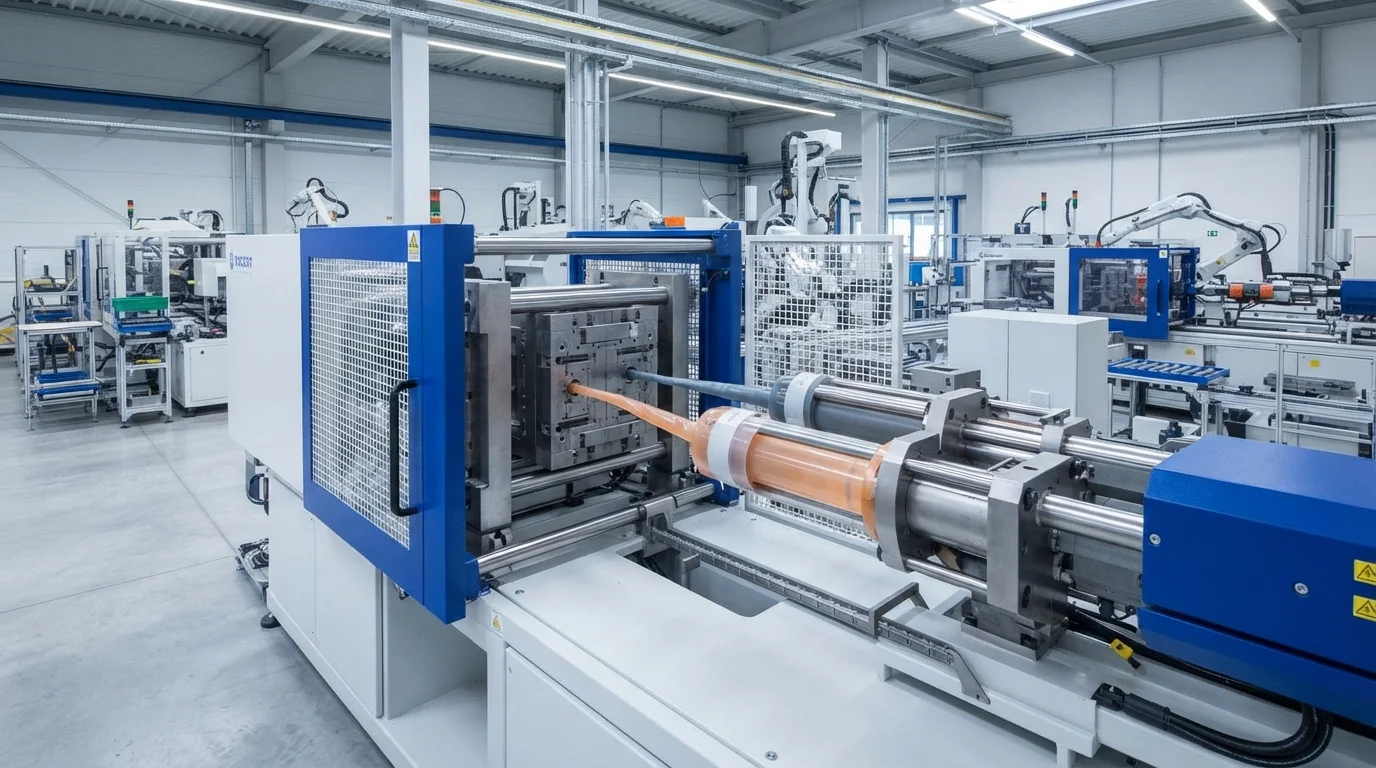
인터페이스에서 높은 계면 결합 강도를 달성하면서 미용상 플래싱이나 코어 시프트를 유발하지 않으려면 용융 온도와 캐비티 압력을 엄격하게 제어해야 합니다. 이 기술 엔지니어링 가이드는 다단계 사출 시퀀싱, 계면 결합 화학, 과학적 공정 제어 매개변수를 검토합니다.
완전한 3단계 사이클: 1차 사출, 금형 회전 및 2차 사출
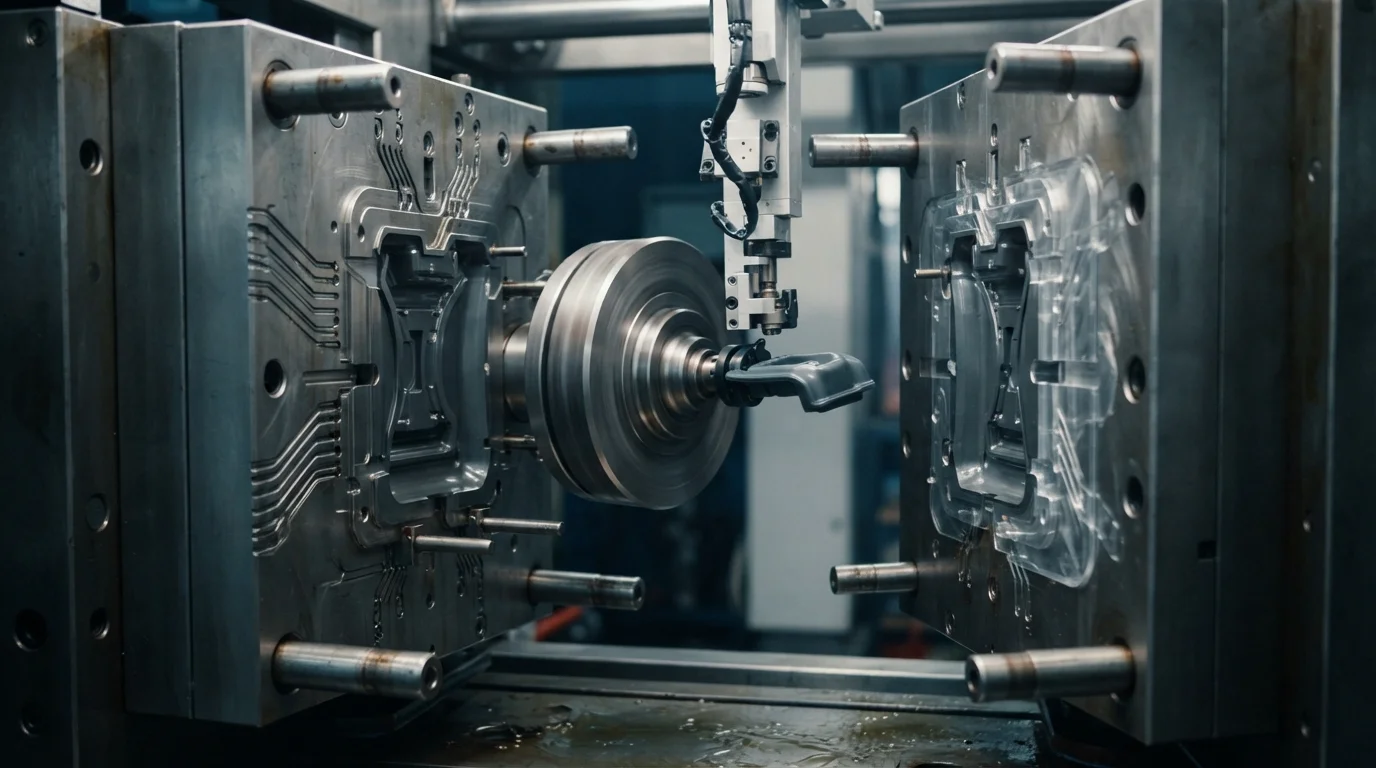
마스터링 2K 사출 성형 공정 은 3개의 자동화된 금형 내 단계에 걸친 정밀한 동기화를 요구합니다. 1차 사출은 강성 엔지니어링 수지를 첫 번째 노즐을 통해 밀어 넣어 구조적 기판을 형성합니다. 1차 사출물이 기하학적 안정성을 유지할 만큼 충분히 응고되면 클램핑 유닛이 열리고 정밀 회전 턴테이블 플래튼 이 코어 플레이트를 180도 회전시킵니다.
2차 사출은 즉시 지정된 기판 접촉 영역 위로 두 번째 수지 또는 엘라스토머를 분사합니다. 두 재료 층은 금형 내부에서 동시에 냉각된 후 유압 또는 공압 이젝터가 완성된 이중 재료 어셈블리를 깨끗하게 밀어냅니다.
순차적 2K 성형 사이클 단계는 다음과 같습니다:
- 1차 기판 사출—1차 배럴을 통해 강성 열가소성 수지를 사출하여 구조적 프레임과 치수 기준을 설정합니다.
- 회전 코어 180도 인덱싱—몰드 코어 플레이트를 180도 회전시켜 예열된 기판을 2차 사출 캐비티에 정렬합니다.
- 2차 오버몰딩 사출—연질 엘라스토머 또는 2차 착색 수지를 사출하여 지정된 기판 영역을 캡슐화합니다.
- 동시 냉각 및 이젝션—두 재료 단계를 동시에 냉각하여 프레스 처리량을 극대화한 후 자동 부품 이젝션을 수행합니다.
계면에서의 열 융착 vs 기계적 인터로킹
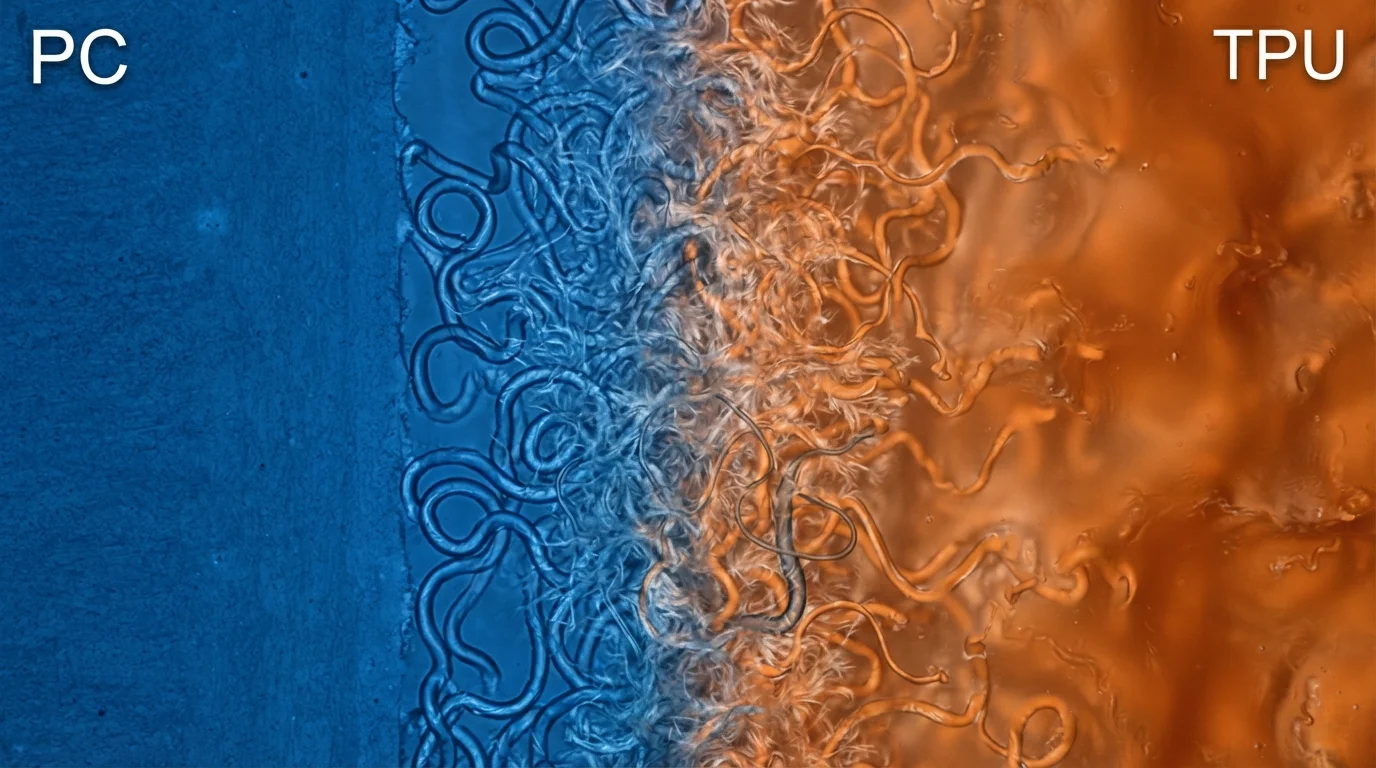
2색 사출 성형 공정 중 열 관리는 두 폴리머가 영구적인 화학 융합을 달성하는지 여부를 결정합니다. 2차 재료를 따뜻한 기판 경계면에 사출하면 계면 분자 확산 이 계면이 응고되기 전에 발생할 수 있습니다. 용융된 2차 샷 수지는 기판의 미세한 표면층을 용융시켜 두 재료의 폴리머 사슬이 얽힐 수 있게 합니다.
선택된 수지 간의 화학적 호환성이 낮은 경우, 툴링 엔지니어는 기계적 언더컷, 관통 구멍 또는 더브테일 채널을 통합합니다. 물리적 인터로킹은 유연한 엘라스토머를 강성 기판에 고정시킵니다. PA66 또는 폴리카보네이트(PC), preventing edge peeling under dynamic shear.
| Polymer Combination | Rigid Substrate | Secondary Resin | Interfacial Bond Mechanism | 주요 엔지니어링 이점 |
|---|---|---|---|---|
| Rigid + Soft Elastomer | ABS / PC+ABS 합금 | SEBS-based TPE | Chemical Molecular Fusion | Ergonomic soft-touch grips & vibration dampening |
| Rigid + High-Wear TPU | 폴리카보네이트(PC) | Ester-based TPU | 고강도 확산 | Scratch-resistant automotive dials & buttons |
| Structural + Seal TPV | PA66-GF30 (유리 섬유 강화) | 산토프렌 TPV | Chemical + Mechanical Interlock | IP67 waterproof environmental sealing |
Scientific Process Controls for Repeatable 2K Cycles
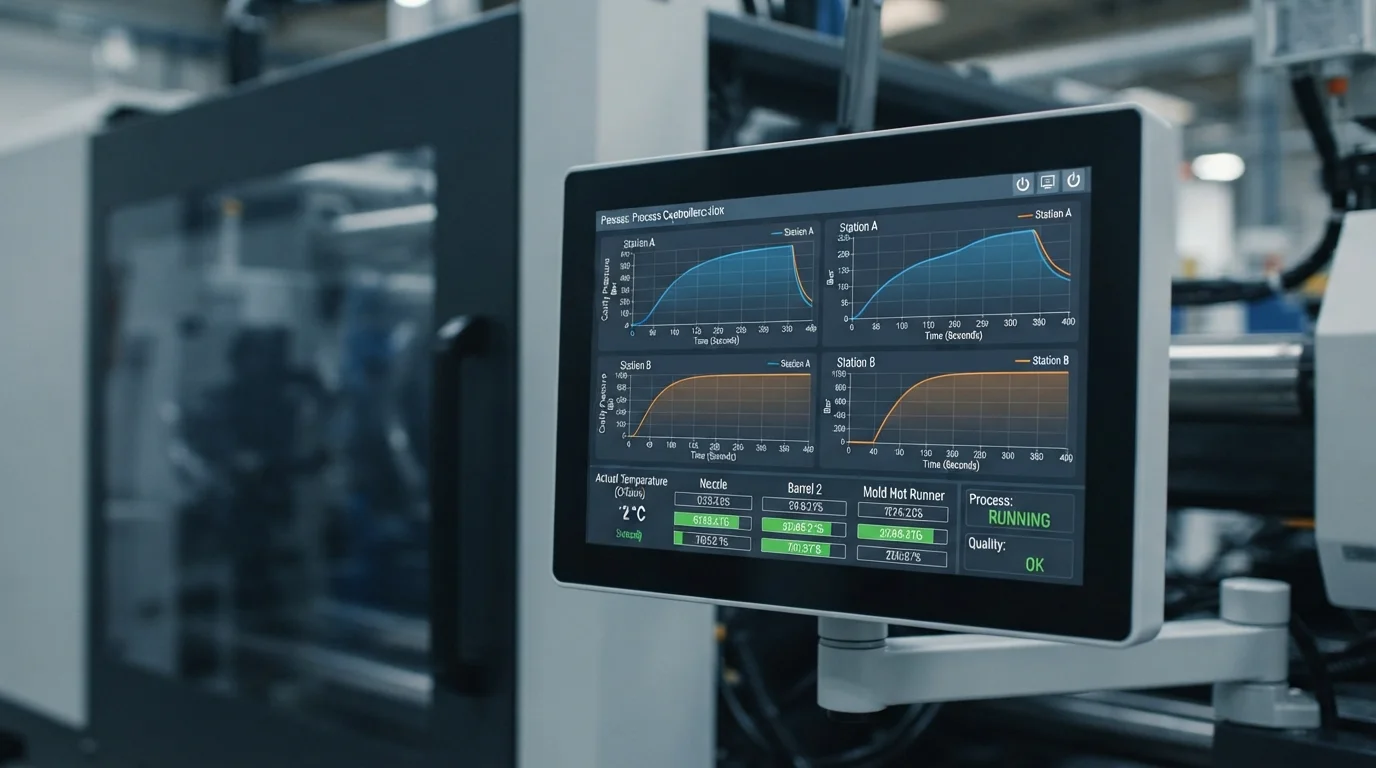
Maintaining dimensional consistency across high-volume 2K production runs requires closed-loop cavity pressure monitoring. Embedding cavity pressure transducers behind shut-off steel lands provides real-time feedback on melt compression. Real-time transducer monitoring detects raw material viscosity shifts, preventing short shots or parting line flash before defective components drop.
Balancing mold cooling channels between station one and station two prevents asymmetrical core contraction and post-mold warpage. Controlling thermal transitions during the two shot injection molding process is essential for zero-defect component repeatability.
Why Choose JUCHENG for Turnkey 2K Manufacturing
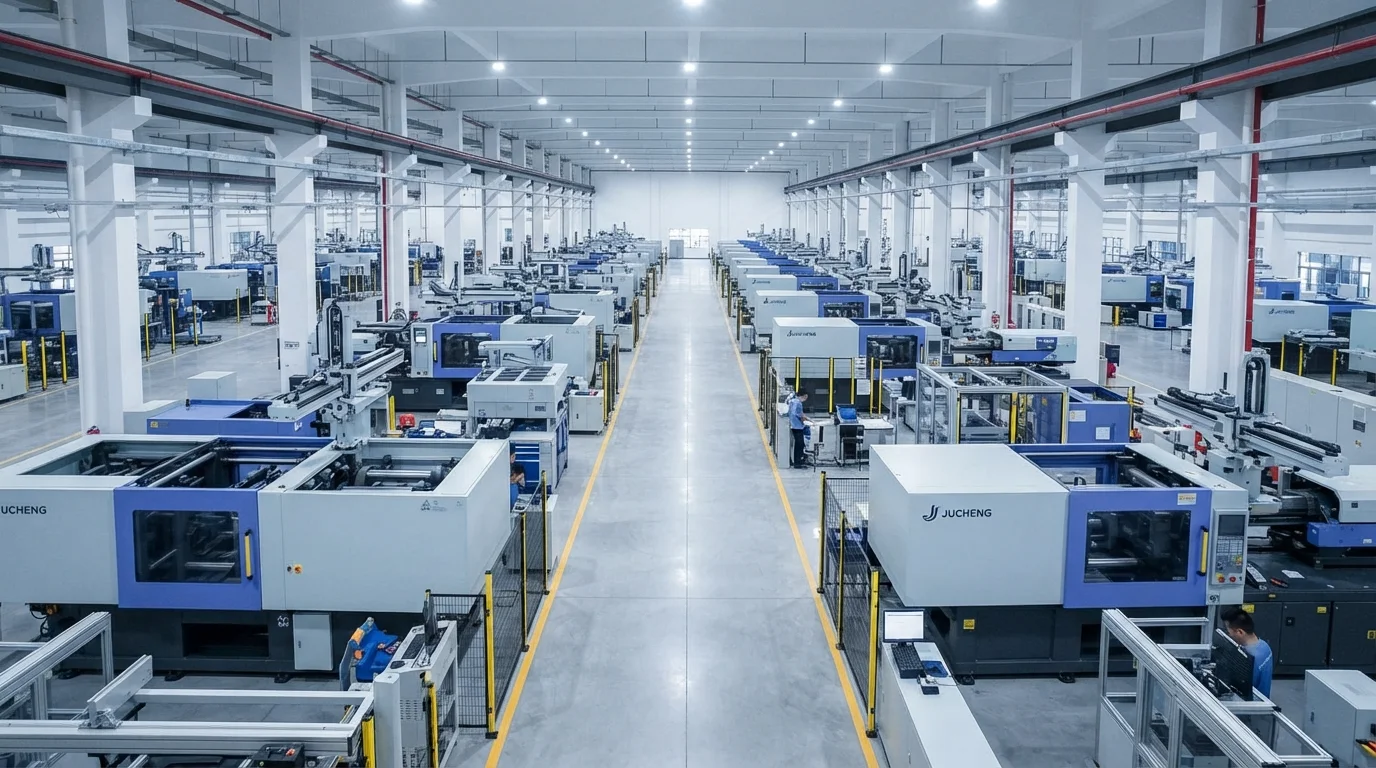
Partnering with JUCHENG for multi-material encapsulation projects provides access to an extensive production floor equipped with 35+ automated injection presses ranging from 15T to 3000T clamping force. Our facility operates dedicated multi-barrel presses fitted with high-precision hydraulic and servo-electric rotary platens. Toolmakers machine precision shut-off lands from hardened S136 스테인리스강 또는 H13 공구강, guaranteeing flash-free sealing over 1,000,000 cycles.
Quality management systems certified to IATF 16949 and ISO 13485 back every multi-shot production run, offering full PPAP Level 3 documentation for automotive programs. Operating an ISO Class 8 cleanroom molding department protects medical components from particulate contamination during molding and drop-packaging. Controlling thermal transitions during the two shot injection molding process is essential for high-yield 2액 사출 성형.
자주 묻는 질문 (FAQ)
What are the three main stages of the two shot injection molding process?
The three main stages include primary substrate injection, 180-degree mold core rotation indexing, and secondary overmold injection. Both materials then cool concurrently before automated ejector pins push the completed multi-material part out of the press.
How does mold rotation work in two-shot injection molding?
Mold rotation is powered by a hydraulic or servo-electric turntable platen mounted on the moving press platen. After the first shot cools to hold shape, the tool opens, swivels the core plate 180 degrees with ±0.01 mm positioning accuracy, and closes for the second shot.
Why is substrate surface temperature critical during second-shot injection?
Substrate surface temperature determines whether molecular chain diffusion can occur. If the substrate surface is too cold, the second-shot resin solidifies prematurely without melting the boundary skin, resulting in weak interfacial adhesion and part delamination.
How do mechanical undercuts improve 2K joint strength?
Mechanical undercuts, such as 90-degree dovetail grooves and through-holes, physically trap the second-shot resin inside the rigid substrate frame. Mechanical anchoring prevents elastomeric layers from peeling off under dynamic shear stress if chemical bonding is compromised.
What causes second-shot plastic flash in two-shot injection molding?
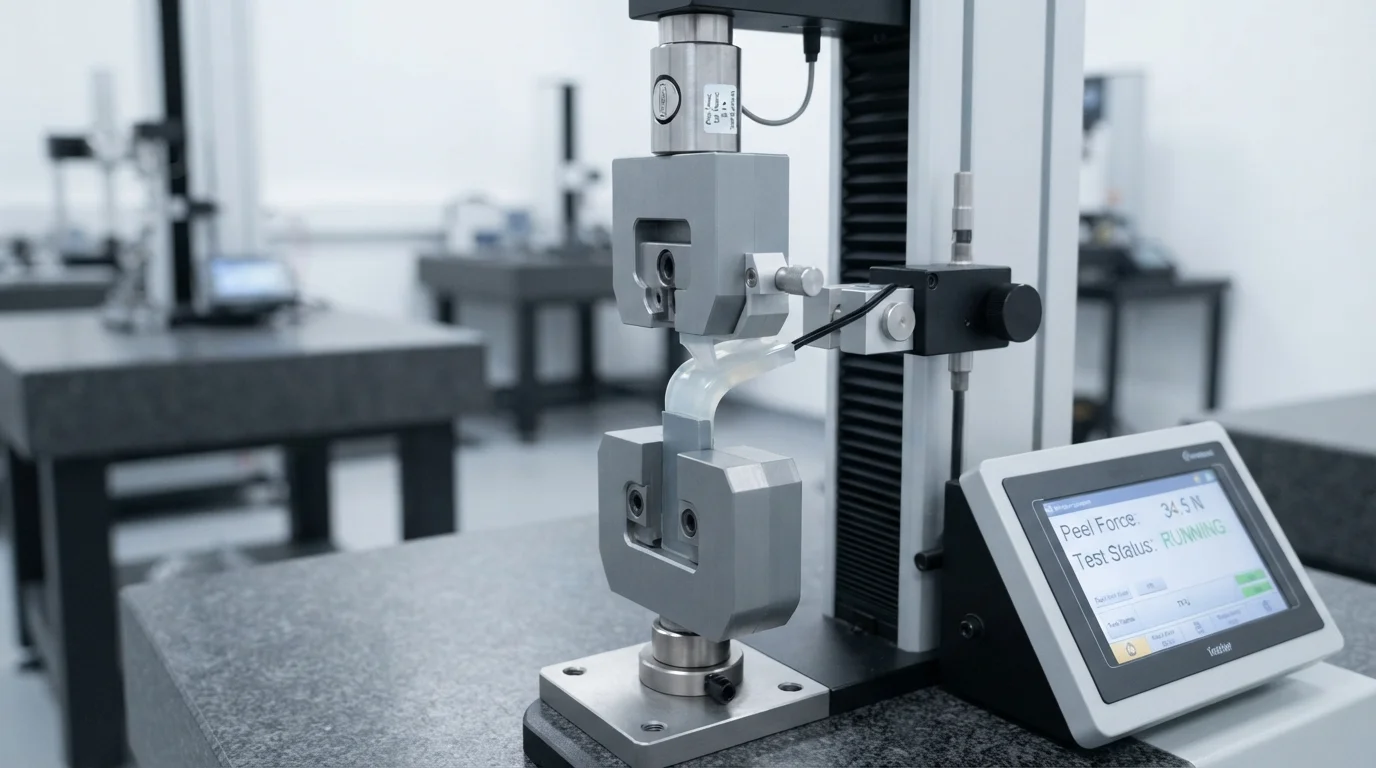
Second-shot flash occurs when mold shut-off lands are improperly fitted or when second-stage injection packing pressure is excessively high. Maintaining shut-off steel tolerances tighter than 0.01 mm prevents low-viscosity soft resin from bleeding over substrate surfaces.
Why is two-shot molding more cost-effective than overmolding for large production runs?
Two-shot molding completes both material injections within a single machine cycle, completely eliminating secondary manual handling and transfer labor. Lower cycle times, reduced scrap rates, and zero assembly fixtures quickly offset the higher initial tooling investment on high-volume runs.