
A buckle that clicks shut in a warm sample room can become difficult to release with gloves, let wet webbing creep, or develop a damaged latch after repeated use. Hiking backpack buckles should be selected as molded assemblies, not by choosing POM or nylon from a material-name comparison alone. The useful choice combines the resin grade, buckle geometry, actual webbing, and evidence from the intended operating conditions.
POM is a candidate where low moisture sensitivity, sliding behavior, and dimensional consistency matter. Nylon is also a candidate, but its grade and moisture state need to be understood when comparing flexibility, fit, and impact behavior. Neither family guarantees winter durability. This article concerns ordinary backpack strap buckles only—not climbing, fall-arrest, rescue, or other life-safety connectors.
POM or nylon? Compare the grade in its working condition
Begin with the unacceptable failure: a fractured latch, loss of engagement, strap movement, or an operating force the user cannot manage. The same change can help one requirement and harm another. A stiffer latch may resist unintended deformation but demand more finger force; a more compliant feature may feel easier without providing the required retention after wear.
For hiking backpack buckles made from POM, check the complete acetal grade rather than assuming all homopolymers, copolymers, toughened grades, and colored compounds behave identically. Celanese’s Hostaform POM product manual distinguishes grade-dependent impact behavior and discusses the effects of temperature and notches. That is a reason to investigate the actual latch, not to assign the whole buckle a temperature rating from a resin chart.
For polyamide or nylon candidates, specify the family, complete grade, and test condition. BASF’s Ultramid material and conditioning guidance explains why moisture state matters to molded polyamide behavior. A dry fresh sample and a conditioned sample are not interchangeable evidence. Confirm current grade information and the condition relevant to the product.
| Decision factor | POM candidate | Nylon candidate |
|---|---|---|
| Moisture-related dimensional change | Generally a useful starting point where low moisture sensitivity matters; still verify the grade and finished fit | Define conditioning and service state before comparing dimensions or operating force |
| Cold handling and impact | Inspect the particular grade, notches, latch section, and molded-part evidence | Check grade and condition alongside the same geometry and cold-use scenario |
| Repeated latch movement | Evaluate sliding contact, wear, and retained engagement | Evaluate the same functions, including any condition-dependent dimensional or force change |
| Outdoor exposure | Review the specified color/stabilization system and relevant exposure evidence | Do not infer weathering performance from the polymer name alone |
Use this comparison to shortlist grades, not to name a universal winner. Reinforcement or impact modification also changes the design review. A data-sheet stiffness increase does not automatically improve a repeatedly deflected buckle arm.
A width match does not establish a webbing fit
The nominal strap width is only the first check. Actual width tolerance, thickness, weave, edge finish, stiffness, and compressibility affect threading and adjustment. A buckle slot that accepts one sample easily may grip another poorly, even when both webbings carry the same nominal size.
Review the complete routing through the adjustment bars. Contact geometry, wrap direction, and the available tail influence whether the strap stays in place. Include wet webbing where relevant to use, and examine the sewn assembly if seams or folded layers approach the buckle. Do not solve poor retention by making an edge sharp enough to damage the textile.
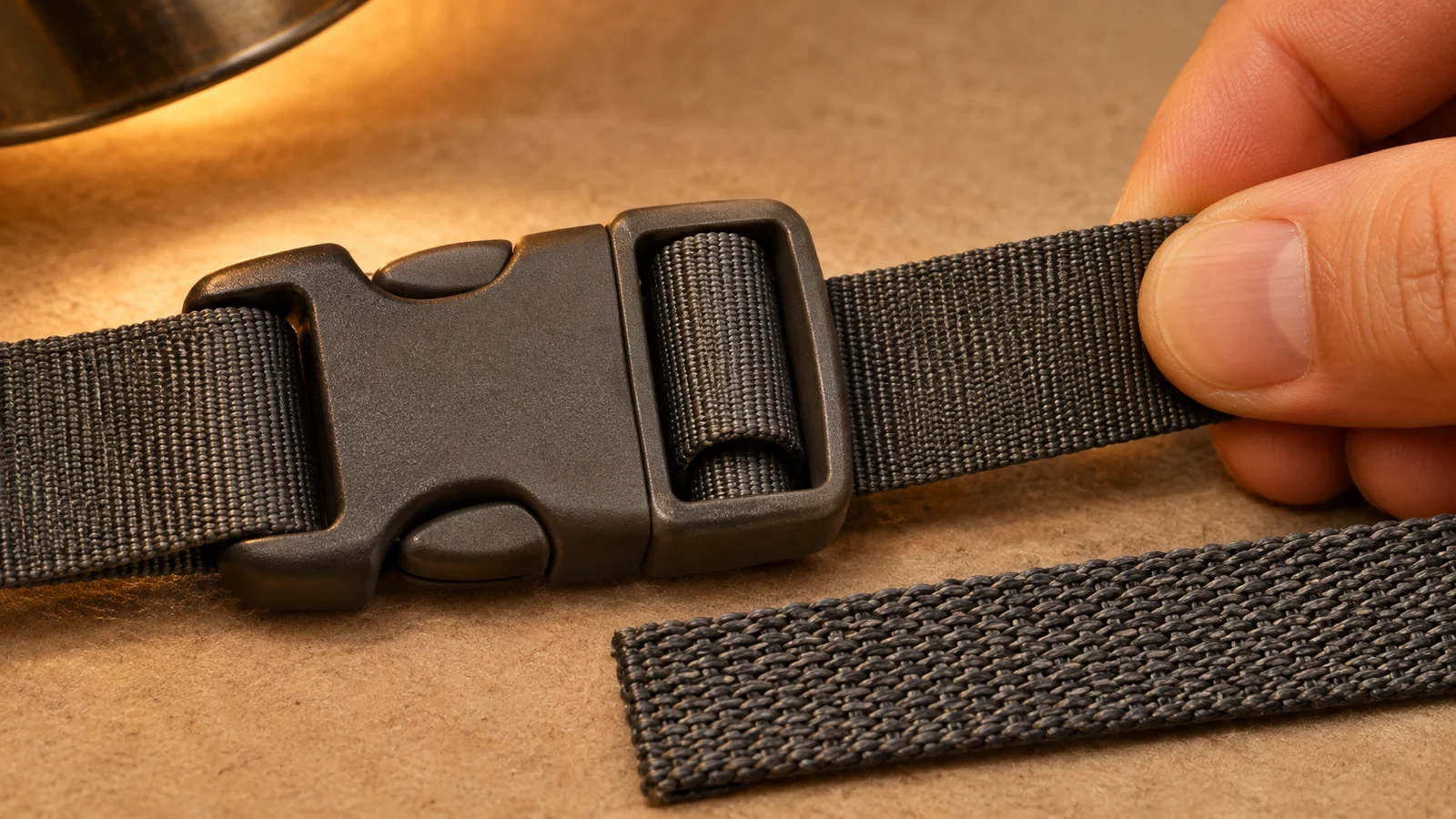
A useful fit trial uses production-intent webbing from the intended source, with the relevant manufacturing variation represented. Record the buckle position before and after the agreed load and movement sequence. If the strap moves, determine whether it is slipping through the adjuster, compressing locally, or changing elsewhere in the assembly before blaming the latch material.
Make room for a gloved hand without inviting release
Opening force is not the same as retention under strap tension. A side-release design needs intentional access to its operating features while avoiding easy accidental activation. Evaluate the two functions separately rather than describing a buckle simply as “strong” or “easy to open.”
For a hiking pack intended for cold weather, use the relevant glove type during the handling assessment. Check finger access, squeeze travel, feedback at full engagement, and whether the user can distinguish a partial insertion from a fully latched connection. Record the strap tension and buckle orientation during each check; otherwise two operating-force results may describe different conditions.
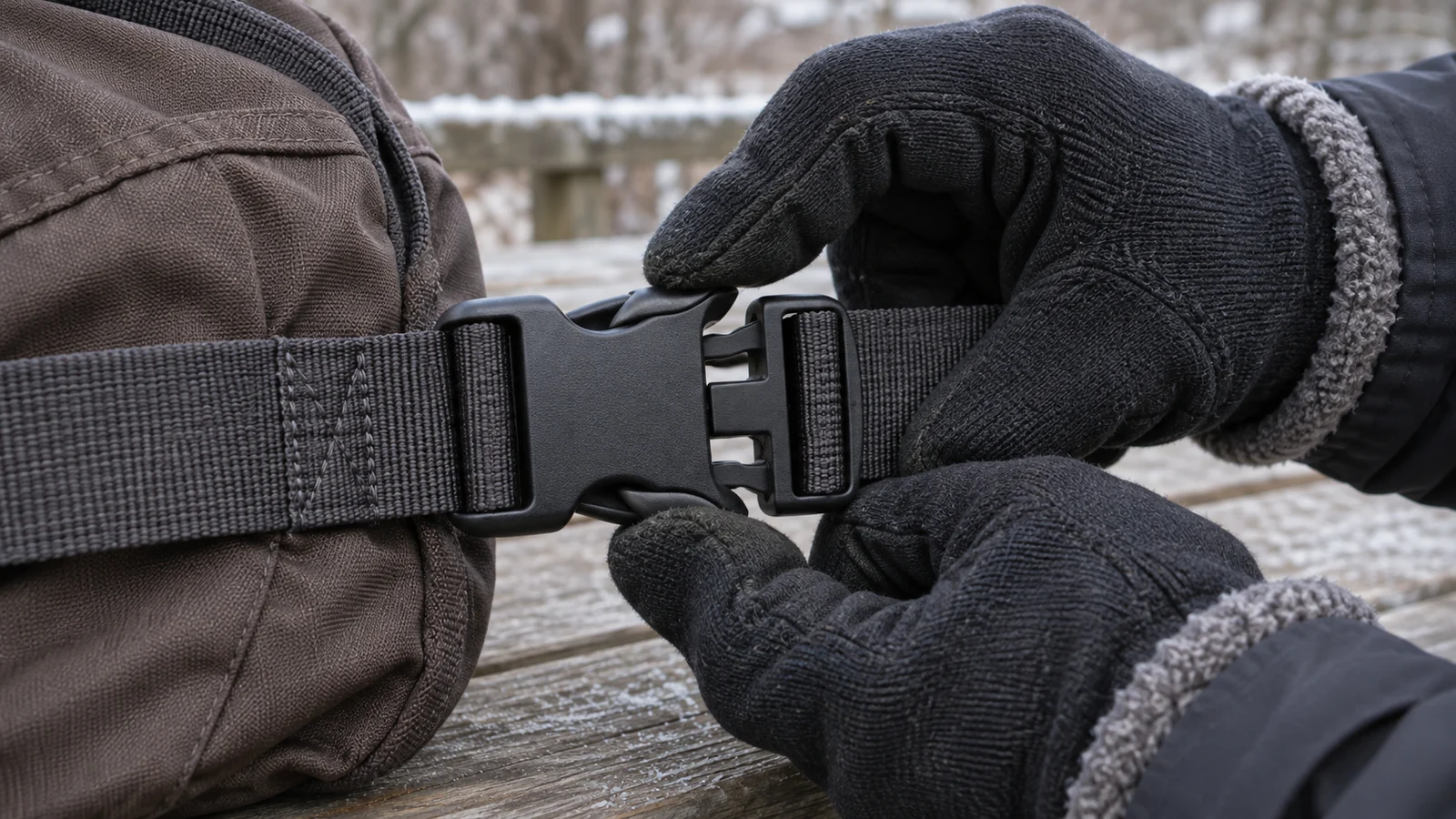
Texture and tab shape should support deliberate operation, but deep recesses can restrict access or retain contamination. Where dirt, wetting, or freezing is part of the specified use, evaluate those conditions in a defined procedure. A room-temperature demonstration with bare hands should not be reported as proof of winter usability.
Read the molded latch before changing the resin
A crack at a latch root may involve geometry and molding as well as material. Examine radii, section changes, local engagement, and where material meets during filling. Gate placement, weld lines, preparation, and processing history can affect the sample being tested. Changing to a tougher grade without understanding the location of failure may leave the controlling problem in place.
The plastic injection molding review should therefore connect the part drawing to the latch’s movement and load path. Identify where the arm bends during insertion and release, where it bears when latched, and whether mold-parting flash or gate removal could affect those surfaces.
Compare matched parts with known revisions and material identity. Keep cavity identification where relevant so that a local tooling issue is not hidden in a batch average. If the male and female halves come from different designs or suppliers, treat compatibility as a new assessment rather than assuming that similar outside dimensions establish a usable pair.
Test retention and usability through the same service sequence
A qualification plan for hiking backpack buckles should follow the product’s actual concerns. Establish a baseline for engagement, release force, strap retention, and visible condition. Then apply the agreed conditioning and use sequence and repeat the measurements. Define limits from the pack’s requirements; there is no universal force or cycle count that this article can assign to every buckle.
- Confirm the correct mating halves, material grade, drawing revision, and production-intent webbing.
- Measure or assess baseline insertion, intentional release, and retention using a documented setup.
- Apply the specified temperature, moisture, contamination, or outdoor exposure conditions.
- Cycle the buckle and adjustment mechanism using the agreed motion and load, checking for changing force, wear, and textile damage.
- Repeat functional checks at the relevant condition, including gloved operation where required, and inspect the failure location if a sample does not meet the criteria.
Consider a hypothetical ordinary pack buckle that still latches after cycling but allows its wet strap to migrate. That result does not justify switching from nylon to POM automatically. The evidence points first to the webbing-and-adjuster interface. Conversely, a latch that fractures during a cold handling test needs investigation of grade, geometry, and molded quality together.
Use representative samples rather than the most attractive first molding. Keep separate records of intentional opening, unintended disengagement, strap slip, and fracture. A single “pass” box loses the information needed to decide what should change.
Turn the sample result into a purchasing specification
The specification should name the approved material and color system, controlled geometry, mating half, and webbing construction. Include the conditions for operating-force, retention, and durability checks. A resin substitution, webbing-source change, or revised latch tool should trigger review of the tests it could affect.
For an initial manufacturing assessment, provide the model or drawings of both halves, webbing samples or a controlled textile specification, expected quantity, and the relevant use conditions. State explicitly that the component is an ordinary backpack fastener, not life-safety hardware. That keeps the engineering review focused on the intended product and avoids unsupported load or certification claims.
Backpack buckle questions
Does black plastic automatically have adequate UV durability?
No. Color alone does not identify a stabilization package or establish outdoor life. Specify the actual compound and the exposure evidence relevant to the product.
Can a replacement half be used with an existing buckle?
Not on appearance alone. Engagement geometry, movement, and retention must be checked with the actual pair. Similar nominal width does not establish interchangeability.
Is the strap’s material the same thing as the buckle’s resin?
No. A nylon webbing strap can be paired with a POM buckle, for example. Specify and evaluate the textile and molded component separately, then test their assembled interaction.