
The handle feels secure when it is new. After repeated workouts and cleaning, the user’s hand slips, the soft covering rotates, or an edge starts to lift. Those are different failures. Fitness equipment grips should be evaluated as a system of surface, elastomer, substrate, and attachment—not approved because one fresh sample feels soft and comfortable.
TPE overmolding can integrate a gripping surface with a suitable rigid component, while a separate slip-on sleeve can offer a practical assembly or replacement route. Neither construction guarantees wet grip or cleaner resistance. Choose between them by the actual handle, material pairing, exposure conditions, and the failures that the finished part must prevent.
Find out which interface is moving
First separate the hand-to-grip surface from the grip-to-substrate interface. A user’s hand may slide while the grip remains attached, or the complete soft layer may move around the rigid handle. Treating both as “poor grip” can send a redesign in the wrong direction.
A third failure occurs when a free edge begins to peel or tear. The main body of the grip can remain stable while that edge catches during use or wiping. Local texture wear is another condition: it may change the contact surface without obvious movement of the attachment.
| Observed symptom | Interface to investigate | Useful evidence |
|---|---|---|
| The hand slides on a wet handle | Hand or representative contact surface against the elastomer | Defined wet-contact assessment before and after exposure |
| The soft covering rotates | Elastomer or sleeve attachment to the rigid substrate | Torque, angular movement, and the actual failure location |
| An edge lifts or tears | Local termination, bond, or elastomer section | Edge inspection and a controlled peel or relevant local loading test |
| The contact texture becomes polished or damaged | Exposed elastomer surface | Wear history, surface inspection, and retained grip performance |
Record the location and condition of the failure before changing hardness or texture. A stronger bond cannot by itself fix a slippery contact surface, and a more aggressive surface texture cannot secure a sleeve that rotates around its support.
Choose the construction before comparing soft-touch samples
With overmolding injection molding, the soft region is formed around a substrate designed for the process. Its retention may depend on a compatible material bond, deliberate mechanical engagement, or a suitable combination. Confirm the actual materials and geometry rather than assuming that every TPE bonds to every plastic or metal.
A separate sleeve uses a different assembly concept. Its fit, length, end restraint, surface condition, and any specified attachment method affect movement in use. A sleeve may be valuable when replacement is an intended maintenance action, but it still needs a defined retention and cleaning strategy. Do not treat easy installation as proof of resistance to twisting.
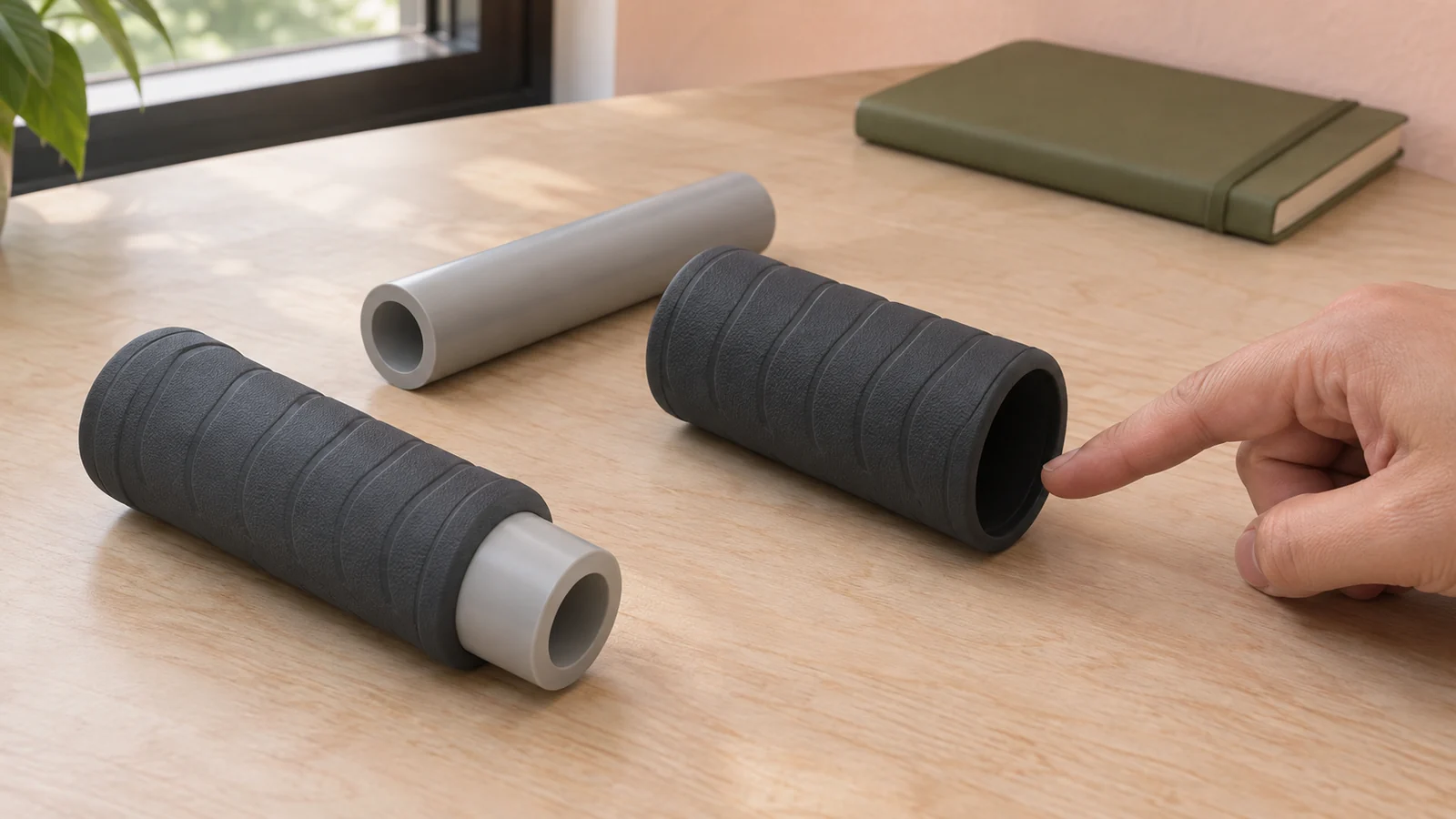
The existing material-pairing overview for fitness equipment grips provides background on TPE/TPU bonding. This application needs a more specific decision: what keeps the chosen grip in place after the actual exposure sequence, and how will that be demonstrated?
- Consider overmolding when an integrated contact region and controlled termination can solve the attachment requirement without unacceptable tooling or handling complexity.
- Consider a separate sleeve when service replacement, a common handle geometry, or the assembly strategy justifies a detachable component.
- For either route, include finishing, assembly, inspection, and maintenance requirements in the comparison—not just the price of the soft part.
If the support is metal, identify how retention is intended to work. A compound intended to bond to one rigid polymer is not automatically a direct-bonding choice for steel or a coated tube. If the design uses an interlock, assess how the soft material bears against it under repeated torsion and at its exposed edges.
Write the exposure recipe before choosing a softer grade
“Sweat resistant” and “cleaner resistant” are incomplete purchasing descriptions. Identify the relevant contact medium, cleaner chemistry, concentration, temperature, contact time, wiping method, and frequency. A wet wipe, a prolonged soak, and repeated drying cycles can create different conditions. Do not select an exposure merely because it is easy to perform in a laboratory.
Where simulated perspiration is used, state the selected composition and method. It is not automatically equivalent to every real use condition. Keep skin-contact, regulatory, or complete-equipment safety requirements separate from a mechanical grip and durability review.
Hardness alone is also insufficient. Avient’s TPE overmolding guide distinguishes material hardness from friction and explains that thickness and surface texture influence feel. It also emphasizes substrate-specific material selection. A softer sample can therefore feel attractive while leaving the relevant wet-contact or attachment question unanswered.
Use the site’s thermoplastic elastomer material overview to organize candidate families, then request grade-specific evidence for the proposed substrate and exposure. Record the exact grade, color system, substrate material, and relevant surface preparation. Approval of one combination should not silently extend to a different sleeve compound or coated support.
Torque, peel, and abrasion need different evidence
Check rotation at the assembled handle
Hold the rigid support in a defined fixture and apply the agreed torsional loading to the grip without creating an unrealistic clamp condition. Record torque and angular movement as appropriate to the test, alongside where movement begins. Distinguish interface slip, elastomer deformation, and movement of the support itself. Repeat the relevant assessment after conditioning rather than relying only on a dry baseline.
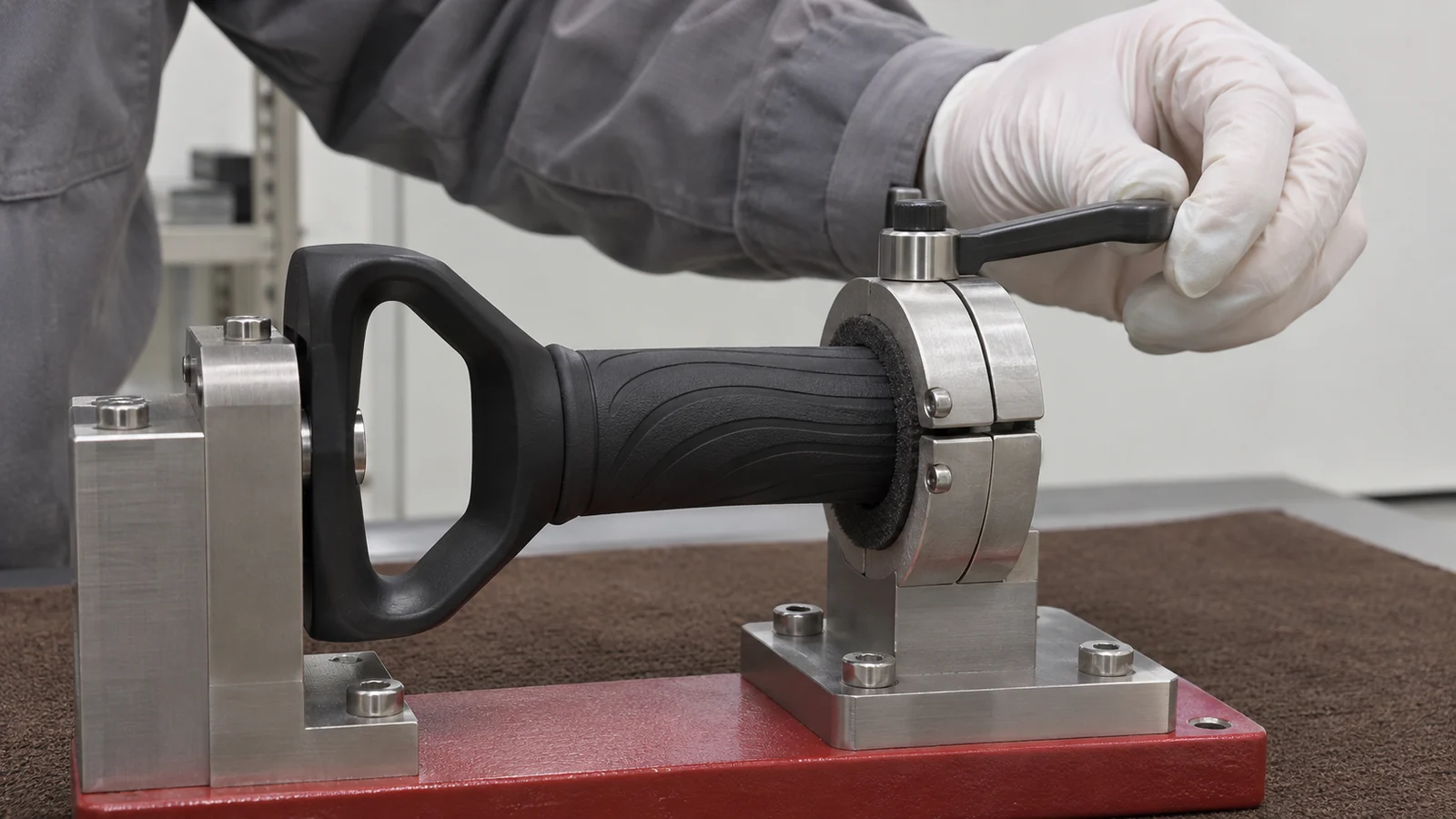
Inspect edges and identify the failure mode
A locally exposed edge may be vulnerable to catching during use or wiping. Review the termination geometry, flash, unsupported lips, and the actual direction of applied force. A test on a flat material plaque can help compare a material pair, but it does not reproduce every curved handle edge.
Teknor Apex’s overmolding adhesion guidance distinguishes separation at the interface from tearing within the elastomer. Record that distinction. An apparently high peel force and an apparently high torque result still describe different loading conditions; neither should be substituted for the other without a justified relationship.
Connect wear to retained function
Abrasion evaluation should represent the intended contact and cleaning action closely enough to answer the design question. Inspect texture loss, surface damage, exposed substrate, and changes that affect grip. A small visual mark may be acceptable while a polished contact area is not, or the appearance requirement may be stricter; the product specification must decide.
After wear or exposure, reassess the relevant functional requirement. A part that remains attached can still become difficult to hold. Conversely, a surface that still feels comfortable can conceal a weakened edge or loose attachment. Keep those observations separate in the report.
Follow one handle through cleaning and retesting
Consider a hypothetical grip on a seated exercise machine. Its first samples feel secure and show no obvious edge damage. After repeated cleaning, one candidate becomes tacky at the surface while another begins to rotate. This example does not represent a customer project or a completed test.
The tacky sample calls for review of the material and exposure interaction; simply tightening its attachment would not address the contact surface. The rotating sample needs investigation at the attachment and support. Check for an assembly or dimensional issue, a changed interface, or a retention concept that does not tolerate the exposure. Do not label both outcomes as the same TPE problem.
- Record the original dimensions, material identities, surface condition, and assembly method.
- Measure the baseline functions that matter, including wet contact, intentional attachment, and edge condition.
- Apply the agreed exposure and use sequence, including drying or recovery periods where specified.
- Repeat the relevant measurements and inspect the failure location using the same criteria.
- Decide whether to change the grade, geometry, process, attachment method, or construction, and retest the affected functions.
The resulting fitness equipment grips specification should identify the accepted material pair or sleeve assembly, geometry, texture, critical edges, exposure recipe, and pass/fail requirements. A change to the cleaner, substrate coating, elastomer grade, or support dimensions may change the qualification question even when the outside shape looks the same.
For a manufacturing review, provide the handle model, substrate details, grip coverage and thickness concept, assembly or overmolding preference, expected quantities, and the real use-and-cleaning conditions. Include the functions that must remain after exposure. This makes the discussion about a durable grip system rather than a generic request for a soft material.
Grip specification questions
Does overmolding automatically prevent a grip from rotating?
No. Retention depends on the material combination, geometry, process, and operating conditions. Demonstrate the required performance on the proposed assembled handle.
Should the same texture be used for dry and wet contact?
Not without evaluation. The effect of texture depends on material, geometry, contact conditions, and cleaning requirements. Compare relevant contact states rather than assuming that a rougher pattern is always better.
Can a cleaning-resistant grip be called disinfectant-proof?
No. A result supports only the chemicals and conditions actually evaluated. It does not establish unlimited compatibility, antimicrobial activity, or finished-equipment approval.