
Does the useful shape repeat along the whole length, or does the part need local three-dimensional detail? That question is a better starting point for injection molding vs extrusion than a tooling-price comparison. Extrusion forms a continuous profile that is subsequently handled and cut as needed. Injection molding forms individual components in a cavity. The sensible route depends on what the finished part must contain, including end features and assembly interfaces.
A straight plastic rail and a short housing can serve the same product but ask very different things of the manufacturing process. Compare them as complete components, not as equal amounts of resin. This discussion concerns profile extrusion, not extrusion blow molding, and does not imply that Jucheng offers an extrusion production service.
A repeating cross-section is a useful first filter
Profile extrusion is worth investigating when the required cross-sectional shape continues along the length. Tubes, channels, rails, and edge profiles are familiar examples. The material passes through a shaped die, and downstream handling helps establish the resulting profile. The process does not directly create arbitrary isolated features at different positions along that length.
Injection molding is worth investigating when local details are central to the part: mounting bosses, ribs, stops, pockets, or changing exterior sections. Those features still require mold access, suitable walls, draft where needed, and a workable release concept. The ability to model a detail does not prove it can be formed in a simple open-and-close tool.
Neither observation says that the more detailed route is always better. A simple long channel may gain little from being divided into separately molded segments. Conversely, starting with an extrusion and machining away much of it can lose the benefit of a repeating section. Identify which geometry actually provides the product’s function before selecting a process.
The ends can change the manufacturing decision
A profile can be simple through most of its length while needing a complicated connection at each end. Cutting, drilling, machining, joining, or adding a separate end component may be part of the extrusion route. These operations are not automatically undesirable, but they belong in the manufacturing comparison from the start.
Ask whether an end feature locates the part, seals it, carries a fastening load, or simply covers an opening. Each role creates a different tolerance and validation task. An added end cap may be a sensible solution for appearance but introduce a joint that matters to sealing or load transfer. A quotation for bare cut profile does not include that engineering problem.
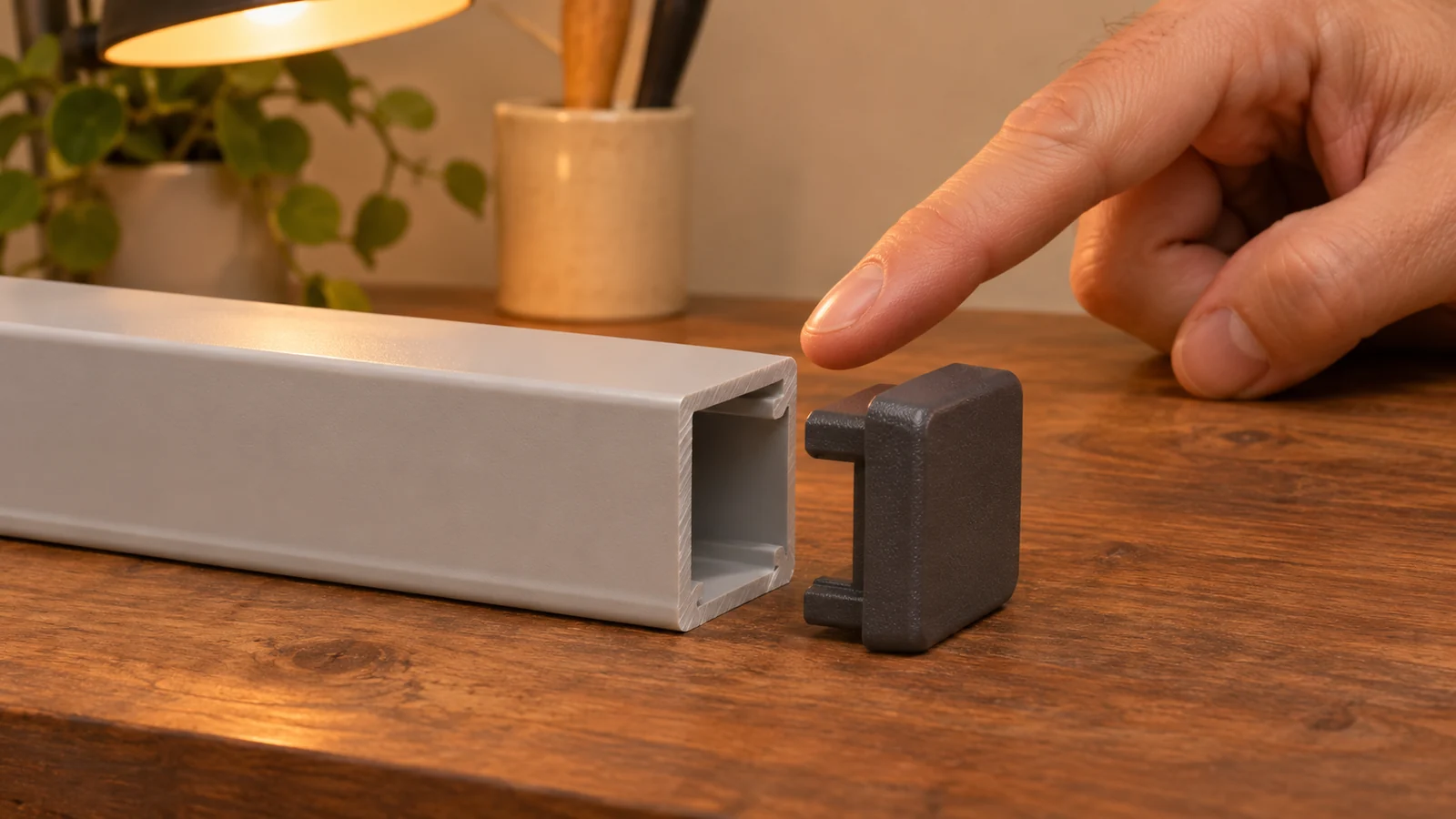
The Plastic Injection Molding option may integrate useful end or mounting features in an individual component. Compare the resulting tool complexity and part layout with the profile-plus-secondary-work route. Do not assume that removing an assembly step automatically outweighs every tooling and production consequence.
Compare the complete route, not just the forming step
Use the table to establish what each proposal actually delivers. It is a decision framework, not a universal cost ranking. Material grade, geometry, output requirements, tolerances, and secondary operations can change the result.
| Decision factor | Extrusion route to investigate | Injection route to investigate |
|---|---|---|
| Shape along the length | Whether the useful cross-section repeats continuously | Whether local detail justifies individual molded components |
| End and mounting features | Cutting, machining, joining, or separate components | Integrated features with suitable tool access |
| Dimensional control | Profile geometry, straightness, cut length, and later features | Cavity features, shrinkage, datums, and assembled fit |
| Product variants | Whether a common profile can serve several cut lengths | Whether length or detail changes require tool changes |
| Finished component price | Forming plus all required secondary work and assembly | Tooling allocation, molding, finishing, and assembly where needed |
A profile with several length variants may benefit from sharing a cross-section, provided the downstream operations remain suitable. An injection-molded part with different lengths may require a different tooling strategy. Compare actual variants and volumes rather than assuming that both routes scale in the same way.
Material selection also needs equal treatment. A family name shared by two proposals does not establish identical grade properties or the same processing suitability. Confirm the actual grades and relevant performance requirements. Otherwise, a supposed process comparison may be hiding a change in material, wall layout, or acceptance standard.
Follow a rail and a housing through the decision
A rail that only changes length
In a hypothetical product, a protective rail has the same channel section throughout and is offered in several lengths. An extrusion cut to length is a reasonable route to assess. Check straightness, the fit of the channel, the cut-end condition, and any drilling required for installation. If a separate end cover is needed, include its fit and assembly in the proposal.
Replacing that rail with molded segments would introduce joints and a different installation concept. That may be justified for particular features or packaging needs, but it should solve a real requirement. Do not introduce joints merely because injection molding can produce a detailed sample.
A housing with detail around several faces
Now consider a short enclosure that needs internal board supports, local openings, a latch, and a shaped mounting region. Starting with a constant-section profile may leave substantial secondary work and added components. An injection concept deserves review because the useful geometry is local and three-dimensional, although slides, split lines, walls, and ejection may still constrain the design.
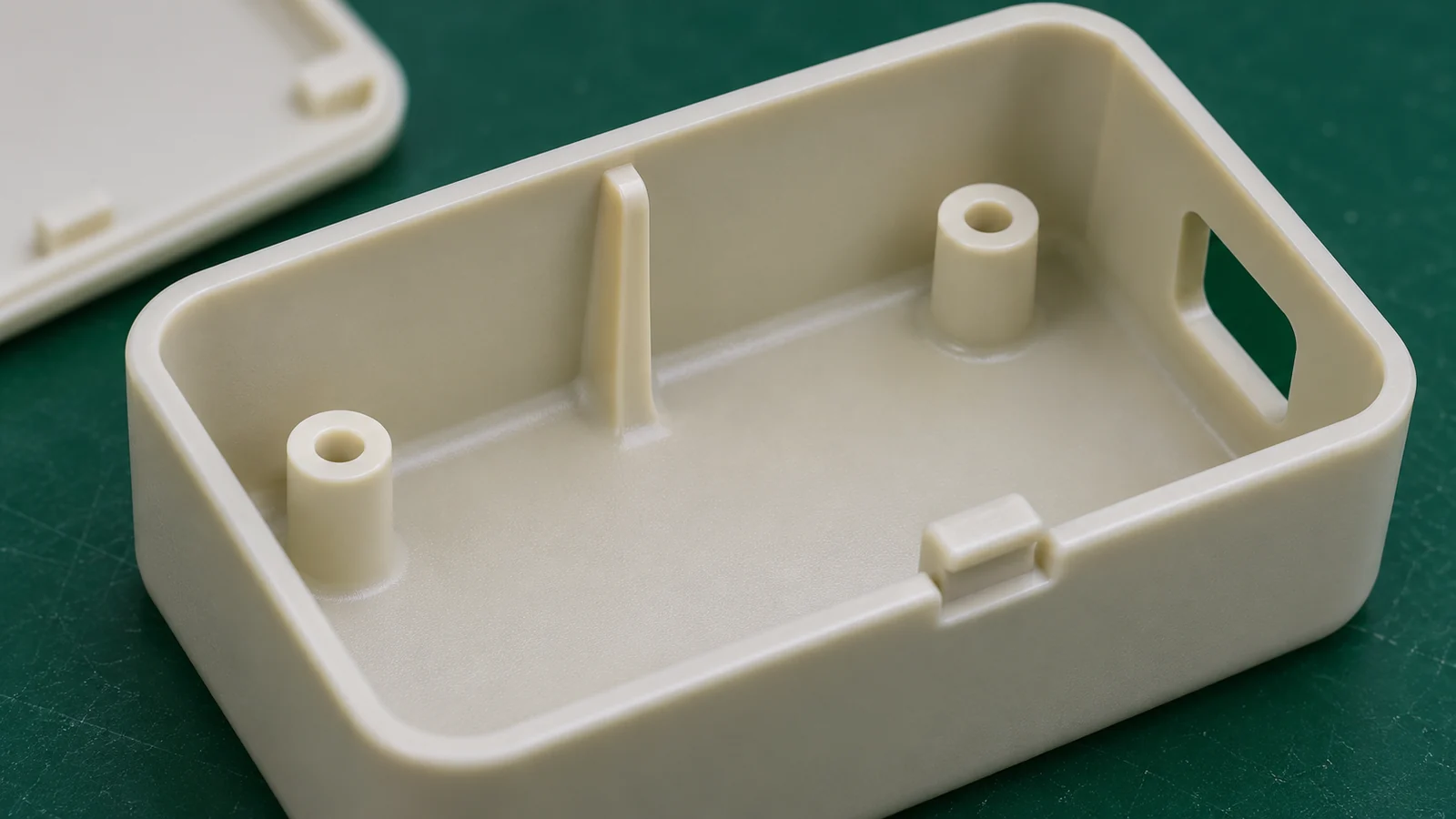
A useful injection molding vs extrusion review draws both manufacturing concepts against the same assembly. Record what is integral, what is added, and how each route will locate the finished component. These hypothetical examples illustrate the decision; they are not company customer cases.
Put tolerances where the two routes behave differently
A dimensional comparison needs more than a statement that one process is “more precise.” An extruded profile can have cross-sectional requirements, straightness or twist limits, cut-length requirements, and later machined-feature tolerances. An injection-molded part has its own dimensional response to geometry, cooling, shrinkage, and conditioning.
Define functional datums and inspect the feature that matters to the assembly. If a hole is drilled after extrusion, its position depends on how the profile is located in that operation. If a boss is molded integrally, its relationship to the other features still needs verification on the finished part. Neither route eliminates tolerance stack-up simply by reducing the part count.
Check long or flexible parts in the state intended by the requirement. Free-state straightness and fit under assembly restraint are different observations. Agree the support, temperature, and conditioning where relevant, so a component is not approved only because a fixture forces it into position.
Make competing quotes describe the same deliverable
Specify the finished geometry, grade, surface requirements, variants, quantities, secondary operations, and inspection scope. Identify whether the quoted output is a bare profile, a completed part, or an assembly. Include tooling and other nonrecurring work separately from recurring component costs so the comparison remains visible as volumes change.
Do not merge this decision with unrelated forming comparisons. The blow-molding comparison concerns enclosed hollow bodies, while the thermoforming comparison concerns shaped sheet and its finishing route. Those are different geometric questions from a continuous profile.
Injection molding vs extrusion is ready for a decision when the proposals satisfy the same functional drawing and include the work required to finish the component. If one option is still missing its end treatment, joining method, or inspection plan, the comparison is not yet like for like. Resolve that missing scope before treating a lower first quote as a manufacturing saving.
Questions about mixed manufacturing routes
Can an assembly use an extruded rail and molded end caps?
Yes, that is a route to evaluate when the rail and end details serve different geometric needs. Check joint fit, fastening or bonding, load transfer, and the environment; combining processes does not remove interface risk.
Is a hollow profile the same as a blow-molded body?
No. A profile maintains a cross-section along its length, while blow molding forms a body by expanding a parison or preform. Compare the actual geometry and required openings rather than using “hollow” as the only selection rule.
Does a simple extrusion die guarantee a lower finished-part price?
No. Cutting, machining, joining, inspection, and scrap can affect the completed component cost. Compare a defined deliverable at the expected volumes.