
Fusing flexible elastomeric materials over rigid plastic structural frameworks requires strict control over processing temperatures, injection speeds, and cavity pressure curves. Multi-material encapsulation provides ergonomic soft-touch grips, impact absorption, and fluidic sealing while eliminating secondary manual assembly steps. Achieving high bond strength without causing thermal distortion or substrate wash-out presents a complex processing challenge.
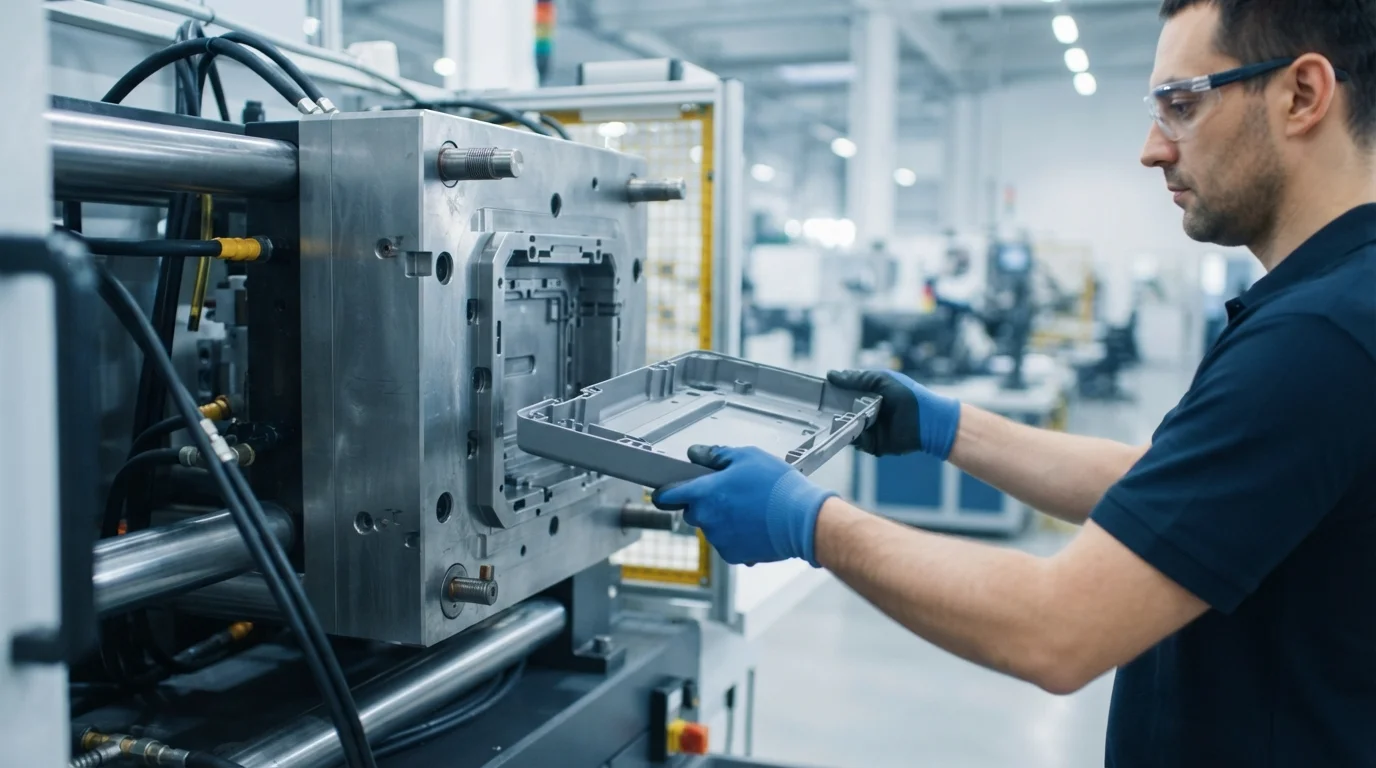
Understanding the sequential in-mold stages—from primary substrate molding to secondary elastomer injection—allows manufacturing engineers to establish stable process windows. Thermal management along the polymer boundary layer dictates whether the two materials form a permanent chemical bond or suffer from delamination under mechanical stress. This technical processing guide analyzes two-stage molding mechanics, interfacial bonding chemistry, and substrate remelting prevention.
جدول المحتويات
The Two In-Mold Stages: Substrate Molding & Elastomer Overmolding
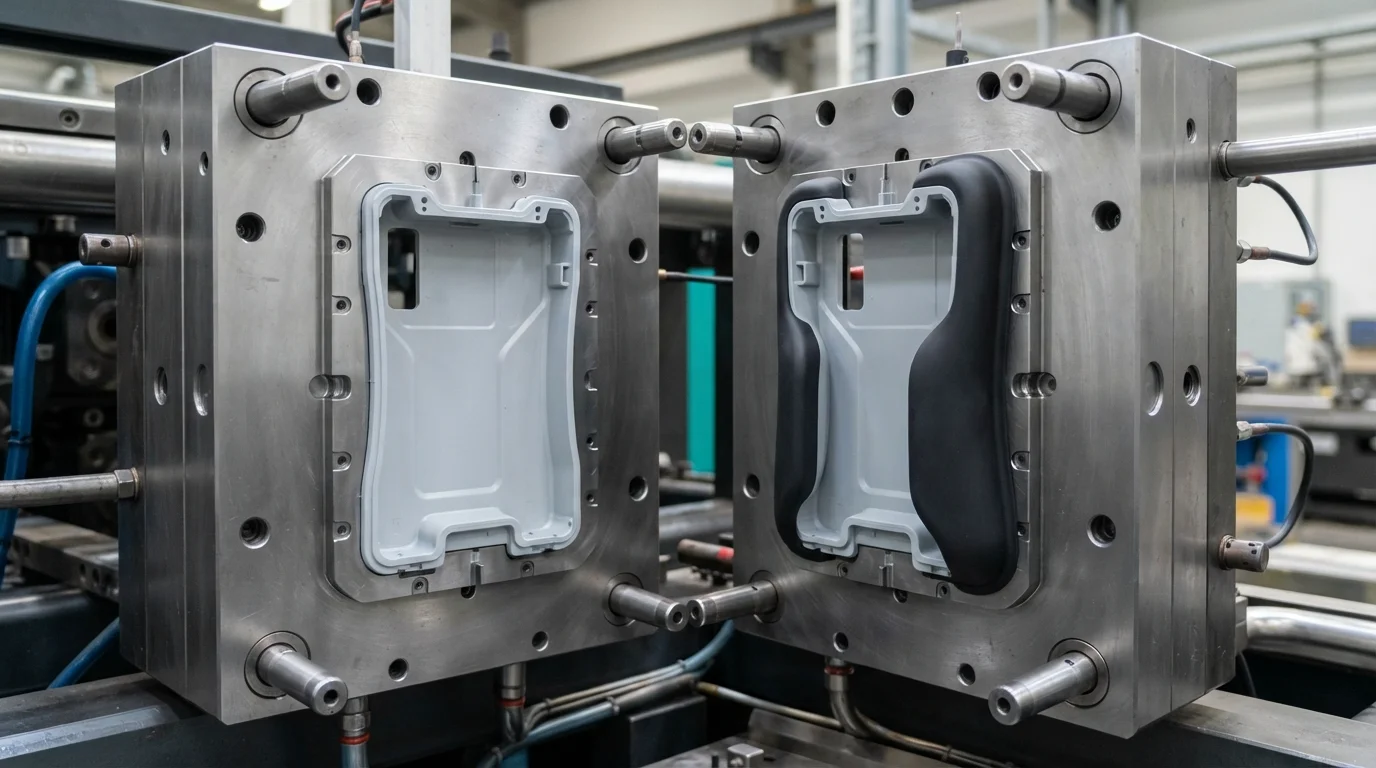
Executing a successful overmolding injection molding process involves dividing manufacturing into two distinct thermal and mechanical phases. Stage one focuses on substrate molding, injecting rigid engineering thermoplastics like بولي كربونات (PC), ABS, or PA66 into the primary cavity.
Once the rigid substrate solidifies sufficiently to retain structural shape, elastomer overmolding takes place in a secondary cavity. Transferring the substrate manually or using automated 6-axis robotic arms positions the rigid frame into the overmold cavity. Secondary injection then forces molten TPE, TPU, or TPV over the pre-molded frame, encapsulating designated contact areas.
Two-stage overmolding processing sequence includes:
- Substrate primary molding—Injecting rigid engineering resin establishes the structural frame and dimensional baseline.
- Substrate transfer and loading—Moving the warm plastic frame into the secondary cavity prepares the part for elastomer encapsulation.
- Elastomer secondary injection—Injecting soft TPE or TPU under controlled velocity fills designated seal or grip zones.
- Interfacial cooling and ejection—Cooling both material layers concurrently allows chemical chain entanglements to lock before mold opening.
Mechanical Interlocks vs. Chemical Interfacial Bonding
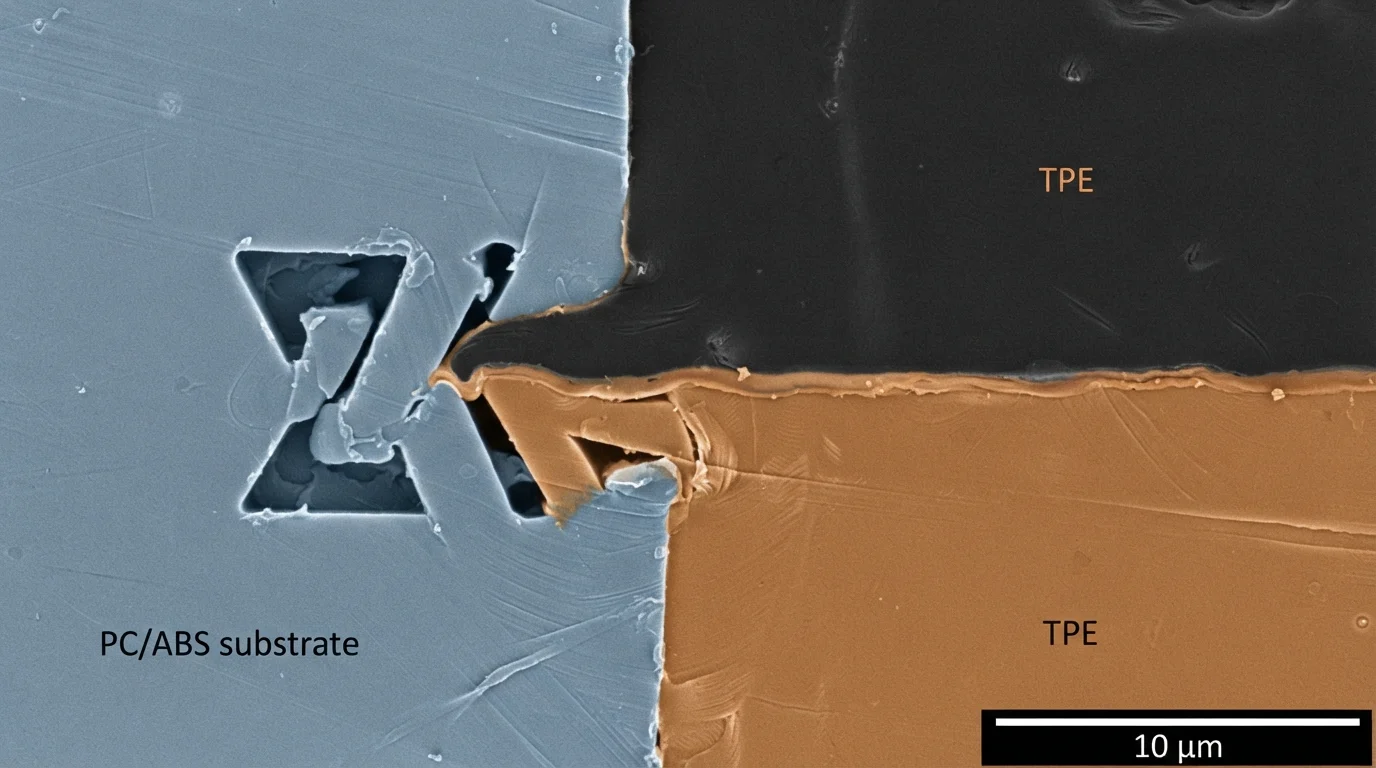
Achieving high peel strength depends on two distinct adhesion mechanisms: chemical interdiffusion and physical anchoring. Interfacial bonding occurs when hot second-shot resin melts a microscopic boundary layer of the rigid substrate, permitting polymer chains to interdiffuse.
Chemical compatibility between resin families dictates whether molecular interdiffusion can take place naturally. When chemical affinity is low, mold designers incorporate mechanical interlocks like dovetails, through-holes, or perimeter undercuts. Physical anchors lock the elastomeric layer onto the substrate mechanically, preventing edge peeling under dynamic shear.
| Adhesion Mechanism | Primary Physical Driver | Compatible Polymer Pairs | Engineering Tooling Requirement |
|---|---|---|---|
| Chemical Molecular Fusion | Chain interdiffusion across boundary skin | ABS + TPE / PC + TPU / PP + TPV | Preheat substrate cavity to 70-90°C |
| Mechanical Interlocking | Physical trapping inside dovetails/undercuts | PA66-GF + Standard TPE / POM + TPU | Machining 90-degree mechanical locking grooves |
Processing Controls to Prevent Substrate Remelting
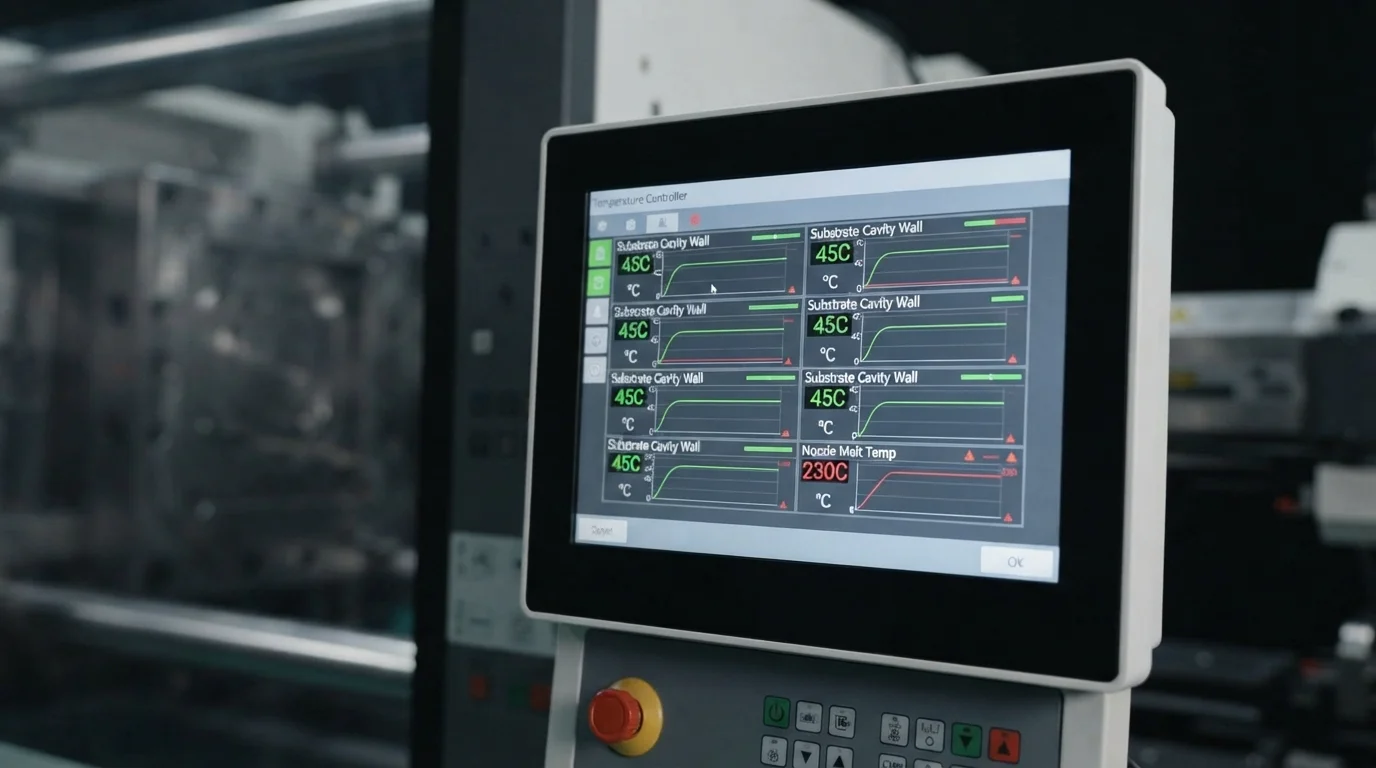
Preventing substrate deformation during secondary injection requires balancing melt temperatures and fill speeds. Excessive second-shot heat or high localized injection pressure can wash out thin substrate walls, causing cosmetic distortion.
Monitoring melt temperatures ensures that the overmold resin enters the cavity hot enough to promote adhesion without melting the structural frame. Mastered execution of the overmolding injection molding process ensures strong adhesion during custom overmolding injection molding.
Frequently Asked Questions (FAQs)
Why does substrate surface temperature affect overmolding bond strength?
Maintaining warm substrate cavity surfaces permits the second-shot elastomer melt to diffuse into the rigid polymer skin. Cold substrate surfaces quench the incoming overmold resin prematurely, preventing molecular chain entanglement and causing interfacial delamination.
What causes substrate remelting or wash-out during secondary injection?
Substrate remelting occurs when second-shot injection temperatures or localized melt velocities are excessively high. High shear friction washes away thin substrate wall sections, causing part deformation and color bleeding between layers.
How do mechanical interlocks improve overmolded gasket durability?
Mechanical interlocks like dovetails and perimeter grooves physically trap the elastomeric layer inside rigid substrate channels. Physical anchoring prevents the soft gasket from peeling or lifting under high-pressure fluid exposure or dynamic mechanical fatigue.