
Choosing plastic rivets vs screws is not just a fastener decision. It determines whether a molded housing can be reopened, what features must be designed into the part, how assembly access is arranged, and which failure mode needs inspection. A screw is usually the more serviceable option; a rivet is a better fit when a permanent, low-profile joint and one-sided access matter. The right choice still depends on load, resin, geometry, and the cost of a failed joint.
Use this guide to compare the two methods at the molded-part interface—not as universal strength rankings. For broader joining choices, see the site’s plastic part assembly processes.
In this article:
- What each fastener does to the molded part
- Service access changes the decision
- Design checks before the drawing is frozen
- How to validate the joint
- FAQ
What each fastener does to the molded part
A screw creates a clamped connection through a threaded engagement. In a plastic housing, that engagement may be formed by a thread-forming screw entering a molded pilot hole, a machine screw engaging a metal insert, or a screw passing through one component into a separate nut. Each option puts different demands on the boss, thread, and assembly torque. A screw connection can be opened for service, but repeated removal may wear the plastic thread or reduce clamp retention unless the joint was designed for reuse.
A rivet forms a mechanical lock by deforming or expanding a shank so that material captures the joined layers. It can be quick to install and can work where the reverse side is difficult to reach, depending on the rivet style and assembly setup. The trade-off is that disassembly is usually destructive or requires drilling/cutting, and the part must tolerate the setting force without cracking, crushing, or distorting.
Neither label guarantees a stronger joint. Compare the actual load direction, bearing area, edge distance, vibration, temperature, and resin behavior. A screw may loosen or strip; a rivet may pull through, shear, or damage a thin wall during setting. The governing failure mode matters more than a generic fastener ranking.
Service access changes the decision
If a technician or end user must replace a battery, board, filter, or other component, a screw often makes the service path clearer. The design must still account for access to the driver, screw retention, torque limits, and the number of expected opening cycles. If the enclosure uses a molded boss, avoid treating it as a solid column: excessive local thickness can create sink or warpage, while a weak root can crack under tightening. Ribs and gussets may help, but their placement should be checked against wall thickness and cosmetic requirements.
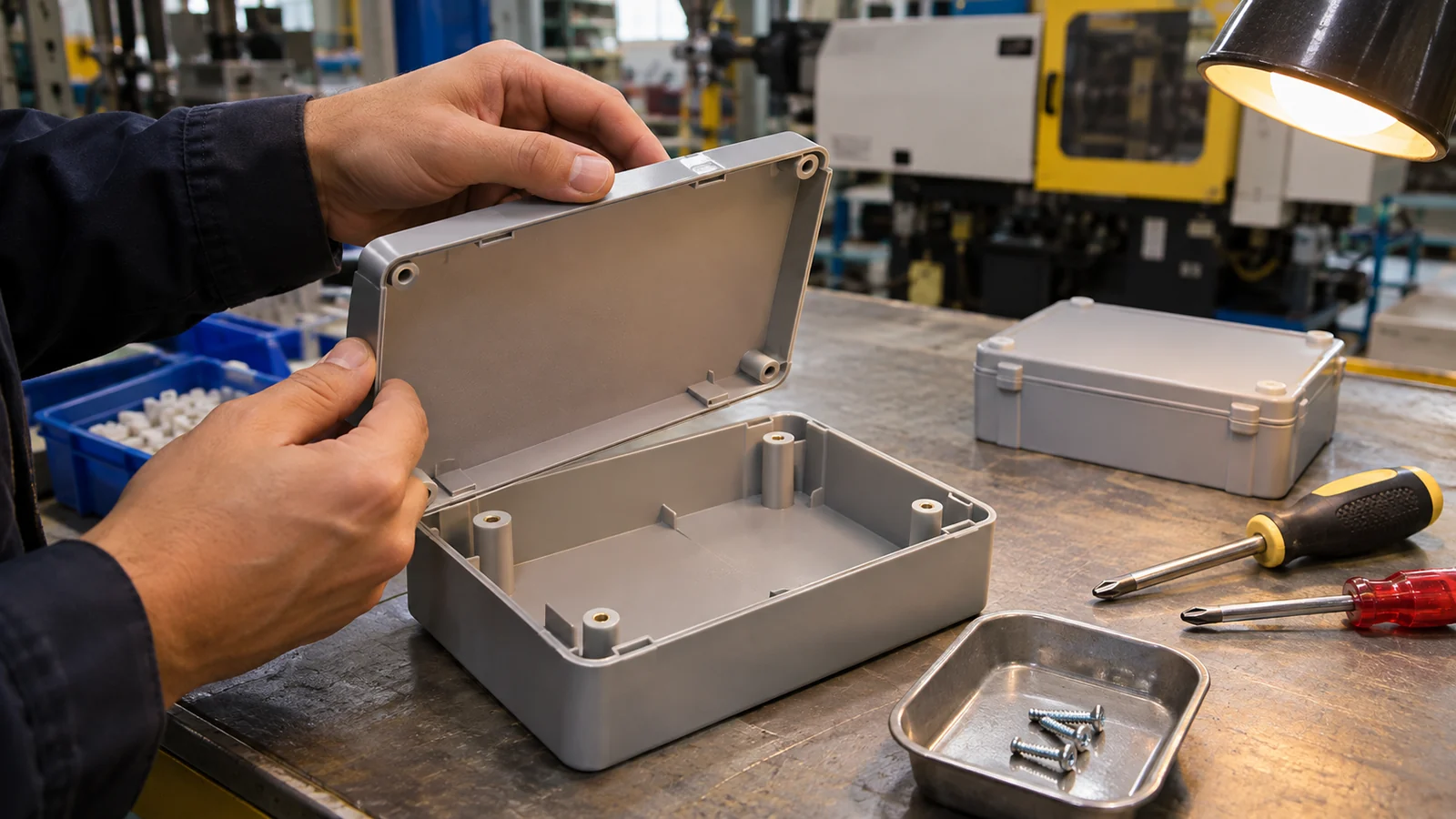 A rivet can make sense for a joint intended to stay closed during normal use, particularly when the assembly has limited access from one side or the fastener must sit close to the surface. Confirm that the mating stack is consistent and that the rivet head will not interfere with adjacent parts. For assemblies that may need repair, plan how a rivet will be removed and whether the surrounding molded feature can survive replacement.
When the parts themselves are molded with fastening features, compare assembly needs early with screw assembly and riveting options. These process pages describe the available route; the part drawing and qualification plan determine whether it fits a particular product.
Design checks before the drawing is frozen
- Define the joint job. State whether it carries pull, shear, clamp, vibration, sealing, or alignment loads, and identify which direction is critical.
- Check local geometry. Review boss wall, root radius, edge distance, hole size, nearby ribs, and the risk of sink on the opposite cosmetic surface.
- Confirm assembly access. A screw needs driver approach and a controlled tightening method; a rivet needs room for the setting tool and clearance for its formed head.
- Match the fastener to the resin and stack. Resin stiffness, creep, moisture, temperature, fillers, and part thickness can all change retention. Do not transfer a torque or pull-out limit from a different grade or geometry.
- Set service expectations. Document whether the joint is single-use, how many service cycles are expected, and whether replacement hardware is allowed.
These checks should be reflected in the 3D model, drawing notes, and assembly specification. If a metal insert is being considered instead of a direct screw thread, keep that as a separate design route: insert molding or post-mold insertion changes tooling and assembly requirements and should not be treated as a rivet substitute.
How to validate the joint
Build representative assemblies using production-intent resin, fasteners, and molded geometry. Record the assembly tool, torque or setting conditions, part lot, and any visible damage. Then test the property the product actually needs: pull-out, shear, clamp retention, vibration durability, repeated opening, or environmental exposure. A single peak-load result may not answer whether the joint remains serviceable or whether the plastic boss cracks after cycling.
Inspect failure surfaces as well as the measured value. A stripped boss, a fractured wall, a deformed rivet, and a loosened screw point to different design actions. If the failure occurs in the molded feature, changing only the assembly setting may shift damage elsewhere without resolving the geometry. Set acceptance limits before the trial so a borderline result is not judged by appearance alone.
For the drawing package, specify fastener type and size, hole or pilot geometry, accessible side, cosmetic limits, assembly conditions, and the required verification test. This makes supplier feedback more useful and prevents “secure” from meaning different things to design, production, and quality teams.
Frequently asked questions
Are rivets always cheaper than screws?
Not automatically. Fastener price is only one part of the comparison. Tooling for the molded feature, installation time, access, inspection, service, and replacement cost can change the total assembly cost.
Can a plastic housing be reopened after riveting?
Usually the rivet must be removed destructively, and the joint may need new hardware for reassembly. If routine access is required, evaluate a screw or another serviceable design before freezing the enclosure.
What should be tested on a screw boss?
Test the relevant retention or clamp function under the expected assembly and service conditions. Depending on the application, this may include installation torque, strip-out, pull-out, vibration, temperature exposure, or repeated opening. Use the actual resin grade and molded geometry.