
Automotive battery pack designers require structural framing materials that balance mechanical toughness with electrical isolation in compact spaces.
Designing precision structural carriers such as injection molded Lexan 940A battery frames requires a detailed understanding of amorphous polymer rheology and tool steel chemistry.
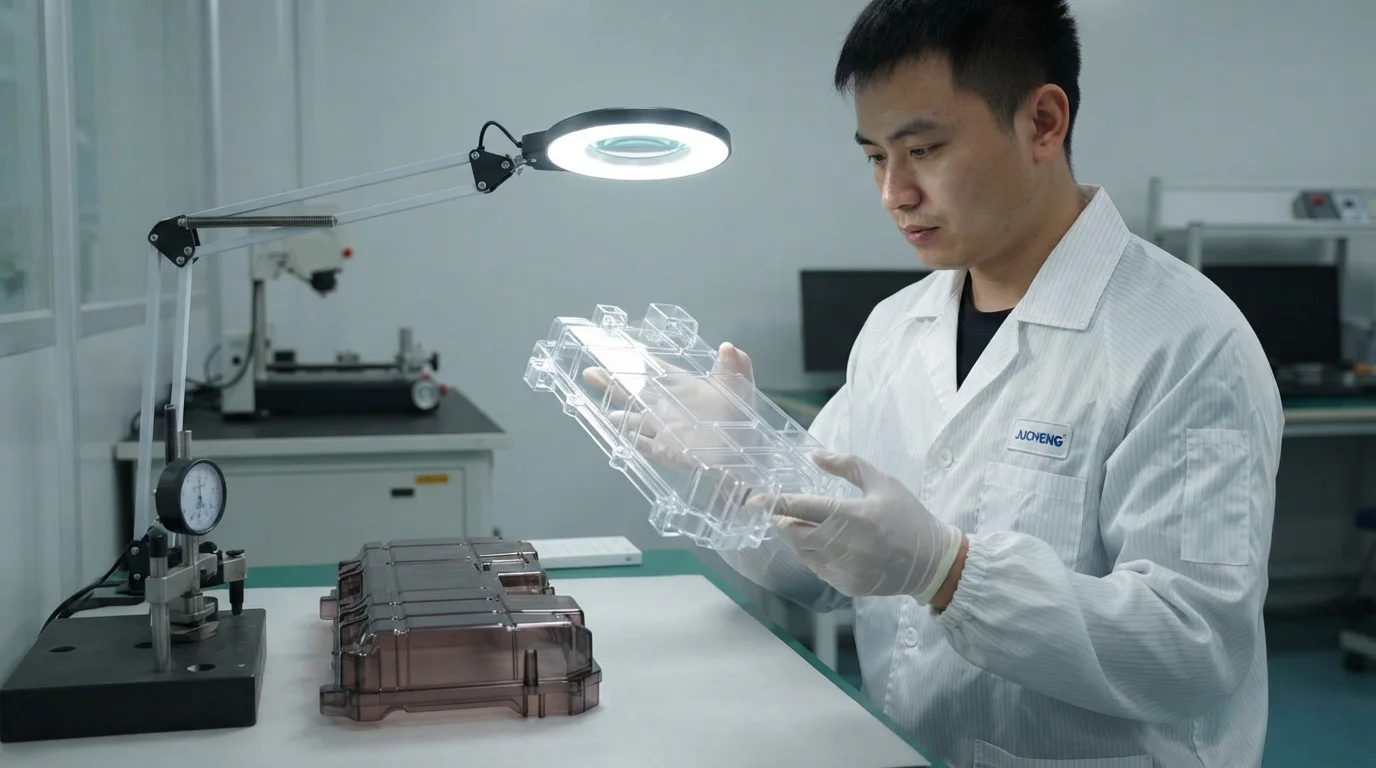
Prismatic cell modules must be packed close to each other to optimize energy density, making dielectric insulation and safety compliance critical concerns under extreme vehicular vibration.
Selecting amorphous polycarbonate instead of semi-crystalline polymers ensures zero localized crystallization warpage, resulting in extremely flat components.
This technical datasheet reviews processing conditions, tooling parameters, and material specifications necessary to manufacture high-yield structural frames.
Table of Contents
Benefits of SABIC Lexan 940A for Prismatic Battery Cradles
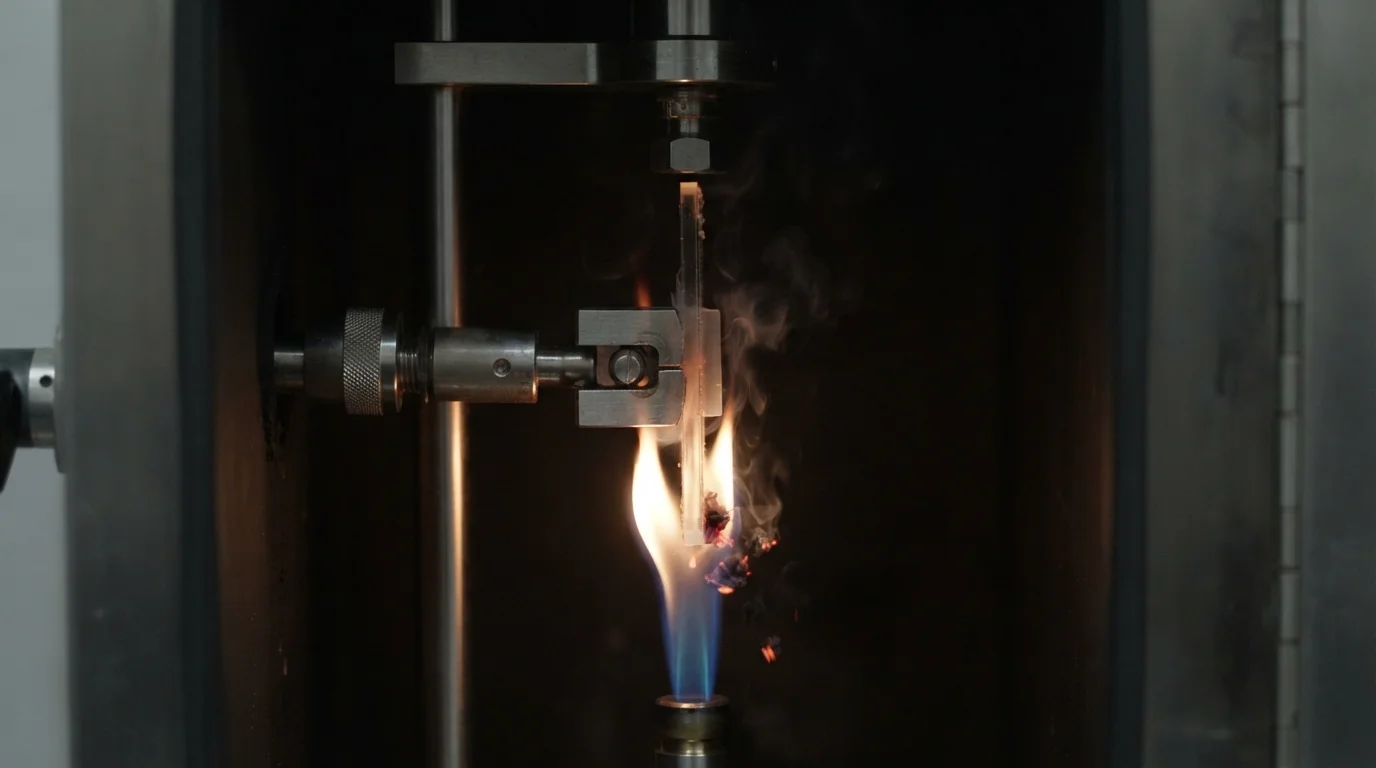
Selecting SABIC polycarbonate allows design engineers to optimize thin-wall designs without compromising on physical safety.
Specifically, specifying injection molded Lexan 940A battery frames guarantees high-voltage isolation while maintaining structural integrity.
Unfilled amorphous polycarbonate provides consistent processing and predictable isotropic shrinkage, unlike semi-crystalline alternatives.
Shrinkage rates of 0.5% to 0.7% allow tooling engineers to cut mold cavities with extreme dimensional accuracy, preventing assembly alignment stack-up issues.
Ensuring that injection molded Lexan 940A battery frames remain physically rigid under cyclic thermal loads prevents battery cells from shifting during operation.
Lithium-ion prismatic cells expand and contract during rapid charging cycles, putting a continuous mechanical load on the structural frames.
Using Lexan 940A, which possesses a heat deflection temperature (HDT) of 132°C under a 1.82 MPa load, prevents the carrier ribs from collapsing under these thermal stresses.
Furthermore, this polymer retains its structural properties across a wide temperature spectrum, ensuring mechanical integrity in both arctic and tropical environments.
Key advantages of using this premium polycarbonate grade include:
- Flame retardancy—Unfilled PC formulation achieves a UL94 V-0 safety rating at thin-wall dimensions down to 0.8mm, containing potential thermal events.
- Dimensional stability—Isotropic shrinkage rates of 0.5% to 0.7% limit structural warpage in complex, interlocking thin-wall geometries.
- Dielectric insulation—High volume resistivity protects internal cell terminals from high-voltage electrical arcing inside the module.
- Impact resistance—Inherent polycarbonate toughness prevents frame cracking during high-velocity vehicular crash tests, protecting the battery cells.
- Thermal endurance—Withstanding continuous operating temperatures up to 115°C prevents physical deformation during rapid charging cycles.
These mechanical strengths make Lexan 940A a preferred choice for compact prismatic cell carriers.
Rigid polymer frames prevent localized cell expansion, maintaining uniform pack compression which is vital to extend the battery lifespan.
Implementing this material ensures compliance with demanding automotive flammability and impact safety protocols.
Specialized Tooling Requirements for Lexan 940A
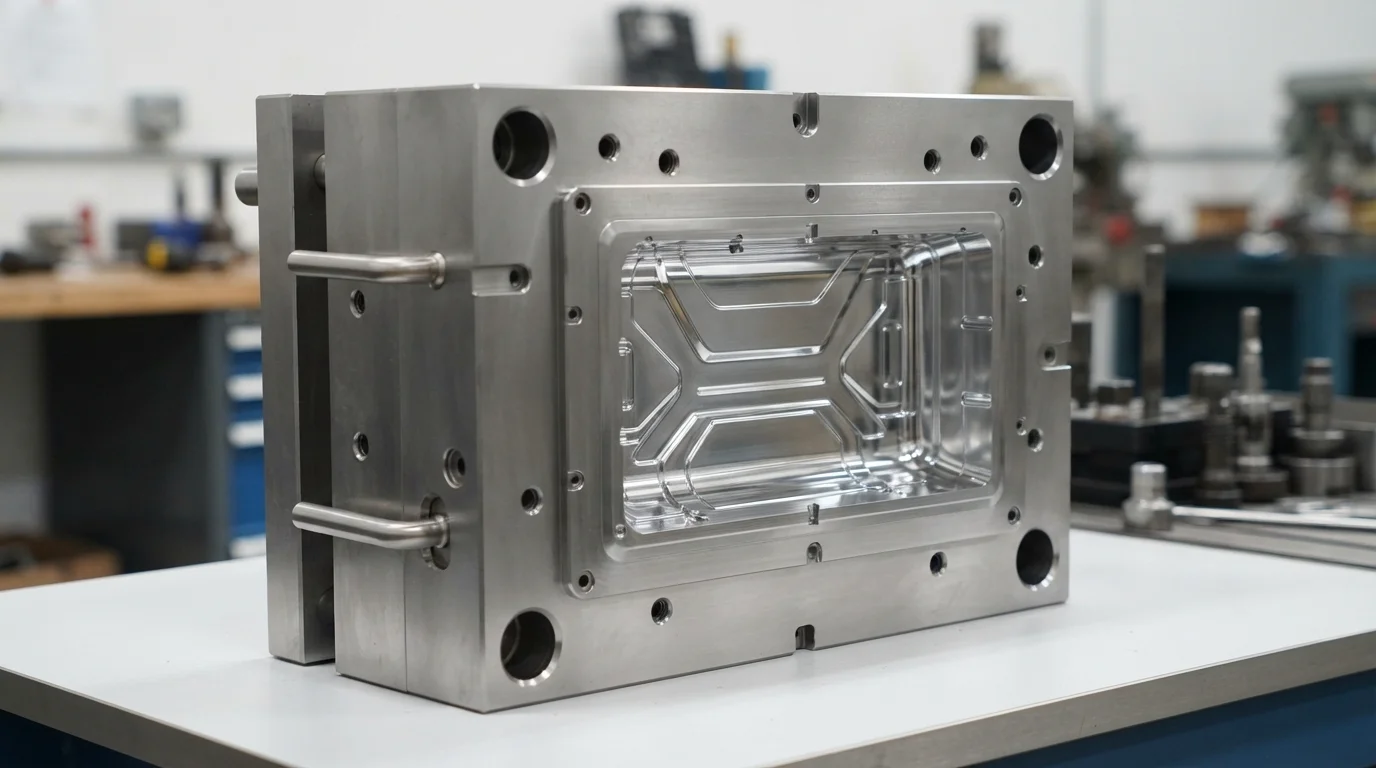
Processing the medium-viscosity resin needed for injection molded Lexan 940A battery frames presents unique tool design challenges.
Flame-retardant additives in Lexan 940A can release trace acidic byproducts if the polymer is overheated or subjected to excessive shear.
These acidic gases corrode standard mold steels like P20, causing surface pitting, loss of dimensional accuracy, and degradation of the aesthetic surface finish.
To combat corrosive degradation, tooling designers specify high-chrome stainless steels like mirror-polished S136, which contains approximately 13% chromium.
Hardening this tool steel to HRC 48-52 protects the mold face from long-term wear and chemical erosion.
Furthermore, maintaining mold temperatures between 70°C and 95°C is critical to minimize molded-in residual stresses.
Lower mold temperatures trigger rapid solidification, trapping mechanical stresses that cause premature cracking in the finished parts.
Optimizing gate configuration also plays a major role; narrow gates subject the melt to high shear, degrading the organic flame retardants and creating weak spots.
Molding parameters must be precisely controlled on modern closed-loop injection presses.
Because Lexan 940A is amorphous, it has no sharp melting point but softens gradually over a broad temperature range.
Our tooling guidelines incorporate these critical processing settings:
- Melt temperature regulation—Maintaining melt temperatures between 295°C and 315°C prevents physical degradation of the amorphous structure.
- Mold heat balancing—Configuring water heating channels to hold mold temperatures at 70°C to 95°C reduces molded-in stress.
- Corrosion-resistant steel cavity—Using mirror-polished S136 stainless steel protects the mold face from corrosive acidic outgassing.
- Vent depth control—Integrating venting slots measuring 0.025mm to 0.038mm prevents localized burning or diesel effects without causing flash.
- Balanced hot runner system—Employing valve-gated hot runners minimizes shear heating at the gate, maintaining uniform molecular weight distribution.
Our engineering quality database ensures that every batch of injection molded Lexan 940A battery frames aligns with the mechanical requirements of larger custom plastic battery housings for EV.
By combining precision tooling with IATF 16949-certified quality systems, JUCHENG offers reliable manufacturing solutions.
Our team provides comprehensive DfM reviews within 24 hours to optimize your structural component designs.
Frequently Asked Questions (FAQ)
Why is drying Lexan 940A resin critical before injection molding?
Polycarbonate is highly sensitive to hydrolytic degradation at elevated processing temperatures.
Moisture levels exceeding 0.02% trigger a chemical reaction known as hydrolysis, which breaks the polymer chains and reduces molecular weight.
This degradation severely diminishes mechanical properties, making the molded parts brittle and prone to structural failure under impact.
Drying the pellets at 120°C for 3 to 4 hours in a desiccant dryer is mandatory to prevent hydrolysis.
Using a standard hot-air hopper dryer is insufficient because it merely circulates humid air instead of drawing water out of the molecular structure.
We enforce strict moisture testing before every production run to ensure compliance.
How do you eliminate molded-in stresses in thin-walled battery frames?
Using high mold temperatures of 70°C to 95°C is the most effective way to minimize residual stress during the molding cycle.
Slowing the cooling rate of the amorphous melt allows the polymer chains to relax, preventing the formation of high-stress zones near the gates.
Additionally, reducing injection speed near the gate regions lowers local shear stresses, preventing gate blush and mechanical weak spots.
Annealing molded parts in a specialized oven is another proven option for extreme designs.
By heating the parts to approximately 120°C (just below the heat deflection temperature) for several hours, we relieve localized stresses.
This step prevents spontaneous stress cracking when the frames are exposed to environmental vibration or electrolyte chemicals over long service lives.
What is the typical mold shrinkage behavior for Lexan 940A?
Shrinkage rates for this grade remain highly isotropic, typically ranging from 0.5% to 0.7% for a 3.2mm wall thickness.
Isotropic shrinkage means the material contracts evenly along and across the polymer flow path, simplifying warpage control compared to semi-crystalline or fiber-filled polymers.
This uniform shrinkage allows tooling engineers to predict final part dimensions with extreme accuracy, preventing alignment issues during automated pack assembly.
However, thin-walled sections (such as 1.0mm ribs) will exhibit slightly lower shrinkage because of rapid solidification under high injection pressures.
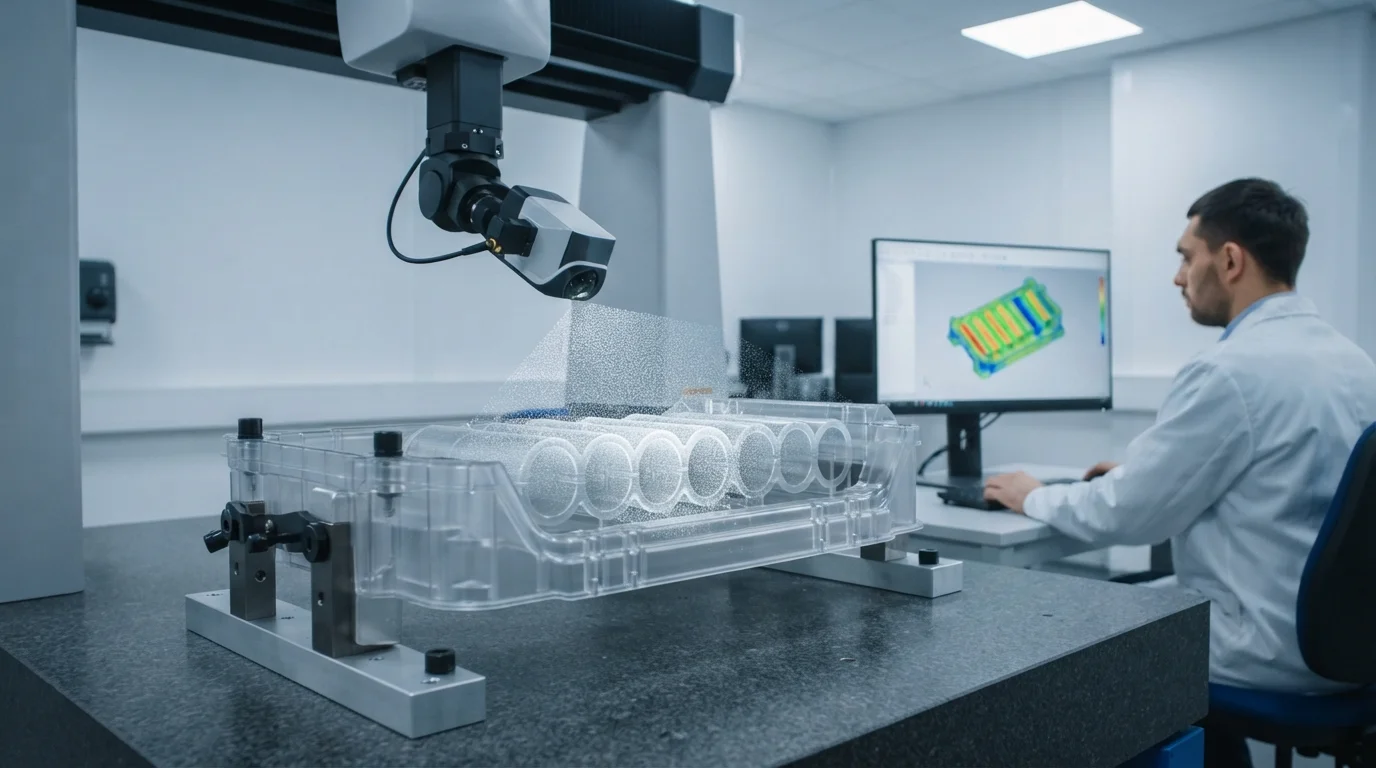
We utilize advanced mold flow simulations to map localized shrinkage deviations across the part.
This simulation data allows us to cut the steel tooling with precise offsets, ensuring that every cell pocket conforms to strict tolerance specifications.