
PEI-SABIC Ultem 9085
Meeting the uncompromising FAA FAR 25.853 aircraft cabin interior standards for low smoke density, low toxicity, and strict OSU 65/65 heat release limits requires an elite material, which SABIC’s Ultem 9085 delivers through its unreinforced, high-impact modified amorphous polyetherimide (PEI) blend matrix. Featuring a density of 1.34 g/cm³ and a glass transition temperature (Tg) of 186°C, this aerospace-certified polymer provides outstanding impact ductility alongside inherent self-extinguishing safety. Jucheng Precision, under IATF 16949 and ISO 9001 frameworks, specializes in custom injection molding of Ultem 9085. Supported by our 5-axis CNC-machined S136 stainless steel tooling and pressurized oil mold heating controllers, we control thermal stress and ensure uniform physical properties, delivering critical cabin components verified by Zeiss CMM.
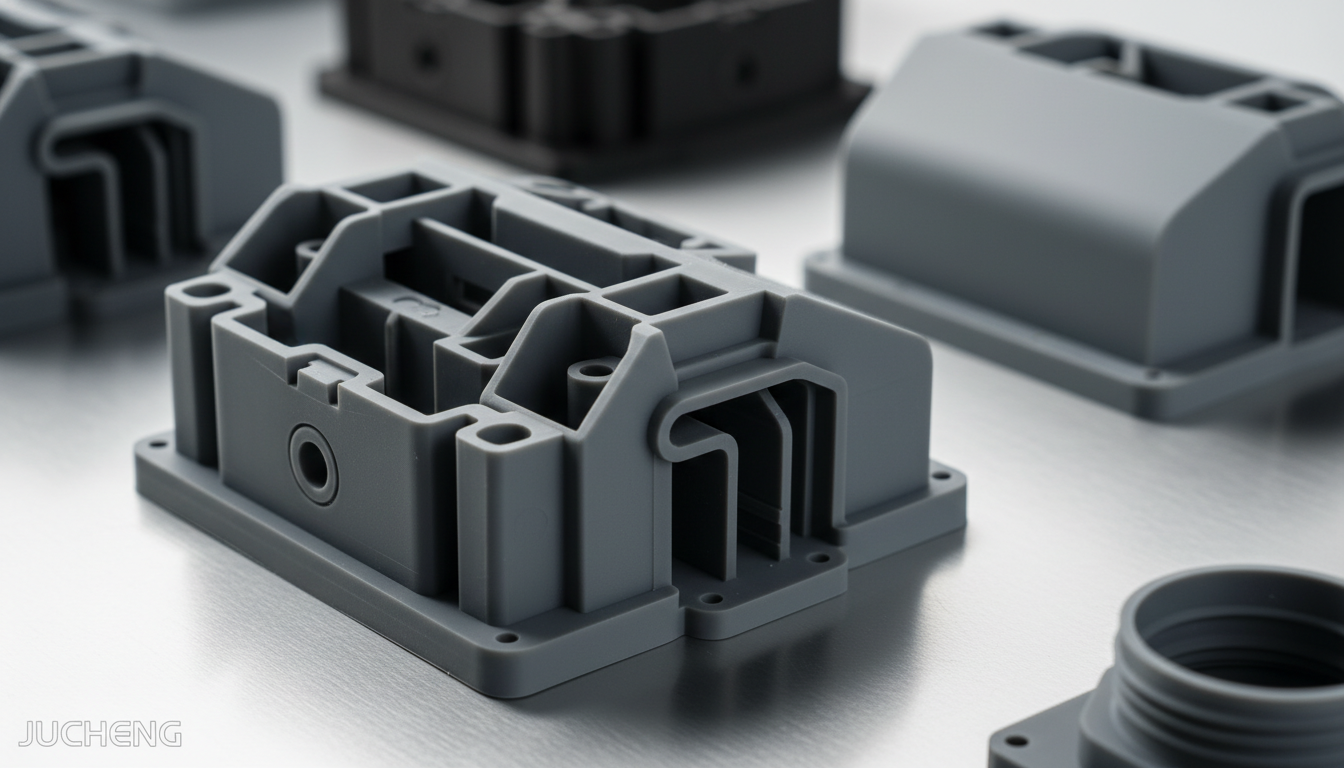
Ultem 9085 Flame-Smoke-Toxicity (FST) & Structural Profile
SABIC™ ULTEM™ Resin 9085 is an unreinforced amorphous Polyetherimide (PEI) blend, certified to deliver outstanding impact strength, low smoke density, and minimal toxic gas emission under international aviation standards:
| Aviation Safety Metric | Ultem 9085 Rating/Value | Cabin Engineering Compliance |
|---|---|---|
| FAA FAR Flammability | FAR 25.853 Compliance (60-sec vertical burn) | Meets strict commercial cabin requirements, ensuring self-extinguishing behavior and preventing fire propagation inside aircraft. |
| OSU Heat Release | OSU 65 / 65 (Peak/Total Heat Release) | Limits total heat release under 65 kW/m² during combustion, highly certified for passenger cabin walls and ceilings. |
| Impact Ductility | Tensile Elongation at Break ~50% to 100% | Copolymer alloy modification provides exceptional yield toughness, preventing brittle part shattering under sudden physical impact. |
High-Compliance Process Adaptability for Ultem 9085
With its high-impact modification and amorphous stability, SABIC Ultem 9085 processes consistently inside complex mold geometries:
| Aesthetic & Structural Process | Process Compatibility & Operational Details |
|---|---|
| Aircraft Cabin Interior Trims | Excellent. Configured with hot-runner gating to mold lightweight window frames, service trays, passenger storage latches, and interior covers. |
| Environmental Control Systems | Excellent. Outstanding dimensional stability, low toxicity outgassing, and excellent flow-thickness ratio prevent structural warping inside aircraft air-ducting manifolds. |
| Rail & Transport Enclosures | Good. Highly certified under EN 45545-2 railway fire safety requirements. Used for heavy-duty commercial bus and high-speed rail brackets. |
PEI-SABIC Ultem 9085 Tooling & Thermal Stress Management Blueprint
Molding an amorphous high-performance blend like Ultem 9085 requires strict thermal boundaries and low-stress mold setups to prevent stress-cracking:
Amorphous Isotropic Shrinkage Control
Being an amorphous copolymer blend, Ultem 9085 exhibits low and highly uniform shrinkage (0.50% to 0.70%). We use our 5-axis CNC machines to cut precise mold cavities and balance cooling paths, ensuring zero warping and zero dimension defects on Zeiss CMM verification.
High Melt Temperature Profiling
Melting requires specialized machines with ceramic heater bands. Processing barrel temperatures are strictly managed between 340°C and 380°C (644°F to 716°F) to ensure homogeneous flow. Exceeding 390°C can result in chemical chain fracturing and polymer degradation.
Pressurized Oil Mold Temperature Control
Pressurized oil heaters are utilized to maintain mold temperatures at 140°C–180°C (284°F to 356°F). Maintaining high mold temperatures is critical to minimize molded-in stress, optimize surface gloss, and completely prevent weld-line stress cracking near intricate snap-fits.
Desiccant Pre-Drying Protocol
PEI is highly hygroscopic. Moisture causes cosmetic splay, bubbles, and loss of transparent optical quality. We dry raw material in desiccant hopper dryers at 150°C (302°F) for 4 hours to keep moisture levels below 0.02% before molding, protecting dynamic mechanical tensile bonds.
Key Application Fields for PEI-SABIC Ultem 9085
- Aviation Cabin Interiors & Systems: High-safety passenger service trays, window trim bezels, personal oxygen covers, commercial ventilation duct fittings, and aerospace wire brackets.
- Rail & Public Transit Infrastructure: Railway passenger cabin wall paneling, ceiling panels, interior seat trim brackets, high-voltage electrical terminal connectors, and heavy-duty switches.
- EV Batteries & Electronics: EV lithium-ion battery brackets, cell holders, electrical fuse box covers, high-voltage busbar isolators, and heavy-duty coil bobbins.
Properties
| Density | 1.34 g/cm³ |
| Melt Volume-Flow Rate (MVR) (337°C/6.6kg) | 12 cm³/10min |
| Tensile Modulus | 2,900 MPa |
| Tensile Stress at Yield | 73 MPa |
| Tensile Elongation at Yield | 7 % |
| Tensile Elongation at Break | 70 % |
| Flexural Modulus | 2,600 MPa |
| Flexural Strength | 115 MPa |
| Notched Izod Impact Strength (23°C) | 110 J/m |
| Glass Transition Temperature (Tg) | 186 °C |
| Vicat Softening Point | 168 °C |
| Heat Deflection Temperature (HDT @ 1.80 MPa) | 153 °C |
| Linear Mold Shrinkage | 0.50 - 0.70 % |
| Flammability Rating (1.5mm) | UL 94 V-0 / 5VB Class |
| OSU Peak Heat Release Rate (5 min) | <65 kV/mm |
| Maximum Part Size | 800 x 600 mm |
| Minimum Part Size | 1 x 1 mm |