
PEI-SABIC Ultem 2300
To satisfy extreme mechanical loading, dimensional stability, and continuous fire safety in advanced aerospace and electrical infrastructures, SABIC’s Ultem 2300 leverages a 30% glass fiber reinforced, amorphous polyetherimide (PEI) matrix. Featuring an elevated density of 1.51 g/cm³ and a glass transition temperature (Tg) of 217°C, this high-stiffness grade provides an exceptional tensile modulus of 9,500 MPa and inherent UL 94 V-0 flammability rating at 0.25mm. Jucheng Precision, operating under ISO 9001 and IATF 16949 frameworks, specializes in molding Ultem 2300. Utilizing 5-axis CNC-machined H13 toolings, we control its low, isotropic shrink variables (0.2%-0.4%) to eliminate warpage, verified by Zeiss CMM.
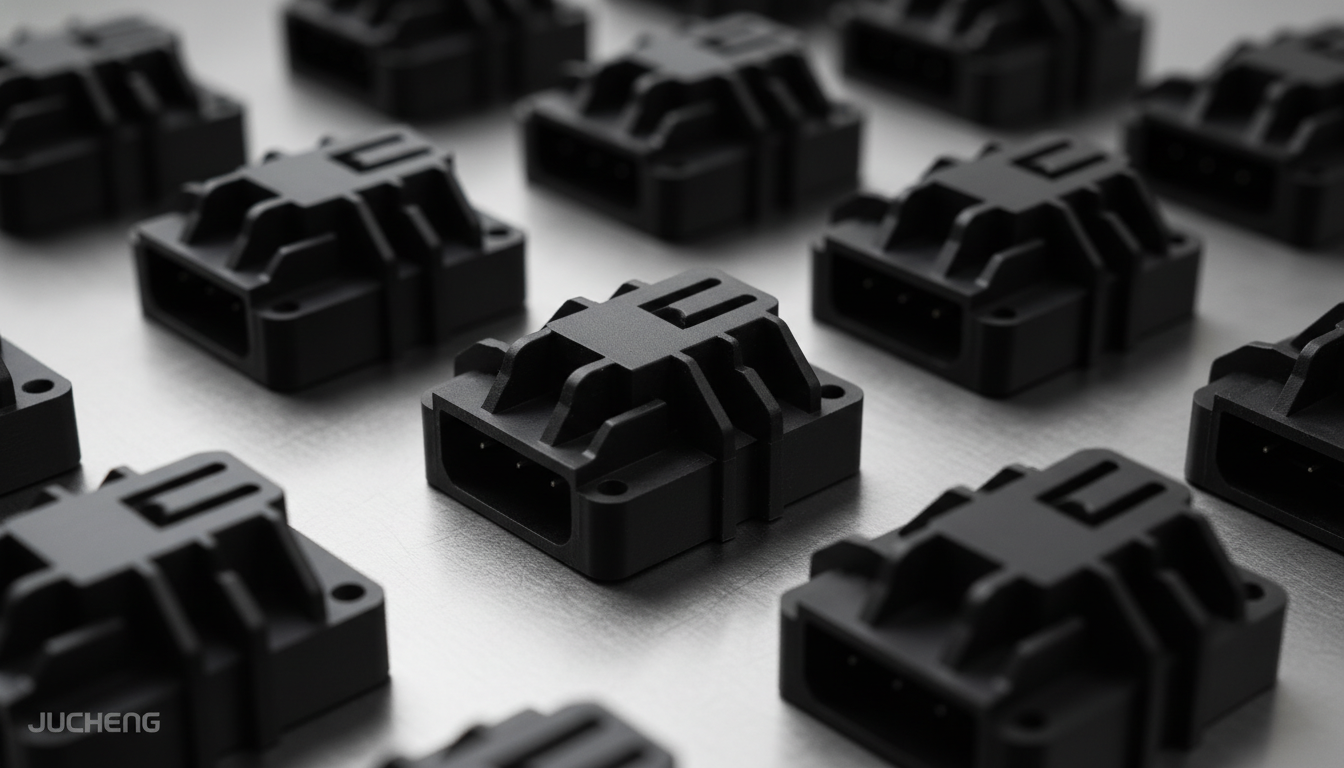
SABIC Ultem 2300 Glass-Filled Modulus & Flammability Profile
SABIC™ ULTEM™ Resin 2300 is a 30% glass fiber reinforced amorphous Polyetherimide (PEI) resin, certified to deliver outstanding stiffness, non-halogenated flame retardancy, and low outgassing under ISO/ASTM standards:
| Performance Metric | SABIC Ultem 2300 Typical Value | Molding & Assembly Advantage |
|---|---|---|
| Structural Rigidity | Tensile Modulus 9,500 MPa / Strength 165 MPa | Provides metal-matching modulus and creep resistance, preventing structural sagging under high continuous dynamic stress load. |
| Flame Retardancy | UL 94 V-0 (at 0.25 mm) / 5VA (at 1.24 mm) | Inherently flame retardant without modifiers, complying with FAR 25.853 low smoke toxicity for high-safety aerospace interiors. |
| Thermal Softening | Heat Deflection Temp (HDT) 210 °C (@ 1.82 MPa) | Retains mechanical properties and shape under continuous thermal load in high-heat industrial and under-the-hood systems. |
Structural Component Process Configurations for Reinforced Ultem 2300
With its high rigidity and standard melt flow index, Ultem 2300 processes consistently inside precise tooling cavities:
| Dynamic Molding Process | Process Adaptability & Operational Details |
|---|---|
| Aerospace Structural Mounts | Excellent. The primary process for Ultem 2300. Engineered for high-stiffness aircraft brackets, structural engine mounts, and cable harness clamps. |
| High-Voltage Electrical Isolation | Excellent. Outstanding dimensional stability, low outgassing, and high dielectric strength help in challenging high-voltage electrical connector applications. |
| Subsea & Water Management | Good. Highly compliant with potable water WRAS and NSF certifications. Used for heavy-duty water valves and chemical manifold housings. |
PEI-SABIC Ultem 2300 Tooling & Glass Fiber Processing Guide
Molding a 30% glass-filled semi-crystalline/amorphous composite like Ultem 2300 requires strict moisture control and optimized gating to prevent abrasive tool wear and warpage:
Hardened S136 Tooling (Abrasive Wear Prevention)
30% short glass fibers act as an abrasive medium under high injection speeds. Jucheng’s tooling division prevents cavity erosion by constructing molds with premium S136 stainless tool steel hardened to 48–52 HRC and machined on our 5-axis CNCs, ensuring long-term parting line precision and flash-free parts.
Isotropic Low Shrinkage (Warpage Control)
Being an amorphous resin with glass fiber reinforcement, Ultem 2300 exhibits extremely low and uniform shrinkage (0.20% to 0.40%). We utilize 5-axis CNC machines to cut precise mold cavities and balance cooling paths, preventing uneven thermal contraction and structural warping.
Pressurized Oil Mold Temperature Matrix
To prevent surface glass-fibers from floating and reduce internal stresses, mold temperatures must be maintained continuously at 140°C–180°C (284°F to 356°F) using pressurized oil-heating controllers. Slower, uniform packing pressure is applied to ensure full material compaction.
Extended Desiccant Pre-Drying Protocol
PEI is highly hygroscopic. Moisture causes hydrolytic splay, voids, and weld line degradation. We desiccant-dry Ultem 2300 resin at 150°C (302°F) for 4 hours, keeping internal moisture below 0.02% to secure optimal molecular bonds and prevent hydrolytic chain cleavage.
Key Application Fields for PEI-SABIC Ultem 2300
- Aerospace Structural Fittings & Cabin: High-stiffness aircraft bracket mounts, wing structural plates, commercial cabin trays, environmental control system (ECS) ducting, and wire harness clamps.
- Electrical Components & Smart Grids: High-temperature burn-in test sockets, terminal blocks, electrical switches, heavy-duty coil bobbins, smart power meters, and printed circuit board (PCB) fittings.
- Plumbing & Water Management: High-pressure subsea connector covers, potable water mixing valves, chemical spray nozzles, gas flow meters, and hot-water couplers.
Properties
| Density | 1.51 g/cm³ |
| Melt Mass-Flow Rate (MFR) (337°C/6.6kg) | 5.0 g/10 min |
| Tensile Modulus | 9,500 MPa |
| Tensile Stress at Yield | 168 MPa |
| Tensile Stress at Break | 165 MPa |
| Tensile Elongation at Break | 2.0 - 3.0 % |
| Flexural Strength | 225 MPa |
| Flexural Modulus | 8,500 MPa |
| Izod Notched Impact Strength (23°C) | 10 kJ/m² |
| Glass Transition Temperature (Tg) | 217 °C |
| Vicat Softening Point (B/50) | 213 °C |
| Heat Deflection Temperature (HDT @ 1.82 MPa) | 210 °C |
| Linear Mold Shrinkage | 0.20 - 0.40 % |
| Flammability Rating (0.25mm) | UL 94 V-0 Class |
| Flammability Rating (1.24mm) | UL 94 5VA Class |
| Maximum Part Size | 800 x 600 mm |
| Minimum Part Size | 1 x 1 mm |