
PEI-SABIC Ultem 1000
Achieving outstanding dielectric integrity and high-heat dimensional stability in microelectronics without using corrosive halogens requires a specialized amorphous polymer, which SABIC’s Ultem 1000 delivers through its unreinforced, high-viscosity polyetherimide (PEI) matrix. Boasting a density of 1.27 g/cm³ and an inherent UL 94 V-0 flammability rating down to 0.4mm, this transparent amber resin is the global standard for high-temperature test sockets, telecom enclosures, and medical manifolds. Jucheng Precision, under ISO 9001 and IATF 16949 frameworks, specializes in molding Ultem 1000. Operating 35+ advanced presses equipped with ceramic heater bands and oil temperature controllers, we eliminate internal thermal stresses, delivering flawless optical components verified by Zeiss CMM.
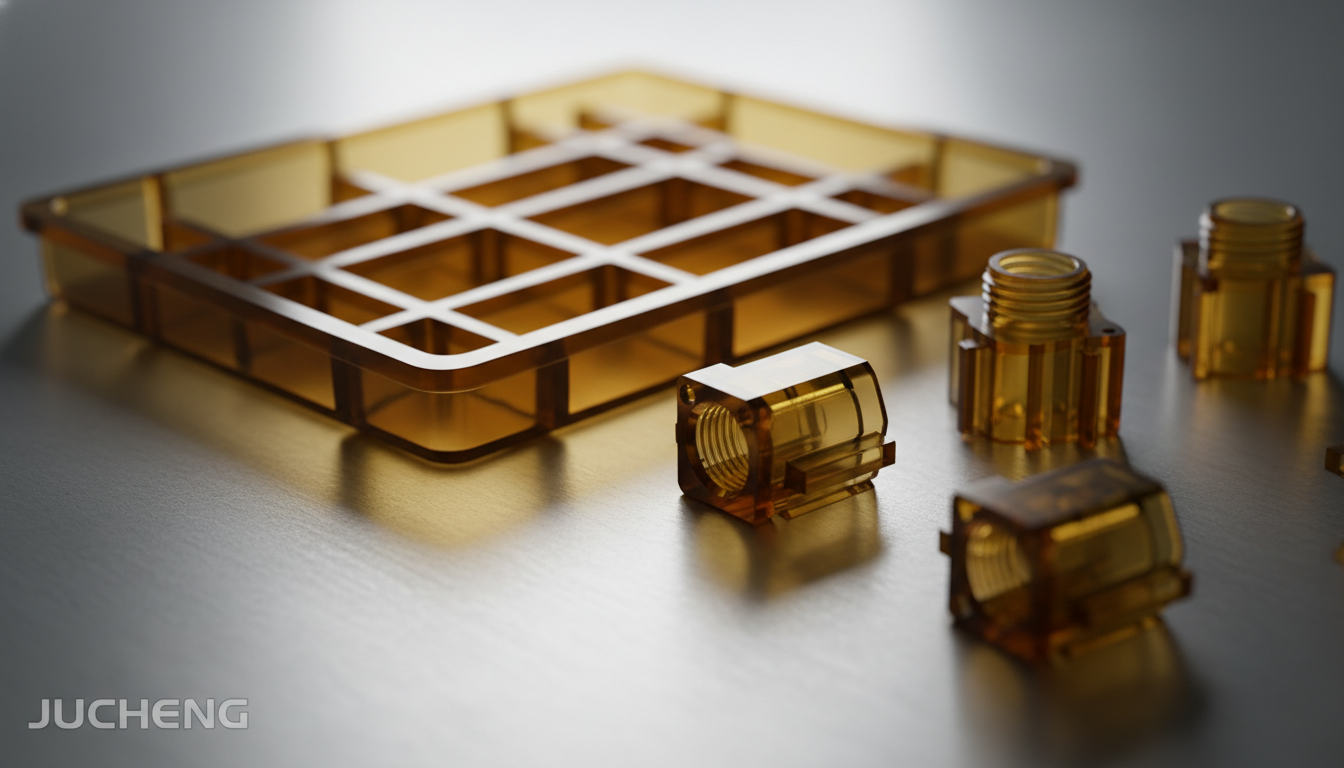
SABIC Ultem 1000 Amorphous Properties & Safety Compliance Profile
SABIC™ Ultem™ 1000 is an unreinforced, standard-flow amorphous Polyetherimide (PEI) resin, certified to deliver outstanding strength, stiffness, and continuous thermal resistance under ISO/ASTM standards:
| Performance Metric | SABIC Ultem 1000 Value | Engineering Advantage |
|---|---|---|
| Inherent Flame Retardancy | UL 94 V-0 (at 0.40 mm) / 5VA (at 1.90 mm) | Self-extinguishes extremely fast without halogenated additives, ensuring low smoke toxicity and excellent safety in microelectronics. |
| Structural Modulus | Tensile Modulus 3200 MPa / Strength 105 MPa | Delivers metal-like stiffness and unyielding tensile strength at elevated operating temperatures up to continuous 170°C. |
| Hydrolytic & Acid Stability | Continuous Autoclave Resistance | Highly resistant to continuous steam hot-water sterilization and acids, preventing part degradation in medical surgical bobbins. |
High-Heat Process Configurations for Unreinforced Ultem 1000
With intermediate melt viscosity and amorphous stability, SABIC Ultem 1000 processes consistently inside high-heat systems:
| Dynamic Molding Process | Process Adaptability & Operational Details |
|---|---|
| High-Voltage Electrical Isolation | Excellent. Highly optimized for high-temperature burn-in test sockets, terminal blocks, electrical relay housings, switch components, and coil bobbins. |
| Microwave & Food Service Components | Excellent. Naturally amber and transparent, FDA compliant, and microwave heating transparent. Used for heavy-duty food steam pans and adapters. |
| Autoclavable Medical Devices | Good (via HU1000 biocompatible grade). Ideal for surgical tools, medical bobbins, cardiovascular connectors, and sterilizing trays. |
PEI-SABIC Ultem 1000 Processing Matrix & Melt Control Checklist
Molding an amorphous high-viscosity resin like Ultem 1000 requires strict thermal boundaries and low-stress mold setups to prevent stress-cracking:
Amorphous Isotropic Shrinkage Control
Being an amorphous material, Ultem 1000 exhibits low and highly uniform shrinkage (0.50% to 0.70%). We use our 5-axis CNC machines to cut precise mold cavities and balance cooling paths, ensuring zero warping and zero dimension defects on Zeiss CMM verification.
High Melt Temperature Profiling
Melting requires specialized machines with ceramic heater bands. Processing barrel temperatures are strictly managed between 340°C and 400°C (644°F to 752°F) to ensure homogeneous flow. Exceeding 400°C can result in chemical chain fracturing and polymer degradation.
High Mold Temperature Control
Pressurized oil heaters are utilized to maintain mold temperatures at 140°C–180°C (284°F to 356°F). Maintaining high mold temperatures is critical to minimize molded-in stress, optimize surface gloss, and completely prevent weld-line stress cracking.
Desiccant Pre-Drying Protocol
PEI is highly hygroscopic. Moisture causes cosmetic splay, bubbles, and loss of transparent optical quality. We dry raw material in desiccant hopper dryers at 150°C (302°F) for 4 hours to keep moisture levels below 0.02% before molding.
Key Application Fields for PEI-SABIC Ultem 1000
- Electrical & Electronics: High-temperature burn-in test sockets, terminal blocks, electrical switches, heavy-duty coil bobbins, and printed circuit board (PCB) components.
- Aircraft Cabin Interiors & Ducting: Internal cabin lighting covers, service trays, protective electrical terminal insulators, commercial ventilation duct fittings, and aerospace wire brackets.
- Medical & Food Service (ISO 13485 Compliant): Autoclavable surgical sterilization trays, medical ventilator manifolds, pharmaceutical filtration housings, and FDA compliant household food steam trays.
Properties
| Density | 1.27 g/cm³ |
| Melt Volume-Flow Rate (MVR) (337°C/6.6kg) | 9.0 cm³/10min |
| Tensile Modulus | 3,200 MPa |
| Tensile Stress at Yield | 105 MPa |
| Tensile Strain at Yield | 7 % |
| Nominal Strain at Break | 60 % |
| Flexural Modulus | 3,300 MPa |
| Flexural Strength | 160 MPa |
| Izod Notched Impact Strength (23°C) | 50 J/m |
| Glass Transition Temperature (Tg) | 217 °C |
| Vicat Softening Point (B/50) | 211 °C |
| Heat Deflection Temperature (HDT @ 1.80 MPa) | 200 °C |
| Linear Mold Shrinkage | 0.50 - 0.70 % |
| Flammability Rating (0.40mm - 3.00mm) | UL 94 V-0 Class |
| Maximum Part Size | 800 x 600 mm |
| Minimum Part Size (Micro Connector limit) | 1 x 1 mm |