
PBT-BASF Ultradur B4500
Securing excellent dimensional stability and high elongation-at-break without the added weight of glass fibers requires a balanced engineering polymer, which BASF’s Ultradur B4500 delivers through its unreinforced, medium-viscosity polybutylene terephthalate matrix. Boasting a density of 1.30 g/cm³ and a melt volume rate of 19 cm³/10 min (at 250°C/2.16kg), this pure PBT grade is globally specified for high-precision components, food-contact systems, and thin-walled profiles. Jucheng Precision, operating under IATF 16949 and ISO 9001 frameworks, specializes in molding Ultradur B4500. Backed by 35+ advanced presses and five-axis tooling, we control its high semi-crystalline shrinkage (1.6%-1.9%) to eliminate warpage, delivering flawless components verified by Zeiss CMM.
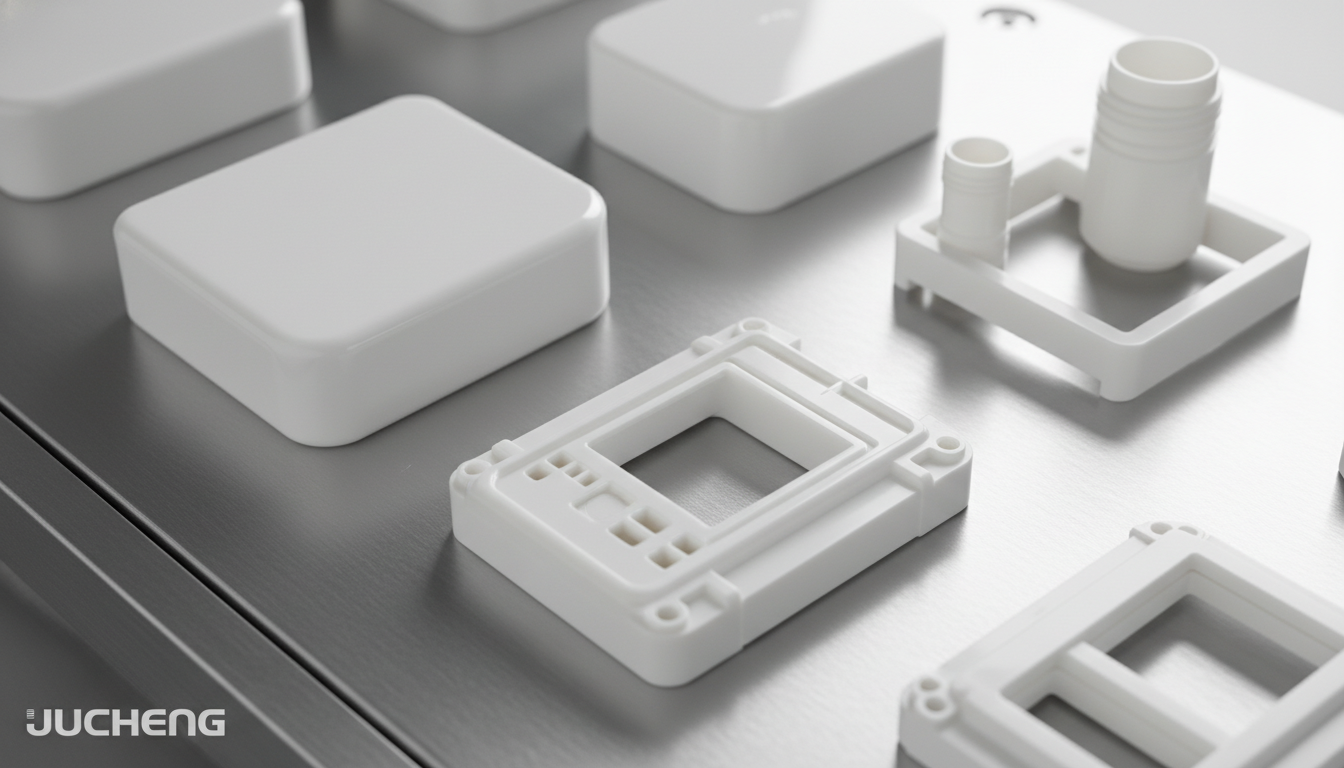
BASF Ultradur B4500 Toughness & Rheological Profile
Ultradur® B 4500 is a medium-viscosity, unreinforced PBT resin engineered by BASF, formulated to provide high melt strength, high tensile ductility, and excellent dimensional repeatability:
| Physical & Strength Parameter | Ultradur B4500 Spec Value | Engineering Advantage for Molded Parts |
|---|---|---|
| Exceptional Ductility | Nominal Strain at Break >50% | Provides substantial structural elongation and toughness without glass fibers, preventing cracking in flexible snap-fits and hinges. |
| Stable Flow Rheology | MVR 19 cm³/10min (250°C x 2.16kg) | Intermediate melt flow rate ensures highly balanced pressure distribution inside thin-walled technical profiles and pipe fittings. |
| Pure Density Profile | Unfilled Density 1.30 g/cm³ | Offers lightweight structural integrity compared to 30% glass-filled variants, ensuring lower weight in dynamic aerospace connectors. |
Structural Component Process Configurations for Ultradur B4500
With its high crystallinity rate and stable melt index, Ultradur B4500 processes smoothly across complex multi-cavity tooling:
| Molding Technology | Process Compatibility & Operational Details |
|---|---|
| Precision Thin-Walled Profiles | Excellent. Highly optimized for extruding and injection molding thin-walled technical pipes, fluid-handling conduits, and complex diagnostic cassettes. |
| Food-Contact Consumer Systems | Excellent (via FC / Food Contact compliant versions). Ideal for high-safety consumer coffee machine adapters, food packaging closures, and structural dishwashing racks. |
| Metal-Insertion Assemblies | Excellent. Safe for encapsulating metallic electrical contacts and bushings directly inside high-insulation connector blocks without cracking. |
PBT-BASF Ultradur B4500 Molding & Melt Control Checklist
Processing a semi-crystalline engineering polyester like Ultradur B4500 requires strict moisture control and balanced cooling to manage volumetric shrinkage:
Hygroscopic Hydrolysis Protection
At high melt temperatures, PBT is highly sensitive to moisture. Wet molding results in rapid hydrolytic chain cleavage, causing severe splay, bubbles, and a major drop in tensile strength. We pre-dry Ultradur B4500 resin in desiccant hopper dryers at 120°C (248°F) for 3–4 hours, keeping moisture strictly below 0.04%.
Balanced Cooling & Shrinkage Controls
Being an unfilled crystal grade, Ultradur B4500 exhibits high shrinkage (typically 1.60% parallel and 1.90% normal to flow). Jucheng’s tooling division uses 5-axis CNC machines to mill uniform, balanced cooling circuits directly inside mirror-polished S136 stainless steel mold cavity blocks to prevent warpage.
Melt & Mold Temperature Control
Processing barrel temperatures are maintained between 250°C and 275°C (482°F to 527°F) to ensure homogeneous melting. Mold temperatures are kept at 40°C to 70°C (104°F to 158°F) to optimize crystalline structure, high surface gloss, and mechanical strength.
Key Application Fields for PBT-BASF Ultradur B4500
- Electrical & Smart-Grid Engineering: High-insulation connector blocks, multi-pin electrical terminals, coil bobbins, smart power meter frames, and switchgears.
- Food-Safe Consumer Systems (FC Compliant): Reusable household coffee machine adapters, steam-resistant caps, food-packaging closures, and dishwasher structural parts.
- Precision Fluid & Automotive Pipes: Thin-walled chemical conduits, industrial pipe connectors, fluid water mixing valves, and fuel sensor enclosures (IATF 16949).
Properties
| Density | 1.3 g/cm³ |
| Melt Volume-Flow Rate (MVR) (250°C/2.16kg) | 19 cm³/10min |
| Tensile Modulus | 2,500 MPa |
| Tensile Stress at Yield | 55 MPa |
| Tensile Yield Strain | 3.7 % |
| Nominal Tensile Strain at Break | >50 % |
| Tensile Creep Modulus (1000h) | 1,200 MPa |
| Flexural Modulus | 2,500 MPa |
| Charpy Notched Impact Strength (23°C) | 5.0 kJ/m² |
| Melting Temperature (DSC) | 223 °C |
| Heat Deflection Temperature (HDT @ 0.45 MPa) | 130 °C |
| Heat Deflection Temperature (HDT @ 1.80 MPa) | 50 °C |
| Linear Mold Shrinkage (Parallel) | 1.6 % |
| Linear Mold Shrinkage (Perpendicular) | 1.9 % |
| Maximum Part Size | 1000 x 800 mm |
| Minimum Part Size | 1 x 1 mm |