
PPS-Solvay Ryton CF30
Sustaining extreme dynamic wear resistance, mechanical stiffness, and chemical inertness in harsh industrial and aerospace environments without adding weight requires a premier structural composite, which Syensqo’s Ryton CF30 (formerly Solvay) delivers through its 30% carbon fiber reinforced polyphenylene sulfide (PPS) matrix. Featuring an optimized density of 1.45 g/cm³ and a heat deflection temperature (HDT) of 265°C, this high-performance grade provides a massive tensile modulus of 21,000 MPa alongside inherent electrostatic dissipation (ESD). Jucheng Precision, under IATF 16949 and ISO 9001 frameworks, specializes in precision molding of Ryton CF30. Utilizing 5-axis CNC-machined S136 stainless steel toolings, we control its anisotropic shrink variables (0.1%-0.3%) to deliver dynamic sliding components verified by Zeiss CMM.
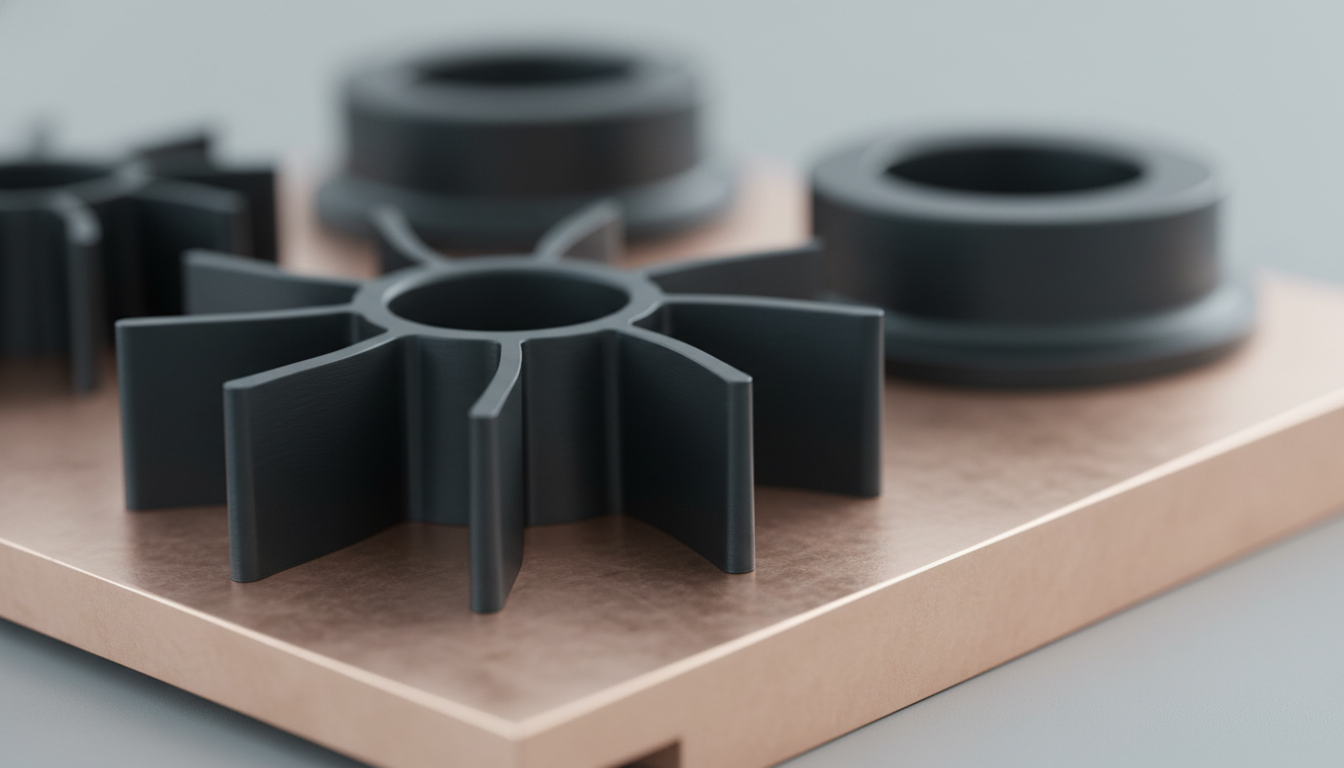
Ryton CF30 Carbon-Filled Strength & Thermal Limits
Ryton® CF30 is a 30% carbon fiber reinforced semi-crystalline Polyphenylene Sulfide (PPS) compound engineered by Syensqo, certified to deliver outstanding strength, continuous dimensional stability, and low coefficient of friction under ISO/ASTM standards:
| Engineering Parameter | Typical Value (DAM / ISO) | Metal-Substitution Advantage |
|---|---|---|
| Structural Stiffness | Tensile Modulus 21.0 GPa (21,000 MPa) | Delivers extraordinary, metal-matching modulus at an exceptionally low density (1.45 g/cm³), enabling massive weight-savings over structural metals. |
| Tensile Strength at Break | 210 MPa (ISO 527-1,2) | Provides immense structural load-bearing capacity, successfully substituting dynamic zinc, brass, and aluminum brackets. |
| Electrical Conductivity | Surface Resistivity 10^2 – 10^6 Ohm/sq | Inherently conductive, providing excellent electrostatic dissipation (ESD) and EMI shielding protection for sensitive electronic components. |
Specialized Dynamic Process Configurations for Reinforced Ryton CF30
With its high mechanical stiffness and carbon fiber reinforcement, Ryton CF30 supports precise, unyielding structural molds:
| Molding Technology Class | Process Compatibility & Operational Details |
|---|---|
| Self-Lubricating Industrial Bearings | Excellent. The primary process for Ryton CF30. Ideal for dynamic spur gears, sliding bearings, dynamic conveyer rollers, and dynamic wear washers. |
| Chemical Vanes & Fluid Impellers | Excellent. Highly optimized for high-pressure chemical pump impellers, fuel tank breather connectors, chemical spray nozzles, and boiler hot-water couplers. |
| Conductive ESD Enclosures | Good. Inherent carbon-fiber conductive matrix provides stable electrostatic dissipation (ESD) and EMI shielding for high-precision components. |
PPS-Solvay Ryton CF30 Tooling & Friction Control Guide
Molding an ultra-high performance carbon-fiber reinforced PPS like Ryton CF30 requires strict thermal boundaries and advanced PM-hardened molds to prevent wear:
Powder Metallurgy Hardened Tool Steel
30% short carbon fibers act as an aggressive grinding agent under high injection pressures and melt viscosity. Jucheng’s tooling division prevents gate and cavity erosion by using premium CPM powder metallurgy tool steels or hardened H13/S136 steel (HRC 54–56) with PVD ceramic coatings.
Managing Anisotropic Shrinkage & Warpage
Ryton CF30 shrinks exceptionally low along the flow (typically 0.10%) but higher perpendicular to the flow (0.30%). We conduct detailed Moldflow analysis during DFM to locate gates, ensuring uniform fiber orientation to prevent structural warping.
Pressurized Oil Mold Temperature Control
We maintain mold temperatures at 135°C–150°C (266°F to 302°F) using pressurized water heaters. High mold temperatures maximize surface gloss, reduce weld lines, and prevent surface carbon-fibers from floating, ensuring a smooth and non-fibrous finish.
Desiccant Drying Protocol (Hydrolysis Prevention)
PPS is highly sensitive to moisture at high melt temperatures. Wet molding results in rapid hydrolytic chain cleavage, causing severe splay, gas bubbles, and a major drop in impact strength. We desiccant dry Ryton CF30 resin at 120°C–140°C (248°F–284°F) for 3–4 hours, keeping moisture below 0.02%.
Key Application Fields for PPS-Solvay Ryton CF30
- Aerospace Structural Fittings & Defense: Ultra-lightweight drone structural arms, aircraft bracket mounts, weapon casing brackets, dynamic slide guides, and optical sensor bezels.
- Precision Dynamic Industrial Machinery: Heavy-duty planetary gears, helical gear sets, self-lubricating sliding bushings, high-pressure pump impellers, and compressor seals.
- Medical Devices & Surgical Systems (ISO 13485): Radiolucent surgical targeting frames, non-magnetic laboratory cassettes, patient-specific orthopedic instruments, and surgical robot joints.
Properties
| Density | 1.45 g/cm³ |
| Tensile Modulus | 21,000 MPa |
| Tensile Strength at Break | 210 MPa |
| Tensile Elongation at Break (DAM) | 1.5 % |
| Flexural Strength | 300 MPa |
| Flexural Modulus | 20,000 MPa |
| Charpy Notched Impact Strength (23°C) | 8.5 kJ/m² |
| Notched Izod Impact Strength (23°C) | 9.0 kJ/m² |
| Melting Temperature | 280 °C |
| Heat Deflection Temperature (HDT @ 1.80 MPa) | 265 °C |
| Surface Resistivity | 1.0E+02 - 1.0E+06 Ohm/sq |
| Linear Mold Shrinkage (Flow Direction) | 0.1 % |
| Linear Mold Shrinkage (Cross Direction) | 0.3 % |
| Maximum Part Size | 800 x 600 mm |
| Minimum Part Size | 1 x 1 mm |