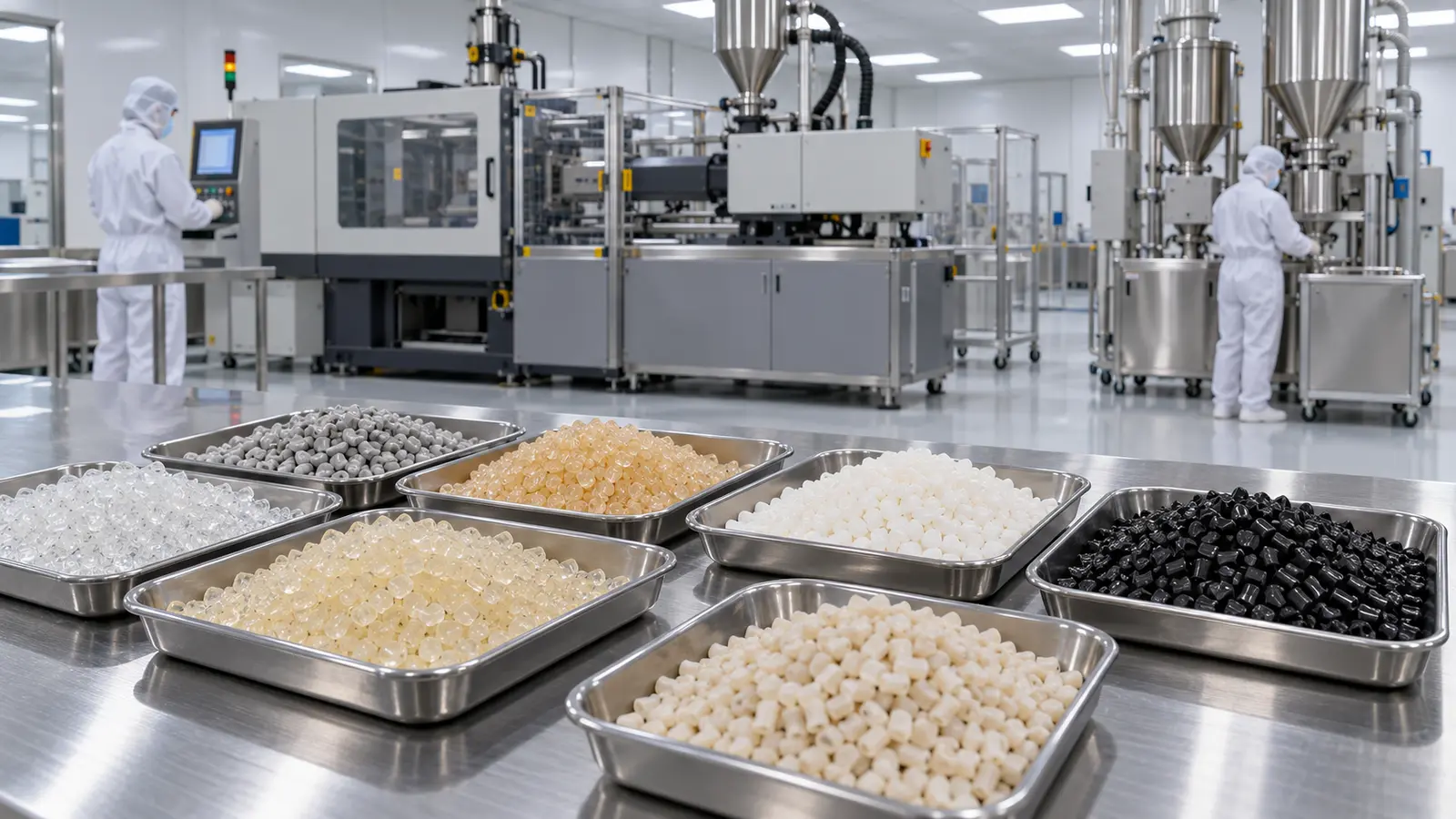
Cleanroom injection molding materials should be selected from the part’s operating environment, not from the room classification alone. The right resin must fill the mold consistently, survive the product’s chemical and thermal conditions, meet dimensional and surface requirements, and remain controlled through storage, processing, inspection, and packaging.
A 클린룸 사출 성형 process reduces exposure to particles and handling contamination, but it does not make every resin suitable for a medical, laboratory, optical, or fluid-path component. Material grade, additives, drying, lot control, and downstream use still determine whether the part is fit for the application.
이 가이드에서:
- Start with the part requirement
- Material families commonly considered
- Moisture, drying, and processing control
- Sterilization and chemical exposure
- Particles, additives, and traceability
- How to qualify the selected grade
- 자주 묻는 질문
Start with the part requirement

Before asking which material is best, describe what the part must do. A transparent diagnostic cover, a fluid connector, a surgical instrument component, and a protective electronic housing may all be molded in a controlled environment, but their material priorities are different.
- Temperature: include continuous exposure, short peaks, sterilization cycles, and storage conditions.
- Chemistry: consider cleaners, disinfectants, solvents, oils, body-contact fluids, and process chemicals.
- Mechanical function: define stiffness, impact, fatigue, creep, wear, sealing, and snap-fit performance.
- Dimensional behavior: account for shrinkage, moisture absorption, thermal expansion, and long-term stability.
- Surface and optical needs: identify transparency, gloss, friction, particulate sensitivity, and visible defects.
The cleanroom controls the environment around molding. It does not replace a material compatibility review or the supporting documentation for the selected grade.
Material families commonly considered

Several thermoplastic families may be considered for controlled molding, but the exact grade matters more than the family name. Suppliers can offer different reinforcement levels, stabilizers, colors, lubricants, and compliance packages under a similar resin designation.
- Polypropylene and polyethylene. These materials can offer chemical resistance and low density. Grade selection must still address stiffness, creep, weld-line strength, and the intended sterilization or cleaning route.
- Polycarbonate. PC is often evaluated where transparency and impact performance matter. Designers should review stress cracking, chemical exposure, optical requirements, and the behavior of the chosen medical or industrial grade.
- Polyamide. Nylon grades can provide strength and wear resistance, but moisture absorption can affect dimensions, processing, and long-term performance. Drying and conditioning need to be defined.
- Polyoxymethylene. POM can be useful for precision mechanisms and low-friction features. Review chemical compatibility, molding decomposition risks, and whether the grade is acceptable for the intended product environment.
- High-temperature engineering polymers. PEEK, PEI, PPSU, PSU, and related materials may be considered for demanding thermal, chemical, or sterilization conditions. They usually require tighter processing discipline and higher material cost.
- Filled and reinforced grades. Glass fiber, mineral, carbon, and other additives can improve stiffness or dimensional behavior, but they may affect surface finish, tool wear, flow, weld lines, and particle control.
Do not choose a resin because it appears on a general cleanroom materials list. Confirm the supplier’s grade-specific data, processing window, compliance documents, and suitability for the finished part.
Moisture, drying, and processing control

Moisture management is a common source of avoidable variation. Hygroscopic materials can absorb water from the environment, and excessive moisture may cause splay, bubbles, brittleness, hydrolysis, surface defects, or dimensional changes. The correct drying temperature, time, hopper condition, and transfer method should come from the resin supplier’s grade data.
Processing control also includes melt temperature, mold temperature, residence time, injection speed, holding pressure, cooling, and purge practice. These settings affect flash, trapped gas, burn marks, weld lines, shrinkage, and the amount of manual handling needed after ejection.
Material preparation should define:
- approved resin grade and revision;
- lot identification and certificate requirements;
- sealed storage and maximum exposure time;
- drying equipment, limits, and records;
- regrind policy, if any, and contamination controls;
- material change approval and line-clearance steps.
Sterilization and chemical exposure

Material selection should follow the actual sterilization and cleaning route. Heat, steam, radiation, ethylene oxide, chemical disinfectants, and repeated cleaning can affect color, transparency, strength, brittleness, stress cracking, or dimensional stability in different ways.
A material that performs well in a short laboratory test may behave differently after repeated cycles, under molded-in stress, or in contact with another material. Review the finished part rather than relying only on a resin datasheet. Gates, weld lines, thin walls, sharp corners, and snap features can become the locations where environmental stress appears first.
For fluid-path or patient-contact applications, the material review may also need extractables, leachables, biocompatibility, and regulatory documentation. These requirements are grade-specific and product-specific. They should be agreed before production samples are approved.
Particles, additives, and traceability

Cleanroom molding reduces contamination risk, but the material itself can introduce variation through pellets, colorants, fillers, packaging fibers, dust, or degraded residue. Material transfer and storage should protect the resin before it reaches the molding area.
Color and additive packages deserve particular attention. A pigment or lubricant can affect surface appearance, chemical resistance, weld-line behavior, or downstream bonding. Reinforcements can improve stiffness while increasing tool wear or making flow and surface quality more difficult to control.
Lot traceability connects the material to the finished parts. A practical system records the resin supplier, grade, lot, drying history, processing date, cavity or tool information, inspection results, and release decision. These records complement the site’s quality control process and make a material-related investigation more precise if a later issue occurs.
How to qualify the selected grade
Material qualification should be built around the part’s failure modes. Start with a representative tool or sample geometry, then check the dimensions, surface, mechanical performance, chemical exposure, and handling path that matter to the application.
- Confirm the grade. Match the drawing, purchase specification, supplier data, and approved material list.
- Run process trials. Establish a stable window for filling, packing, cooling, ejection, and material preparation.
- Inspect critical features. Measure dimensions, sealing surfaces, optical areas, threads, snap fits, and any particle-sensitive features.
- Test realistic exposure. Use the actual cleaning, sterilization, temperature, and chemical conditions when those factors can change performance.
- Document the release basis. Record the sample results, deviations, approvals, and the conditions that must remain controlled in production.
The most suitable cleanroom material is the one that meets the product requirement with a stable, documented process. A more expensive polymer is not automatically the safer choice, and a lower-cost resin is not a good value if it creates repeated scrap or qualification risk.
자주 묻는 질문
Does cleanroom molding require special plastics?
Not always. The required material depends on the part, its exposure, its cleanliness risk, and the customer or regulatory requirements. Many standard engineering resins can be considered when their grade and handling controls fit the application.
Is a medical-grade resin automatically suitable for every cleanroom part?
No. A medical-grade designation does not remove the need to review temperature, chemicals, sterilization, dimensions, mechanical performance, processing, and the intended use of the finished part.
Why is drying important for some cleanroom materials?
Some resins absorb moisture from the air. If moisture is not controlled, it can affect appearance, strength, dimensions, hydrolysis risk, and process stability. The drying procedure should follow the specific resin grade requirements.
Can reinforced materials be used in controlled molding?
They can be considered when stiffness, strength, or dimensional stability requires reinforcement. The trade-offs include flow behavior, surface finish, tool wear, weld-line performance, and the possibility of greater particulate or fiber-control requirements.