
Batteriepakete für Elektrofahrzeuge (EV) erfordern robustes Wärmemanagement, elektrische Isolierung und schlagfeste Strukturen.
Der Übergang von schweren Metallgehäusen zu hochfesten technischen Kunststoffen stellt eine bedeutende Weiterentwicklung im Automobil-Pack-Design dar.
Dieser technische Leitfaden erläutert die Werkzeugkonstruktion, DfM-Überlegungen und fortschrittliche Polymerverarbeitungstechnologien, die für die Herstellung zuverlässiger Gehäuse unerlässlich sind.
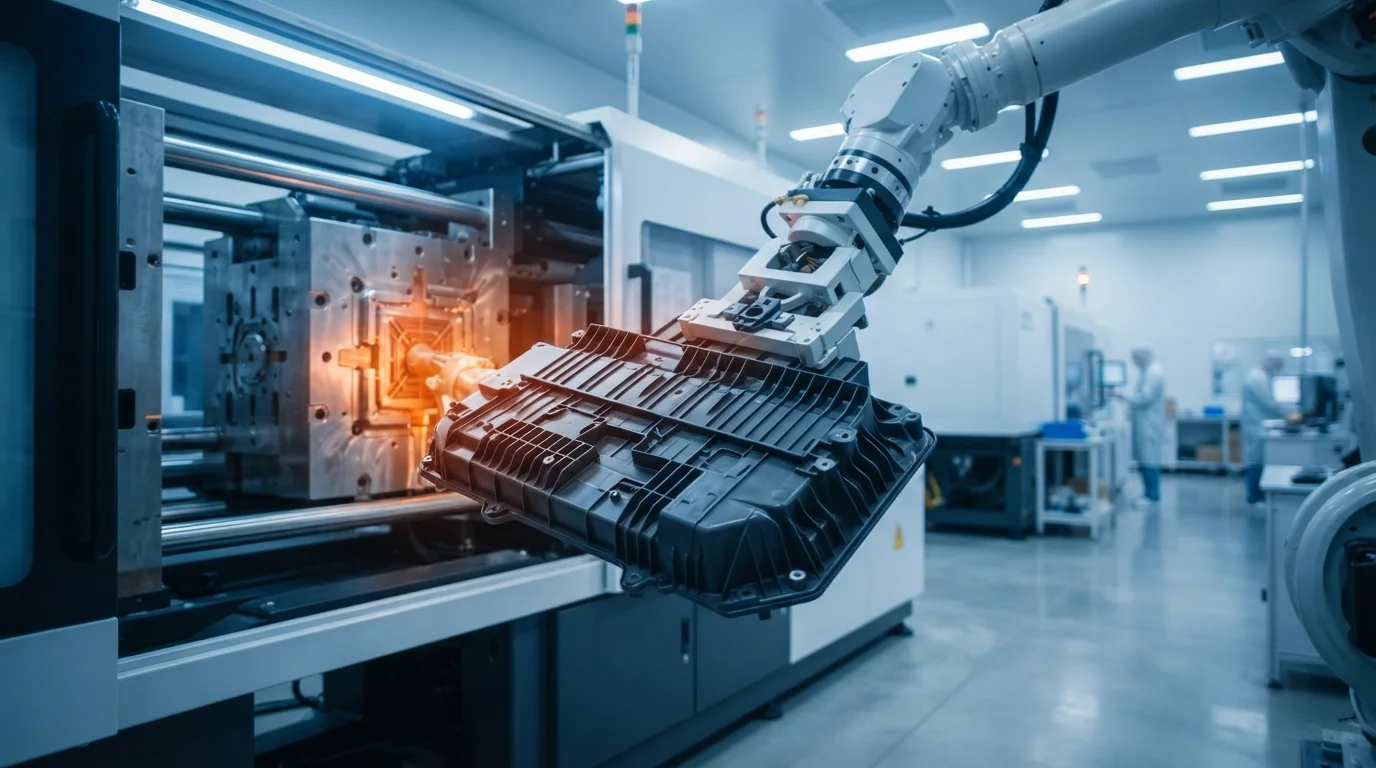
JUCHENG Injection Molding ist ein hochwertiger Auftragsfertigungsbetrieb, der sich auf kundenspezifische Werkzeuge und Präzisionskunststoffspritzguss spezialisiert hat.
Wir verkaufen keine Standard- oder Lager-Batterieboxen im Einzelhandel; jede Komponente wird aus kundenspezifischen 3D-CAD-Modellen entwickelt, um strenge Leistungsspezifikationen zu erfüllen.
Ob in der Prototypenphase oder beim Übergang zur Mehrfachkavitäten-Serienproduktion – unsere Einrichtung bietet maßgeschneiderte Fertigungsunterstützung, untermauert durch IATF 16949- und ISO 13485-Zertifizierungen.
Inhaltsverzeichnis
Warum kundenspezifischer Spritzguss für EV-Batteriegehäuse entscheidend ist
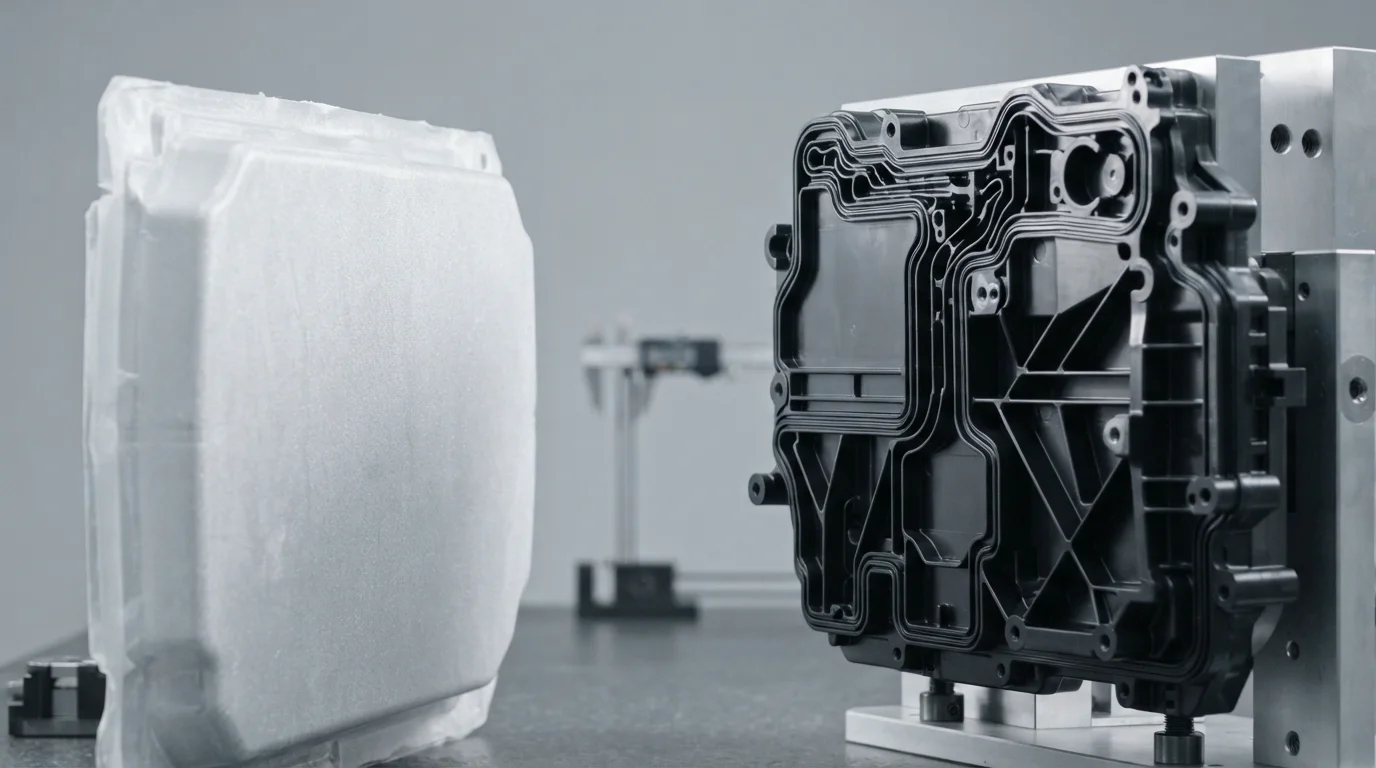
Die Konstruktion robuster kundenspezifischen Kunststoff-Batteriegehäuse für E-Fahrzeuge erfordert ein Verständnis für strukturelle Integration und enge Toleranzkontrolle.
Herkömmliche Metallgehäuse sind schwer und erfordern sekundäre Isoliereinlagen, um Kurzschlüsse zu verhindern.
Durch die Verwendung von Hochleistungspolymeren können Ingenieure komplexe Geometrien, innere Merkmale und funktionale Halterungen direkt in ein einziges, einheitliches Teil formen.
Die Zusammenlegung von Komponenten auf diese Weise reduziert die Materialkosten, eliminiert sekundäre Montageschritte und reduziert das kritische Gewicht des Fahrzeugchassis.
Die Integration interner Komponenten ist entscheidend, um einzelne Lithium-Ionen-Zellen vor der Ausbreitung eines thermischen Durchgehens zu schützen.
Nahtlose Integration von Haltevorrichtungen für Batteriezellen von Elektrofahrzeugen direkt in den strukturellen Wänden des Hauptgehäuses verhindert Vibrationsverschleiß an den Zellanschlüssen.
Darüber hinaus verhindert die Einarbeitung dünner, hochisolierender Elektrofahrzeug-Batterie-Abstandshalter ein thermisches Durchgehen, das zwischen Pouch- oder prismatischen Zellmodulen überspringt.
Solche Konfigurationen optimieren die Raumnutzung im Batteriepaket, ermöglichen eine höhere Energiedichte und erhalten gleichzeitig die strukturelle Integrität bei mechanischen Stößen.
Im Vergleich zu alternativen Verarbeitungsmethoden wie Blechstanzen oder Thermoformen bietet das Spritzgießen eine überlegene Wiederholbarkeit und Maßgenauigkeit.
Hochdruck-Spritzgießen zwingt geschmolzenen Kunststoff in präzisionsgefertigte Kavitäten und erzeugt Teile mit null Formschrägenabweichungen und hochkonsolidierten Molekularstrukturen.
Dies ist besonders wichtig für das Formen von elastomeren Dichtkanälen und umlaufenden Nut-Feder-Verbindungen, die verhindern, dass Feuchtigkeit und Staub in das Batteriemodul eindringen.
Die Partnerschaft mit einem erfahrenen Fertigungsspezialisten stellt sicher, dass Ihre kundenspezifischen Teile strengen Automobilsicherheitsstandards entsprechen.
Materialien und Flammwidrigkeitsnormen (UL94 V-0)
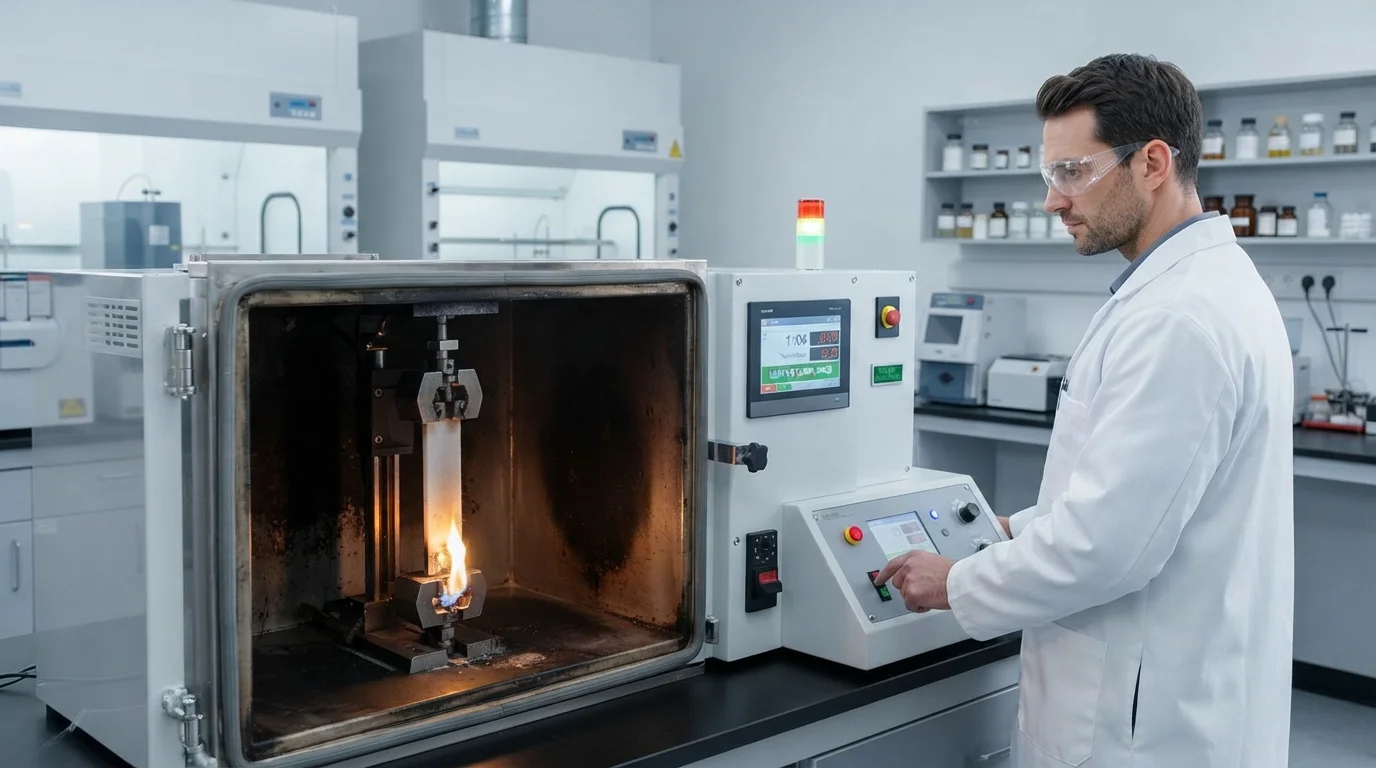
Die Entwicklung spezialisierter kundenspezifischen Kunststoff-Batteriegehäuse für E-Fahrzeuge ist auf Hochleistungsthermoplaste angewiesen.
Ingenieure müssen Schlagzähigkeit, Chemikalienbeständigkeit gegenüber Batterieelektrolyten, Wärmeformbeständigkeitstemperatur und langfristige Kriechbeständigkeit in Einklang bringen.
Folglich sichert die Verwendung von Spritzguss Bayblend FR3010 für EV-Batteriemodule überlegene Schlagleistung bis -30°C bei gleichzeitiger Erfüllung der UL94 V-0-Brandschutzklasse bei 1,5 mm Dicke.
Diese amorphe Polycarbonat- und Acrylnitril-Butadien-Styrol-Mischung bietet vorhersehbare Schrumpfungsraten-Eigenschaften, was die Herstellung von flachen, verzugsfreien Abdeckungen erleichtert.
Zu den wichtigsten Materialleistungsanforderungen für Hochvoltbatteriegehäuse gehören:
- Thermische Stabilität—Technische Kunststoffe müssen ihre strukturelle Integrität bei kontinuierlichen Betriebstemperaturen über 100°C aufrechterhalten.
- Flammhemmung—Das Erreichen einer strengen UL94 V-0-Klassifizierung verhindert Brandausbreitung und löscht Kunststoffteile innerhalb von Sekunden selbst.
- Dielektrische Festigkeit—Hoher spezifischer Durchgangswiderstand verhindert elektrische Lichtbögen zwischen Batteriezellen und dem äußeren Chassis.
- Schlagfestigkeit—Robuste physikalische Eigenschaften schützen die empfindliche Lithiumzellenmatrix vor Schmutz durchstoß während dynamischer Fahrt.
Ähnlich, die Herstellung flammhemmenden PC ABS Batteriegehäusen ensures structural rigidity while providing reliable electrical insulation.
When high mechanical rigidity is required to withstand extreme drop tests, glass-fiber reinforced polymers represent the optimal choice.
For instance, choosing spritzgegossener Lexan 940A Batterierahmen offers exceptional flame retardancy coupled with the dimensional stability required for interlocking prismatic cell matrices.
This polycarbonate resin maintains its physical properties under constant thermal loads, preventing cell migration during rapid charging and discharging cycles.
Safety compliance remains non-negotiable for all high-voltage automotive components.
Therefore, specifying UL94 V-0 flame retardant plastic cell carrier injection molding guarantees that the polymer will self-extinguish within 10 seconds of a flame application, preventing catastrophic thermal fire propagation.
Structural trays also demand extreme load-bearing capabilities.
Indeed, handling Herstellung von Batterieträgern aus glasfaserverstärktem Polyamid presents challenges with warpage due to the differential shrinkage between the transverse and parallel glass fiber orientations.
Our mold design team overcomes this by optimizing gate locations and using balanced hot runner systems to distribute fiber alignment evenly across the mold cavity.
| Materialgüte | Polymerart | Tensile Strength (MPa) | HDT @ 1.82 MPa (°C) | Brennbarkeitsklasse |
|---|---|---|---|---|
| Bayblend FR3010 | PC + ABS Blend | 60 | 110 | UL94 V-0 |
| Lexan 940A | Polycarbonat (PC) | 65 | 125 | UL94 V-0 |
| PA66-GF30 (FR) | Polyamide 66 + 30% GF | 150 | 240 | UL94 V-0 |
| TPV (70A-40D) | Thermoplastisches Vulkanisat | 8 – 15 | N/A (Elastomeric) | UL94 HB / V-0 |
Advanced Tooling Capabilities for Complex Battery Geometry
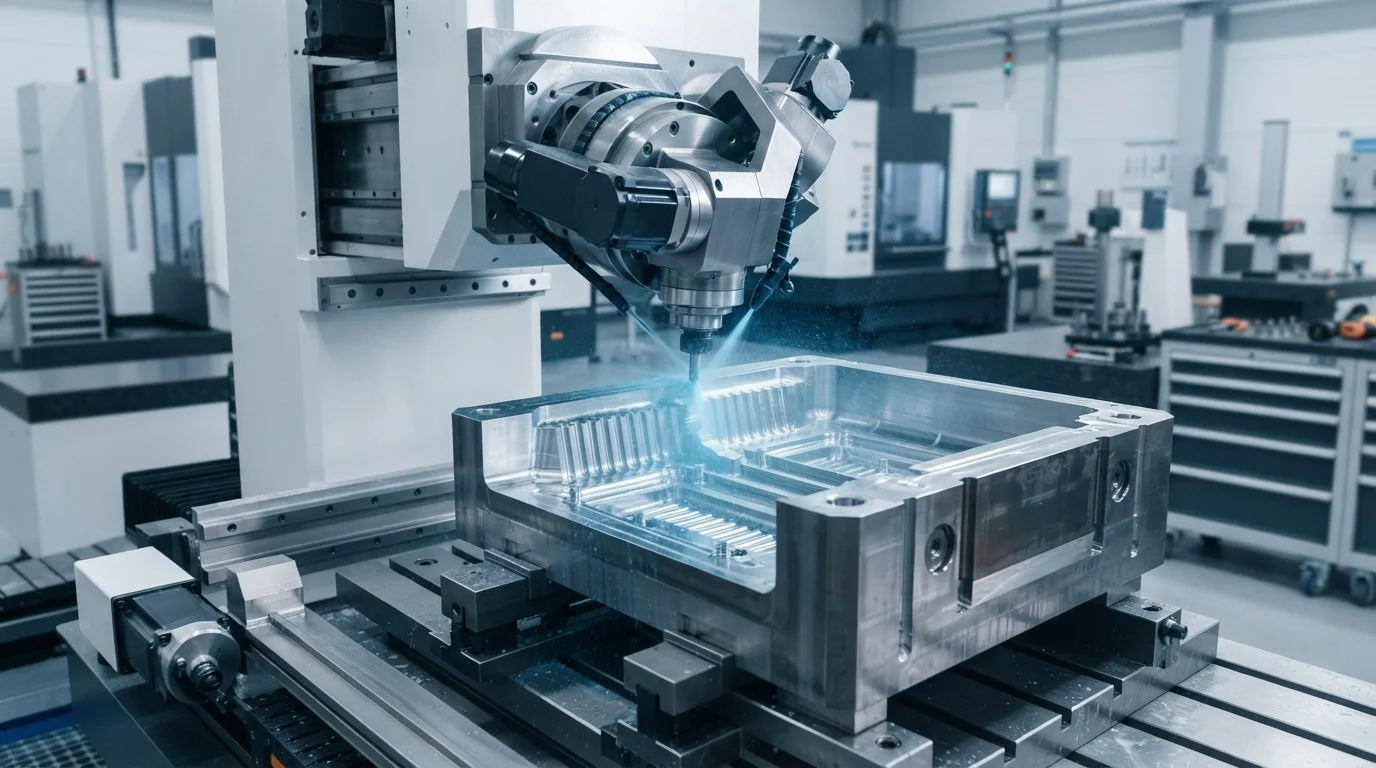
Mold design directly influences the long-term quality, flatness, and structural reliability of custom components.
Our dual-certified facility leverages 25+ in-house 5-axis CNC machines to cut precise mold cores out of hardened H13 or S136 tool steel.
Hardened steels are mandatory for handling highly corrosive, flame-retardant additives and abrasive glass fibers without suffering pitting or rapid dimensional erosion.
During the molding process, optimized conformal cooling channels integrated into the mold steel reduce cycle times by up to 30%, ensuring even heat dissipation and preventing post-mold warpage.
One prominent technique involves overmolding high-voltage conductive elements directly inside the structural shell.
Specifically, employing Durchführung von Insert Molding von Busbars in EV-Batterieabdeckungen minimizes assembly errors and prevents environmental moisture from leaking into critical high-voltage contact areas.
This requires incredibly tight tooling shut-off tolerances to prevent plastic flash from flowing onto the active contact surfaces of copper or aluminum busbars.
Our precise tooling designs utilize spring-loaded core pins and real-time cavity pressure sensors to prevent crushing the metal inserts during mold clamp-up.
Moisture and dust ingress must be prevented to avoid short-circuiting expensive lithium cell modules.
Thus, performing custom molding thermoplastic vulcanizate TPV battery gaskets ensures that our kundenspezifischen Kunststoff-Batteriegehäuse für E-Fahrzeuge achieve dynamic sealing profiles directly integrated onto the rigid PC/ABS cover.
Achieving this dual-material integration is possible through advanced multi-shot injection molding or custom overmolding processes, completely eliminating the labor-intensive hand-application of adhesive foam strips.
Such multi-material integrations remain a hallmark of automotive-grade manufacturing, providing robust protection against IP67 and IP69K moisture standards.
DfM Analysis & Complete Turnkey Services
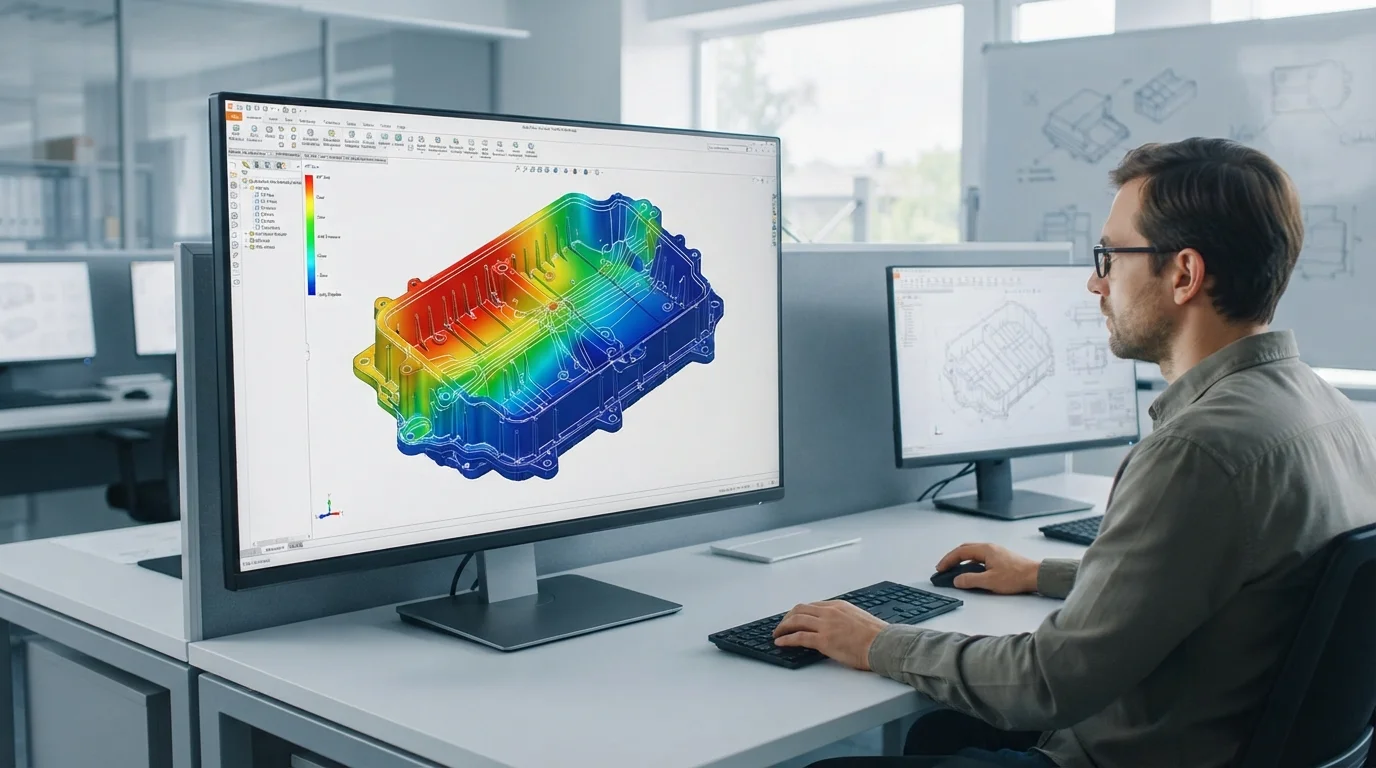
Optimizing structural geometries for kundenspezifischen Kunststoff-Batteriegehäuse für E-Fahrzeuge prevents defects and lowers production costs.
Draft angles of at least 1.5 to 2 degrees must be incorporated on all vertical ribs and side walls to permit clean ejection without part distortion.
Wall thickness must remain as uniform as possible, ideally ranging from 2.5mm to 3.5mm, to prevent differential shrinkage and sink marks.
Flow simulation analysis prevents problematic knit lines, especially around the molded insert zones where molten plastic splits and recombines around cold metal busbars.
Our end-to-end custom tooling and manufacturing workflow typically follows this path:
- Design evaluation (DfM)—Providing a detailed manufacturability review, assessing draft angles, gate locations, and predicting potential knit lines within 24 hours.
- Tooling fabrication—Milling high-precision mold cavities from hardened H13/S136 steel using our in-house 5-axis high-speed CNC machining centers.
- Trial molding (T0/T1)—Conducting trial runs to optimize injection pressure, melt temperature, and holding times, yielding initial physical samples for dimensional checks.
- Quality verification—Utilizing Zeiss coordinate measuring machines to scan critical part geometries and cell pocket concentricity, compiling precise dimensional reports.
- Final production—Executing low-to-high volume injection molding runs backed by IATF 16949-certified quality control and complete lot traceability.
For design validation, relying on low volume rapid tooling for EV battery prototypes accelerates validation times while limiting initial non-recurring engineering tooling expenses.
Our facility builds rapid mold structures utilizing P20 or Alumec 89 aluminum cores, permitting functional molded prototypes of kundenspezifischen Kunststoff-Batteriegehäuse für E-Fahrzeuge to be delivered in as fast as 10 to 12 business days.
This bridge-to-production strategy allows automotive engineering teams to perform real-world environmental stress screening, drop testing, and vibration analysis before investing in mass-production, multi-cavity hardened steel tools.
Our team manages the entire project from initial design optimization to post-mold assembly under one roof.
Our in-house 5-axis CNC machining, ultrasonic plastic welding, thermal heat staking, and coordinate measuring machine inspections complete our comprehensive turnkey operations.
Every production lot is fully traceable, and our quality control engineers verify critical-to-quality dimensions on every shipment.
We sign non-disclosure agreements early in the design cycle, safeguarding proprietary intellectual property and ensuring confidential product launches.
Häufig gestellte Fragen (FAQ)
How do you manage warpage in large, glass-filled battery trays?
Shrinkage management involves balancing the fiber orientation in glass-filled polyamide materials.
Glass fibers tend to align with the melt flow, causing the material to shrink less along the flow direction than across it.
We use advanced mold-flow software to simulate gate placement, frequently utilizing valve-gated hot runner systems to control the flow front and balance orientation, minimizing structural warpage.
What is the typical mold lifespan for flame-retardant plastics?
Mold lifespans vary depending on the tooling steel and polymer additives.
Flame-retardant agents release corrosive gasses at high temperatures, which degrade soft steels.
By using premium hardened S136 or H13 stainless steels with specialized anti-corrosive coatings, our molds consistently achieve over 500,000 cycles, maintaining tight dimensional tolerances over high-volume production runs.
Can you mold copper or aluminum busbars directly into battery covers?
Insert molding requires precise clamping pressure and strict shut-off tolerances to prevent plastic flash.
Our robotic insert systems place busbars with sub-millimeter precision.
We design custom sealing lands on the mold steel that firmly grip the metallic inserts, ensuring a leak-proof seal and preventing any flash onto the connection terminals.