
A hot runner can look balanced on a drawing and still fill cavities unevenly. Equal channel lengths are only one part of the pressure and thermal picture; gate restriction, channel diameter, temperature, resin viscosity, cavity geometry, and manufacturing variation also affect when melt reaches each cavity. A useful hot runner manifold flow balance review asks whether the complete path delivers comparable melt conditions, not whether the runner appears symmetrical. Hot runner manifold flow balance depends on more than channel length: gate restrictions, melt temperature, manifold heat distribution, and cavity pressure can all change the fill pattern.
This issue becomes visible when one cavity short-shots while another flashes, part weights drift, or process changes help one location but harm another. Map the imbalance first, distinguish filling from packing, and use cavity-specific evidence before changing a manifold or compensating with pressure.
In this article:
- What balance should achieve
- Why equal paths can behave differently
- Read the cavity pattern
- Validate the design and process
- FAQ
What balance should achieve
A balanced system aims to deliver a repeatable fill and pack response across cavities without relying on large cavity-specific process corrections. The melt route includes the machine nozzle, manifold, drops, gates, and cavity entrance. A difference anywhere along that path can affect the result. Balance is therefore a property of the complete mold and material system, not the manifold component by itself.
Geometric balance uses comparable runner paths; rheological balance considers how melt resistance changes through the channels and into the cavities. Depending on the layout, the design may need both geometry and process validation. Similar runner lengths are a useful starting point, not proof of equal filling.
Why equal paths can behave differently
Flow resistance depends on channel size, turns, transitions, surface condition, gate dimensions, resin viscosity, and shear. A small difference at the drop or gate can matter because the final restriction strongly influences delivery into the cavity. The cavity itself can also vary in wall thickness or flow length, so identical feeds do not guarantee identical fill progression. Compare hot runner manifold flow balance with the actual cavity results, including short shots, fill time, and part-to-part variation.
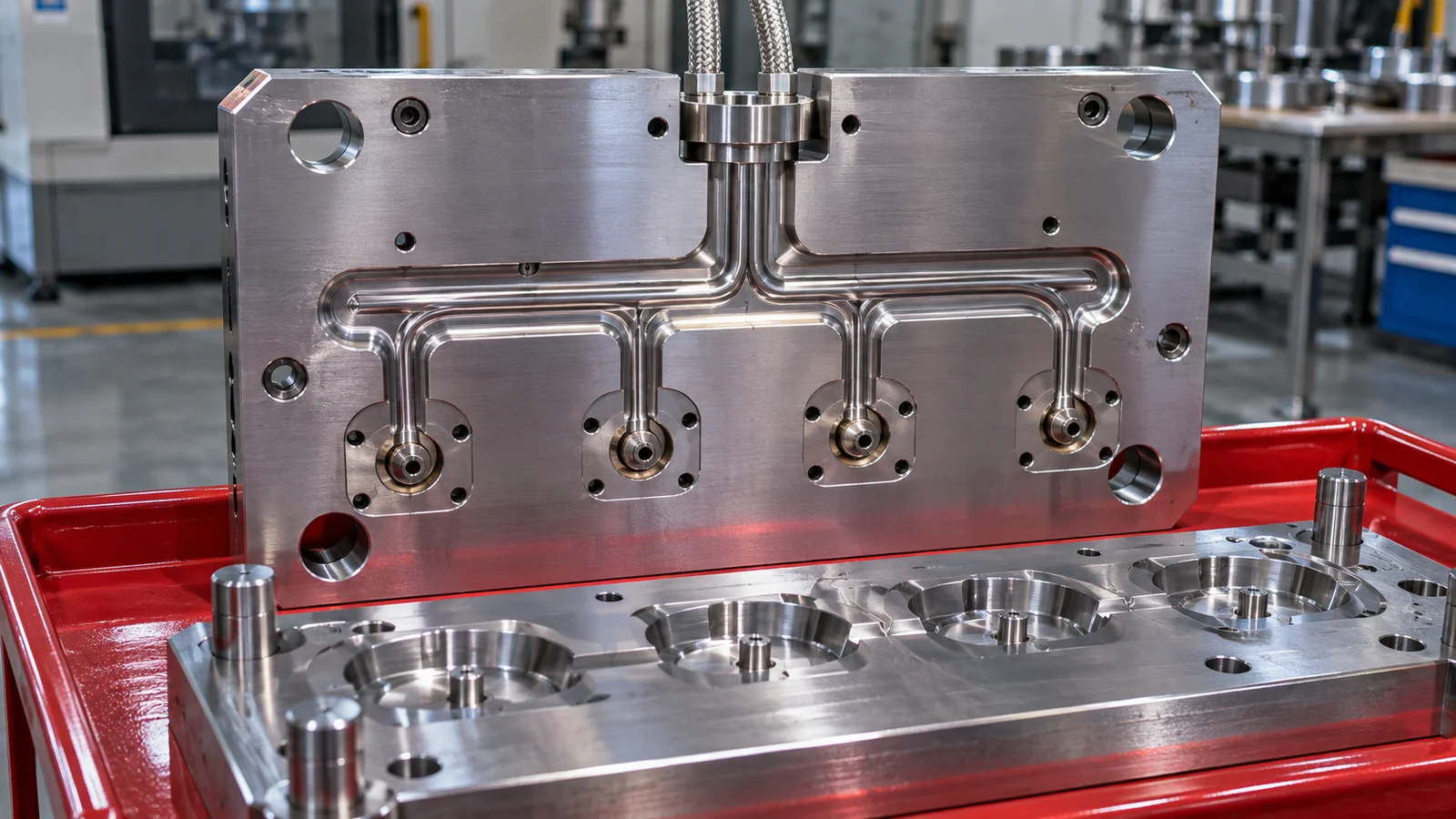 Thermal differences may shift viscosity and timing. Heater zones, insulation, nozzle contact, startup procedure, control stability, and sensor placement can make local melt conditions differ from the setpoint displayed on a controller. Confirm that the mold has reached stable thermal conditions before interpreting a short-shot pattern as a permanent geometric imbalance.
Resin substitutions, color changes, drying, or lot variation may also alter flow behavior. Check material and setup consistency before assigning the root cause to the runner. A correction that works with one grade may not hold across another resin with different viscosity behavior.
Read the cavity pattern
| Observed pattern | Check first | Useful evidence |
|---|---|---|
| Same cavity always lags | Drop, gate, local restriction, cavity geometry | Short shots, gate dimensions, fill progression |
| Imbalance shifts after warm-up | Thermal stability and startup method | Time-stamped temperatures and fill data |
| Fill looks even, weights diverge | Pack, gate freeze, cooling, cavity volume | Cavity weights, hold profile, dimensions |
| Pattern changes after resin change | Grade, drying, colorant, handling | Material lot and setup comparison |
Use a controlled short-shot sequence to see which cavities lead or lag before full packing. Mark cavity identity and record settings, resin lot, thermal stabilization, and the fill condition. A machine pressure reading alone can hide cavity-to-cavity differences. Separate fill imbalance from pack imbalance so that the correction addresses the correct stage.
 Validate the design and process
Before steel release, review channel geometry, drops, gates, cavity layout, resin assumptions, and thermal zones together. A filling analysis can compare candidate layouts and suggest where pressure or timing may differ, but it depends on the model inputs and boundary conditions. Use it to focus design questions, then verify the response on the physical mold. A hot runner manifold flow balance study should separate material, temperature, gate, and process effects before a team changes multiple settings at once.
During trials, compare cavity-identified short shots, fill time, cavity pressure where available, part weight, dimensions, and defect patterns. Repeat measurements under stable conditions and define the acceptable process window. Avoid raising overall pressure as a first response: it can overpack leading cavities and create flash without removing the restriction that caused the lag.
Coordinate this work with the site’s injection mold design review. The tradeoff between runner systems also affects waste, material changes, and maintenance; see hot runner vs. cold runner selection for that broader decision.
FAQ
Do equal runner lengths guarantee balanced filling?
No. Channel size, turns, gates, cavity geometry, temperature, resin viscosity, and manufacturing variation also affect resistance and fill timing.
Should operators compensate cavity by cavity?
Only within a documented and validated window. Large corrections can conceal a runner, thermal, or cavity problem and may reduce robustness.
How can balance be checked?
Use repeated, cavity-identified evidence: short-shot progression, fill time, pressure where available, part weight, dimensions, and defect patterns. Evaluate filling and packing separately.
Can balance drift after launch?
Yes. Wear, contamination, heater or sensor issues, resin changes, maintenance, and process drift can change performance. Include inspection and maintenance in the control plan.