
Two polymer grades can both look suitable on a data sheet and still produce an unstable sandwich-molded part. A sound co-injection molding material selection starts with the skin’s visible and environmental duties, then checks whether the core can flow, bond, and remain contained through the actual geometry. The skin and core do not need identical properties, but their processing windows and interface behavior must work together.
This guide is for product and tooling teams deciding whether a two-material skin-core structure is practical. It is not a generic list of compatible resin pairs: supplier grade, colorant, regrind policy, wall section, gate location, and the switch-over sequence can change the result. Treat candidate combinations as testable hypotheses, not guaranteed recipes.
Quick decision: define what the outer layer must do, what function the core is expected to provide, and what evidence will prove the interface and surface are acceptable. If one material can meet both requirements without an assembly or cost penalty, a simpler molding route may be safer.
In this article:
- Assign a job to each material
- Screen the interface and process window
- Check geometry before choosing a pair
- Compare candidates by failure risk
- Validate the pair in the molded part
- FAQ
Start with the job of the skin and the core
Co-injection places a core polymer inside a skin polymer during a coordinated filling sequence. The skin is intended to cover the exterior; the core occupies part of the interior. In practice, the distribution is shaped by flow, cooling, geometry, and timing, so the drawing cannot be treated as proof that the skin will be continuous everywhere.
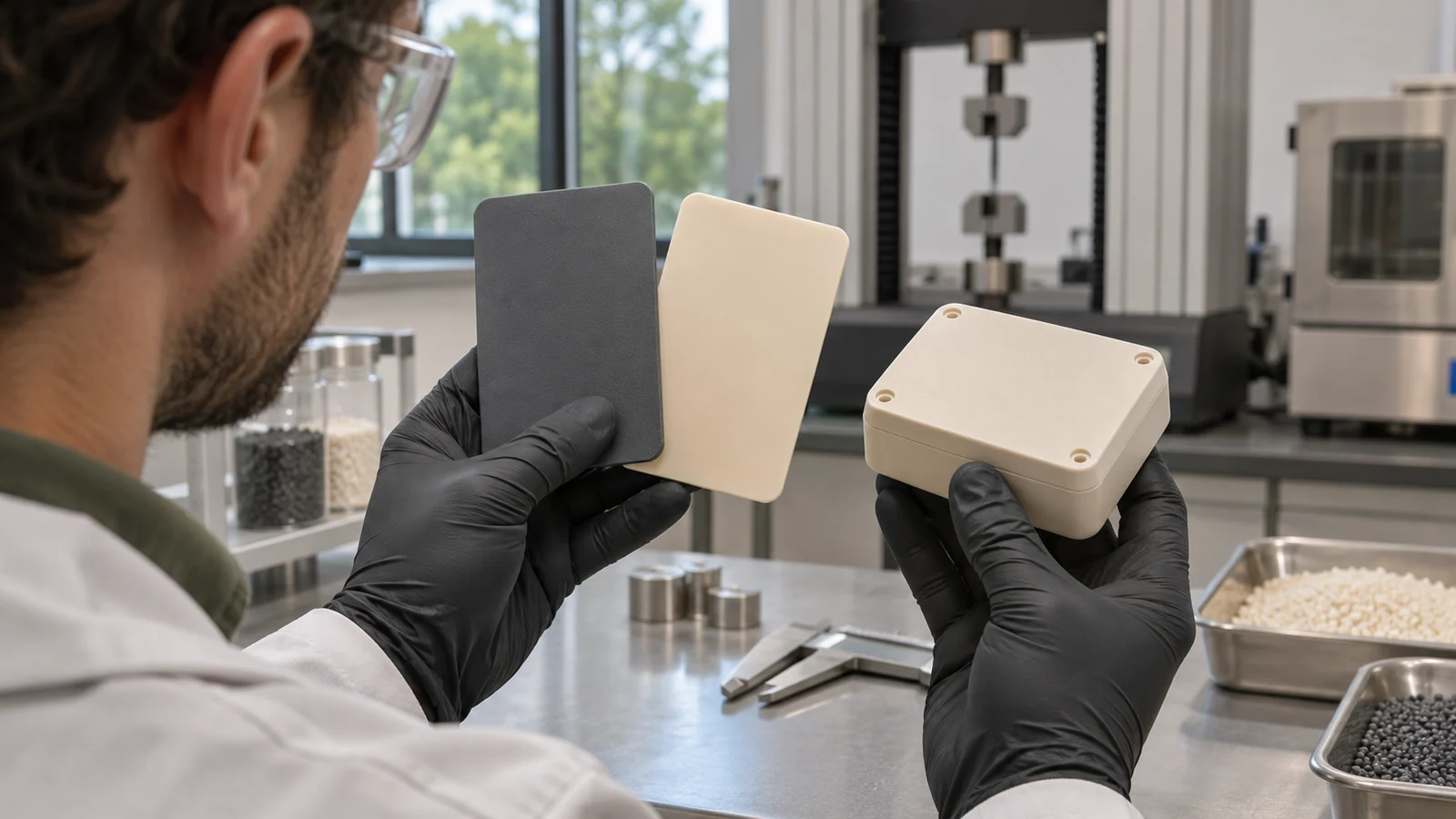
Write a requirement for each layer before asking suppliers for candidate grades. A skin may be responsible for color, texture, chemical exposure, cleanability, or contact with a mating component. The core may be evaluated for stiffness, recycled-content use, thermal behavior, or material cost. The material pair is only useful if the part retains the necessary properties after molding and assembly. A disciplined co-injection molding material selection separates data-sheet screening from proof on the molded geometry.
For example, a housing may need a cosmetic skin while the internal core is selected for a different structural or cost role. That is a design hypothesis, not a claim that any core can be hidden. Long flow paths, thin sections, abrupt thickness changes, and late-fill regions can let the core approach or break through the surface.
Compatibility is more than two resin names
Two materials can share a broad polymer family and still differ in viscosity, melt temperature, shrinkage, additives, or adhesion. Conversely, different families are not automatically impossible, but they need stronger evidence that the interface and process window are workable. Compare exact commercial grades and colorant packages, not only labels such as “nylon” or “polyolefin.”
Ask the material suppliers for grade-specific processing guidance and compatibility information. Review drying requirements, thermal stability, residence-time limits, and any restrictions on regrind or color concentrate. If the skin and core have sharply different flow behavior, the core may not stay centered or the skin may become uneven as the flow front changes through the cavity.
A useful screening question is: can both materials be processed without damaging either one, while still achieving the required skin coverage and bonding behavior? If the answer is uncertain, record the uncertainty and plan a molded evaluation. Do not infer chemical adhesion from visual contact alone; the application may rely on mechanical interlock, and the required bond strength must be defined by the product.
The mold can defeat a promising material pair
Material selection cannot be separated from the flow path. The gate, wall transitions, ribs, bosses, corners, and end-of-fill areas influence where the core travels and how much skin remains. If the skin is too thin or the core advances too far, core surfacing can appear at a late-fill region. If the core is restricted, the expected distribution may not reach the intended area.

Before steel is committed, map the surfaces that must remain cosmetic or functionally sealed. Mark the longest flow paths, thin walls, sharp section changes, and regions where core exposure would be unacceptable. A flow analysis can help compare candidate combinations and switch-over strategies, but it is a prediction to guide tooling decisions—not a substitute for sampling the molded part.
Review the proposed combination alongside the broader plastic injection molding design and production route. For the process distinction, the existing guide to two-shot versus co-injection molding helps establish whether a skin-core structure is actually the right architecture.
A practical screen for candidate material pairs
Use a decision matrix to expose unknowns early. It should not rank materials by a single “best” score; it should show which requirement is supported, which is still uncertain, and what test closes the gap.
| Selection question | Evidence to request | Risk if skipped |
|---|---|---|
| Does the skin meet the exterior requirement? | Exact grade data and molded-part appearance criteria | Color, texture, or exposure failure |
| Can both grades share a workable process window? | Supplier guidance and trial observations | Degradation, unstable flow, or inconsistent skin |
| Is the interface adequate for the part? | Application-specific bond or mechanical-retention test | Delamination or movement in service |
| Will the core stay covered where required? | Flow analysis plus inspection of critical surfaces | Core surfacing, weak appearance, or leakage path |
The matrix also makes the purchasing conversation more useful: provide the CAD model, the required visible surfaces, the environment, assembly loads, and the acceptance criteria. “Need a strong skin” is not a testable specification until the part’s function and failure condition are defined.
Validate the molded part, not the resin brochure
A disciplined trial should separate material questions from geometry and timing questions. Start with an approved baseline, document the exact grades and colorants, and change one meaningful variable at a time where the process allows. Inspect the part at early fill, transition regions, and end of fill; those locations may reveal a distribution problem that a single cosmetic sample hides.
- Confirm the intended layer roles. Identify the skin surfaces, core function, and unacceptable exposure zones.
- Review grade-level evidence. Check processing guidance, chemical exposure, shrinkage behavior, and interface assumptions for the exact grades.
- Evaluate flow and tooling. Review gate position, wall transitions, vents, and predicted skin-core distribution.
- Set acceptance tests. Inspect coverage, dimensions, interface retention, and any functional or environmental requirement relevant to the part.
- Record the approved window. Tie the accepted material pair to the tool, color, and controlled process record.
This is where co-injection molding material selection becomes a project decision rather than a material-table exercise. If the part cannot tolerate local core exposure, uncertain bonding, or a narrow processing window, redesigning the wall or using a different process may be the lower-risk choice.
Frequently asked questions
Can the skin and core use the same polymer?
They can be separate grades from a related family, but grade compatibility and flow still need review. Similar chemistry alone does not prove that the finished interface or skin distribution will meet requirements.
Does a compatible pair guarantee a visible-free surface?
No. Gate placement, geometry, skin volume, timing, and the flow front affect where the core travels. Inspect the actual molded part, especially long-flow and late-fill regions.
Can recycled resin be used as the core?
It may be considered when the product requirements allow it, but the source, consistency, contamination control, and process behavior must be established. Do not assume a recycled core is invisible or mechanically equivalent without validation.
What should be included in a material-selection request?
Share the CAD file, exact skin and core functions, cosmetic surfaces, operating environment, annual or launch volume, assembly requirements, and inspection criteria. These details let engineering evaluate the combination as a part system.