
PSU-BASF Ultrason S 2010
Achieving low-pressure filling in high-density multi-pin automotive connectors and fuse encapsulations while retaining unyielding 176°C heat deflection requires a specialized amorphous polymer, which BASF’s Ultrason S 2010 delivers through its unreinforced, medium-viscosity polysulfone (PSU) matrix. Boasting a density of 1.23 g/cm³ and an exceptionally high melt volume rate (MVR) of 90 cm³/10 min (at 360°C/10kg), this standard grade provides superb dimensional stability and low isotropic shrinkage. Jucheng Precision, under IATF 16949 and ISO 9001 frameworks, specializes in molding Ultrason S 2010. Backed by 35+ advanced injection presses and five-axis CNC-machined S136 toolings, we eliminate air-traps and residual stresses, ensuring zero-defect components verified by Zeiss CMM.
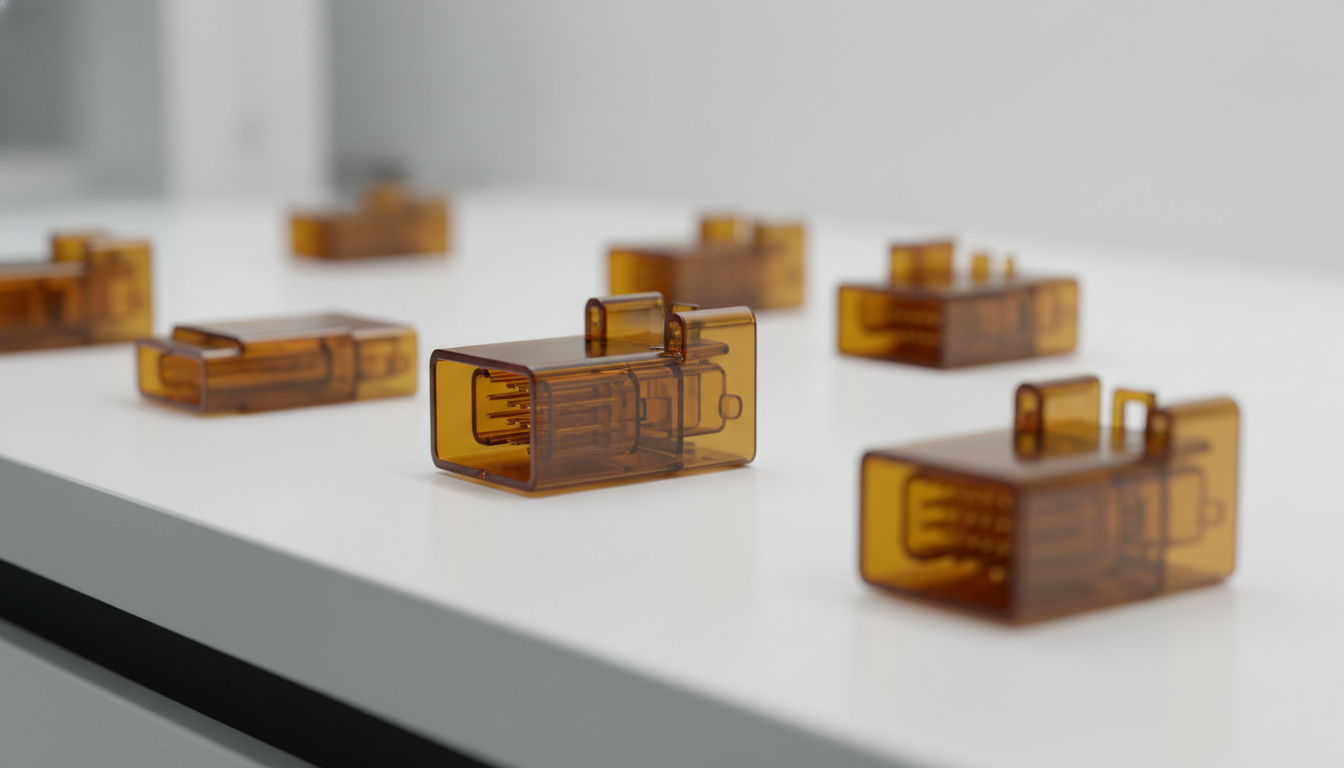
BASF Ultrason S 2010 High-Flow & Rigid Performance Profile
Ultrason® S 2010 is an unreinforced, medium-viscosity, standard injection molding Polysulfone (PSU) resin engineered by BASF, formulated to provide exceptional flowability, outstanding thermal stability, and low isotropic shrinkage:
| Physical & Strength Parameter | SABIC Ultem 1000 Value | Molding & End-Use Advantage |
|---|---|---|
| Ultra-High Flowability | MVR 90 cm³/10min (360°C x 10kg) | Enables smooth, low-pressure cavity filling of complex thin-walled automotive electronic connectors and fuse encapsulations. |
| Dielectric Strength | 40 kV/mm (IEC 60243-1) | Delivers outstanding electrical insulation resistance and arc-tracking resistance, preventing voltage leaks in power systems. |
| Thermal Deflection | HDT A 176 °C (DAM @ 1.80 MPa) | Retains mechanical properties and shape under high thermal stress in automotive under-the-hood and appliance housings. |
Process & Flow Configurations for Easy-Flow Ultrason S 2010
With its amorphous structure and exceptional melt flow index, Ultrason S 2010 is highly suitable for complex structural molds:
| Molding Technology Class | Process Compatibility & Operational Details |
|---|---|
| Automotive Fuse Encapsulations | Excellent. Fully optimized for high-temperature automotive fuse housings, under-the-hood micro-sensors, and electric relay housings. |
| High-Density Multi-Pin Connectors | Excellent. Low linear thermal expansion and standard easy-flow characteristics allow automatic, high-efficiency ejection of multi-cavity microelectronics. |
| High-Heat Appliance Components | Good. Outstanding dimensional stability, low outgassing, and excellent high-temperature creep resistance prevent structural distortion. |
PSU-BASF Ultrason S 2010 High-Speed Flow & Flash Prevention Matrix
Molding an amorphous high-fluidity polymer like Ultrason S 2010 requires strict control of parting line clearances to prevent flashing, alongside high mold temperatures:
Micron-Level Flash Control (Tooling Precision)
Because Ultrason S 2010 exhibits extreme flowability (MVR 90) under high shear, the molten resin can seep easily into minor mold gaps, causing parting line flash. Jucheng’s tooling division uses 5-axis CNC machines to achieve micro-tolerances, keeping mold parting clearances strictly within 0.005mm on premium S136 stainless steel mold cavity blocks.
Uniform Temperature Control Matrix
We maintain mold temperatures at 140°C–180°C (284°F to 356°F) using pressurized oil temperature controllers. High mold temperatures maximize surface gloss, reduce weld lines, and minimize internal molding stresses, ensuring a smooth and stress-free finish.
Desiccant Drying Protocol (Hydrolysis Prevention)
PSU is highly hygroscopic. Moisture causes cosmetic splay, bubbles, and loss of transparent optical quality. We dry raw material in desiccant hopper dryers at 130°C–140°C (266°F to 284°F) for 3–4 hours, keeping moisture strictly below 0.05% to secure optimal molecular bonds.
Amorphous Isotropic Shrinkage Control
Due to its amorphous matrix, Ultrason S 2010 exhibits low and highly uniform shrinkage (0.68% parallel and 0.72% perpendicular). We machine precise core and cavity blocks on our 5-axis CNCs, ensuring that the molded parts are completely flat and warp-free.
Key Application Fields for PSU-BASF Ultrason S 2010
- Automotive Electrical & Powertrains (IATF 16949): High-temperature fuse encapsulations, multi-pin electrical connectors, under-the-hood sensor housings, headlight assemblies, and heating system connectors.
- Electrical & Smart-Grid Engineering: High-voltage circuit breakers, terminal blocks, electrical relay housings, switch components, and coil bobbins.
- Consumer & Household Goods: Reusable household coffee machine adapters, steam-resistant caps, food-packaging closures, and dishwasher structural parts.
Properties
| Density | 1.23 - 1.24 g/cm³ |
| Melt Volume-Flow Rate (MVR) (360°C/10.0kg) | 90 cm³/10min |
| Tensile Modulus (23°C) | 2,550 MPa |
| Tensile Stress at Yield (23°C) | 75 MPa |
| Tensile Strain at Yield (23°C) | 6 % |
| Flexural Strength (23°C) | 124 MPa |
| Flexural Modulus (23°C) | 2,600 MPa |
| Izod Notched Impact Strength (23°C) | 5.5 kJ/m² |
| Charpy Notched Impact Strength (23°C) | 5.5 kJ/m² |
| Glass Transition Temperature (Tg) | 187 °C |
| Heat Distortion Temperature (HDT @ 1.80 MPa / HDT A) | 176 °C |
| Comparative Tracking Index (CTI) | 125 V |
| Dielectric Strength | 40 kV/mm |
| Volume Resistivity | 1.0E+13 Ohm-cm |
| Linear Mold Shrinkage (Parallel) | 0.68 % |
| Linear Mold Shrinkage (Normal) | 0.72 % |
| Maximum Part Size | 1000 x 800 mm |
| Minimum Part Size | 1 x 1 mm |