
PC-SABIC Lexan 940A
Securing reliable structural flammability safety and premium dielectric isolation in complex electronic housings without compromising mechanical drop-toughness requires an elite material, which SABIC’s LEXAN™ 940A delivers through its unreinforced, medium-viscosity flame-retardant polycarbonate matrix. Featuring a density of 1.21 g/cm³ and a glass transition temperature (Tg) of 150°C, this amorphous grade achieves an outstanding UL 94 V-0 flammability rating down to 1.0mm and a 5VA rating at 3.0mm. Jucheng Precision, operating under strict IATF 16949 and ISO 9001 frameworks, specializes in precision injection molding of Lexan 940A. Backed by 35+ advanced presses and in-house five-axis CNC-machined tooling, we control its low isotropic shrinkage (0.5%-0.7%), delivering flawless electrical enclosures verified by Zeiss CMM.
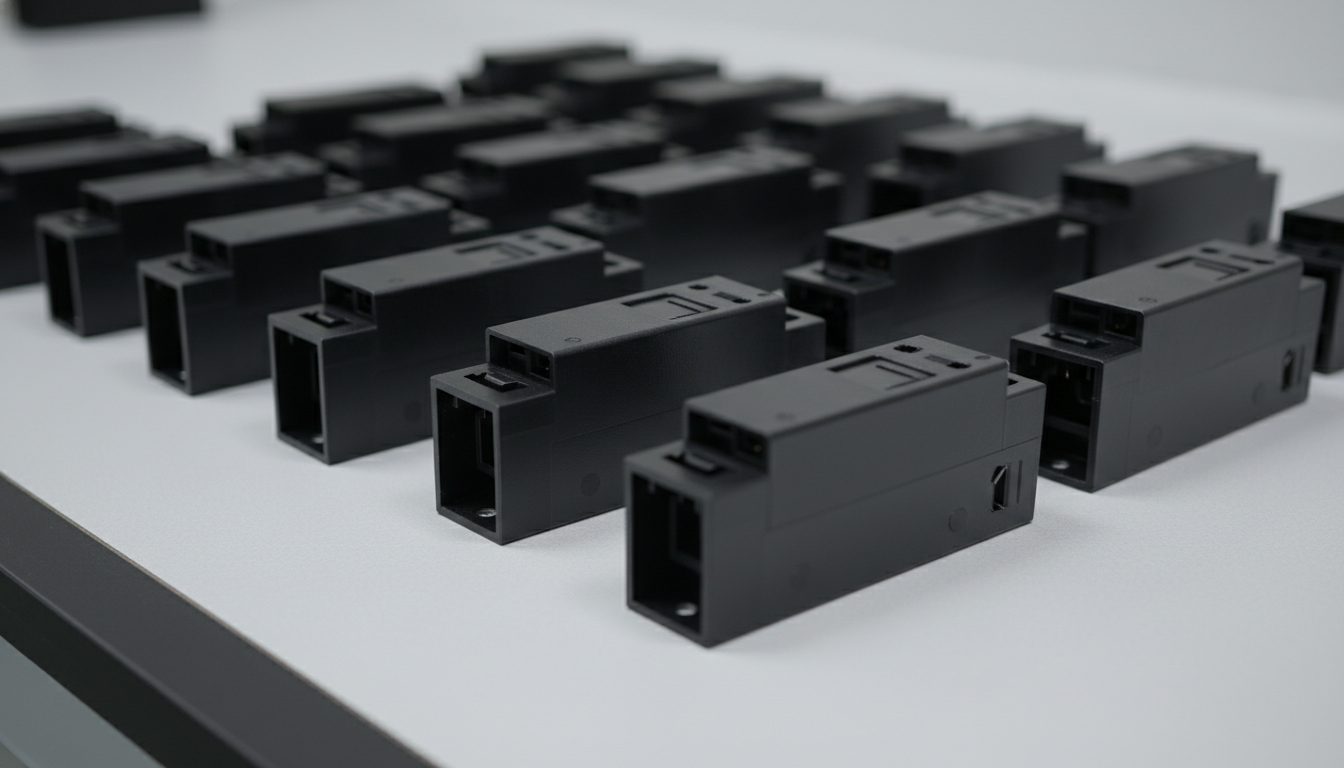
SABIC Lexan 940A Flammability & Toughness Profile
LEXAN™ Resin 940A is an unreinforced, standard-flow amorphous Polycarbonate (PC) resin, certified to deliver outstanding strength, impact stiffness, and continuous thermal resistance under ISO/ASTM standards:
| Flammability & Performance Standard | SABIC Lexan 940A Metric Value | Molding & Electrical Safety Advantage |
|---|---|---|
| UL 94 V-0 Flame Rating | V-0 Rated at 1.0 mm Wall Thickness | Provides exceptional self-extinguishing safety in thin-walled housings, preventing dynamic heat buildup and flame propagation. |
| UL 94 5VA Flame Rating | 5VA Rated at 3.0 mm Wall Thickness | Resists heavy open bar flames without structural burn-through. Essential for high-voltage power distribution boxes. |
| Impact Toughness | ASTM Notched Izod Impact 640 J/m | Unreinforced amorphous matrix provides exceptional mechanical drop-test and impact resilience compared to standard rigid PC. |
Structural Component Process Configurations for Flame-Retardant Lexan 940A
With its high-flow melt performance and low mold shrinkage, Lexan 940A processes consistently inside complex mold geometries:
| Molding Process Category | Process Compatibility & Operational Details |
|---|---|
| Thin-Wall Electronics Molding | Excellent. Highly optimized for high-transparency microelectronic housings, smart-meter accessories, and intricate connector frames. |
| Heavy-Duty Electrical Brackets | Excellent. High tensile modulus and exceptional flame retardancy prevent structural distortion or deformation in smart grids. |
| Power Supply Housings | Excellent. Outstanding dimensional stability, low outgassing, and excellent high-temperature creep resistance prevent structural distortion. |
Amorphous Self-Extinguishing Molding Matrix
Molding an amorphous high-performance resin like Lexan 940A requires strict thermal boundaries and low-stress mold setups to prevent stress-cracking:
Amorphous Isotropic Shrinkage Control
Being an amorphous copolymer, Lexan 940A exhibits low and highly uniform shrinkage (0.50% to 0.70%). We use our 5-axis CNC machines to cut precise mold cavities and balance cooling paths, ensuring zero warping and zero dimension defects on Zeiss CMM verification.
High Melt Temperature Profiling
Melting requires specialized machines with ceramic heater bands. Processing barrel temperatures are strictly managed between 280°C and 310°C (536°F to 590°F) to ensure homogeneous flow. Exceeding 320°C can result in chemical chain fracturing and polymer degradation.
Pressurized Oil Mold Temperature Control
We maintain mold temperatures at 80°C–120°C (176°F to 248°F) using pressurized water heaters. High mold temperatures maximize surface gloss, reduce weld lines, and prevent surface carbon-fibers from floating, ensuring a smooth and non-fibrous finish.
Desiccant Drying & Volatiles Exhaust (Hydrolysis Prevention)
PC is highly sensitive to moisture at high melt temperatures. Wet molding results in rapid hydrolytic chain cleavage, causing severe splay, gas bubbles, and a major drop in impact strength. We desiccant dry Lexan 940A resin at 120°C (248°F) for 3–4 hours, keeping moisture below 0.02%.
Key Application Fields for PC-SABIC Lexan 940A
- Smart-Grids & Electrical Infrastructure: High-voltage circuit breakers, smart electricity meters, terminal blocks, electrical relay housings, wall switch frames, and coil bobbins.
- EV Charging & Automotive Systems (IATF 16949): Electric vehicle charging gun housings, high-voltage junction box covers, interior fuse housings, and vehicle sensor housings.
- Consumer Electronics & Telecommunications: Wi-Fi router enclosures, charger adapter bodies, power tool housings, and set-top boxes.
Properties
| Density | 1.21 - 1.22 g/cm³ |
| Melt Volume-Flow Rate (MVR) (300°C/1.2kg) | 9.5 cm³/10min |
| Melt Mass-Flow Rate (MFR) (300°C/1.2kgf) | 10 g/10 min |
| Tensile Strength at Yield | 62 MPa |
| Tensile Strength at Break | 55 MPa |
| Tensile Elongation at Break (DAM) | 90 % |
| Flexural Strength | 91 MPa |
| Flexural Modulus | 2,240 MPa |
| Izod Notched Impact Strength (1/8, 23°C) | 640 J/m |
| Rockwell Hardness (R-Scale) | 118 - |
| Vicat Softening Point | 151 °C |
| Heat Deflection Temperature (HDT @ 1.82 MPa) | 132 °C |
| Linear Mold Shrinkage | 0.50 - 0.70 % |
| Flammability Rating (1.00mm) | UL 94 V-0 Class |
| Flammability Rating (3.00mm) | UL 94 5VA Class |
| Maximum Part Size | 1000 x 800 mm |
| Minimum Part Size | 1 x 1 mm |