
성형 광학 부품에 폴리카보네이트와 아크릴 중 하나를 선택하는 것은 어느 수지가 “더 우수한가”를 겨루는 경쟁이 아닙니다. 폴리카보네이트 대 아크릴에 대한 유용한 답은 제품이 견딜 수 없는 고장에 달려 있습니다. 아크릴은 광학적 순도, 내후성 및 표면 경도가 지배적인 경우 종종 앞섭니다. 폴리카보네이트는 충격, 인성 또는 까다로운 사용 온도가 더 중요할 때 더 매력적이 됩니다. 형상, 게이트 위치, 벽 두께 및 잔류 응력은 여전히 예상 결과를 뒤집을 수 있으므로, 최종 결정은 일반적인 물성표가 아니라 등급 수준의 성형 및 검증 계획에 속합니다.
1분 안에 결정하기
- 높은 투과율, 야외 색상 안정성 및 눈에 보이는 스크래치에 대한 저항성이 주요 요구 사항일 때 아크릴로 시작하십시오.
- 충격 손상, 균열 또는 높은 사용 온도가 더 큰 위험을 초래할 때 폴리카보네이트로 시작하십시오.
- 공급업체 데이터시트뿐만 아니라 성형된 부품이 광학, 치수 및 환경 검사를 통과할 때까지 어느 재료도 출시하지 마십시오.
이 글에서:
- 받아들일 수 없는 고장부터 시작하십시오
- 아크릴이 더 깨끗한 광학적 선택일 때
- 폴리카보네이트가 제자리를 찾는 경우
- 가공이 순위를 뒤집을 수 있는 방법
- 도면에 바로 적용 가능한 결정 순서 사용하기
- 승인 전에 수지 검증하기
- 자주 묻는 질문
받아들일 수 없는 고장부터 시작하십시오
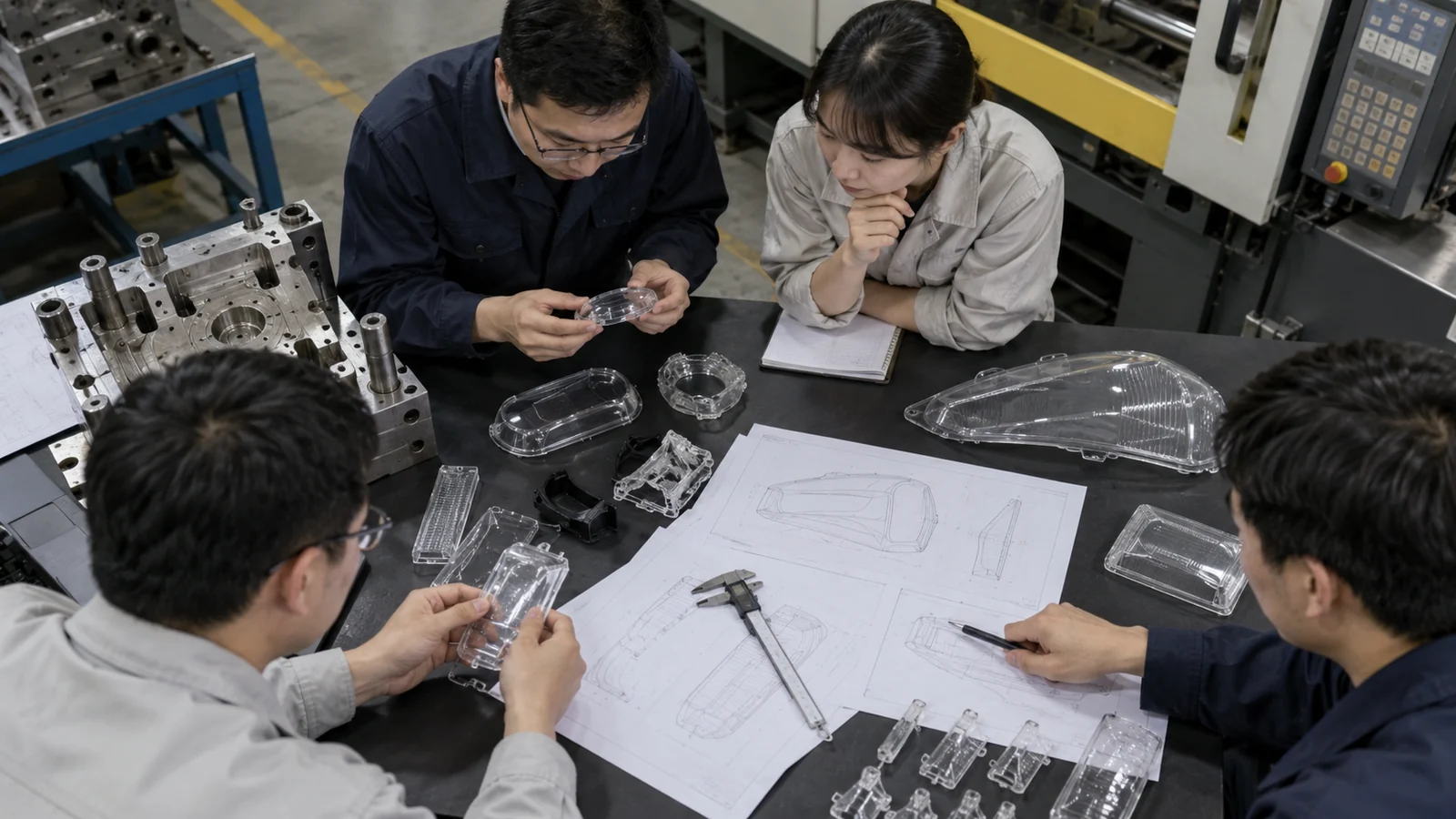
투명 커버, 라이트 파이프 및 이미징 렌즈는 도면상 모두 “투명”해 보일 수 있지만, 재료에 동일한 역할을 요구하지는 않습니다. 보호 커버는 어느 정도의 광학적 왜곡은 견딜 수 있지만 충격 파괴는 견딜 수 없습니다. 라이트 가이드는 충격은 쉽게 견딜 수 있지만 헤이즈, 색상 변화 또는 미세 형상 복제 불량으로 인해 출력이 변하여 실패할 수 있습니다. 따라서 재료 선택은 수지 펠릿의 외관이 아니라 빛의 기능에서 시작됩니다.
등급을 비교하기 전에 거부 조건을 작성하십시오. 유용한 질문에는 부품이 이미지 또는 조명만 전달해야 하는지, 반복적으로 만지거나 세척되는지, 햇빛에 노출되는지, 그리고 균열이 안전 위험을 초래하는지가 포함됩니다. 이는 계획 시 사용되는 것과 동일한 고장 우선 논리입니다 광학 및 투명 사출 성형: 광학 경로, 사용 환경 및 성형 공정을 하나의 시스템으로 검토해야 합니다.
| 주요 위험 | 더 나은 출발점 | 여전히 입증이 필요한 사항 |
|---|---|---|
| 충격 또는 우발적 하중 | 폴리카보네이트 | 노치, 웰드 라인 및 화학적 노출 |
| 눈에 띄는 스크래치 또는 야외 투명도 | 아크릴 | 실제 세척 방법 및 표면 형상 |
| 이미징 왜곡 | 등급 및 공정에 따라 다름 | 복굴절, 형상 오차 및 조립 응력 |
| 고온 작동 환경 | 흔히 폴리카보네이트 | 정확한 등급, 하중, 지속 시간 및 광학적 드리프트 |
아크릴이 더 깨끗한 광학적 선택이 되는 경우
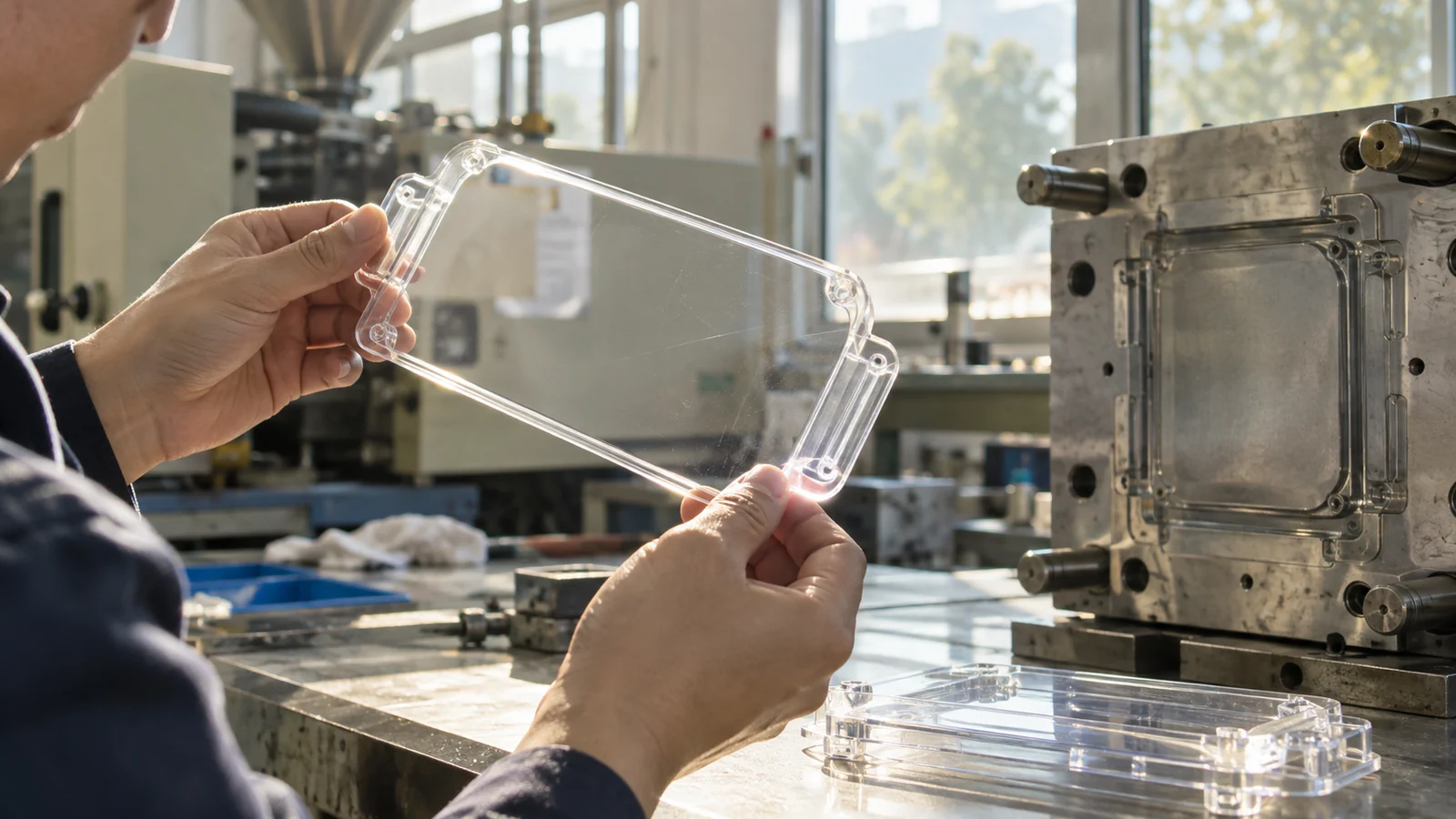
PMMA는 부품이 노출된 환경에서 시각적으로 투명하게 유지되어야 하고 일상적인 표면 마킹에 저항해야 할 때 강력한 출발점입니다. Röhm은 자사의 광학용 PLEXIGLAS 성형 컴파운드에 대해 최대 92%의 광 투과율을 보고하며, 내후성, 색상 안정성 및 정밀한 금형 표면 재현성도 강조합니다. 이러한 설명은 소재군과 특정 등급을 설명하는 것이며, 모든 벽 두께, 텍스처, 색상 또는 성형 사이클에서 동일한 결과를 보장하지는 않습니다. 제조사의 공식 PMMA 광학 응용 가이드 는 유용한 등급 선별 참고 자료입니다.
아크릴의 장점은 충격 하중이 예측 가능하고 부품 형상이 날카로운 응력 집중부를 피할 때 가장 활용하기 쉽습니다. 계기창, 디스플레이 커버, 조명 광학 부품 및 일부 도광체가 이 프로파일에 해당할 수 있습니다. 스냅 핏에 변형이 심하거나, 나사가 투명 영역을 직접 관통하여 조이거나, 부품이 떨어질 가능성이 있는 경우에는 선택이 덜 편안해집니다. 이러한 경우 이를 보상하기 위해 벽 두께를 늘리면 냉각 시간 연장, 싱크 위험 및 광학 경로 변화라는 다른 문제가 생길 수 있습니다.
선택한 PMMA 소재 및 등급 요구 사항 을 검토하십시오. 도면 수준의 라벨로 “아크릴”을 승인하지 마십시오. 동일한 폴리머 이름으로 판매되는 등급 간에도 유동성, 내열성, UV 패키지, 이형 거동 및 광학 품질이 다를 수 있습니다.
폴리카보네이트가 제 역할을 하는 경우
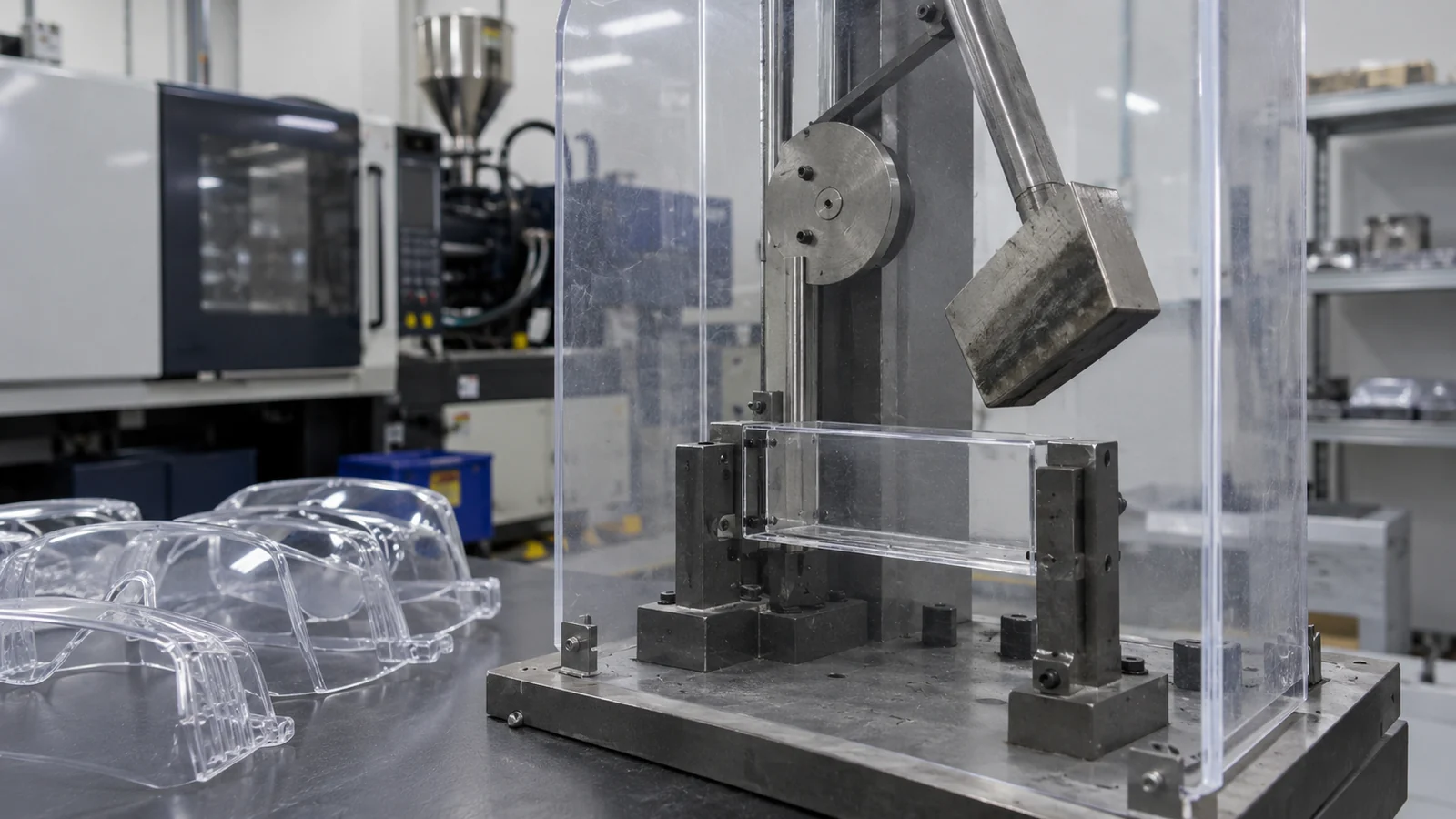
폴리카보네이트는 균열 또는 충격 손상의 결과가 최대 표면 경도에 대한 필요보다 클 때 제 역할을 합니다. 보호 렌즈, 가드, 센서 커버 및 취급이나 진동에 노출되는 조명 부품은 종종 PC 쪽에서 소재 검토를 시작합니다. Covestro는 Makrolon 폴리카보네이트를 투명하고 충격에 강하며 치수 안정성이 뛰어나다고 설명하며, 조명 및 사출 성형 등급을 포함한 포트폴리오를 보유하고 있습니다. 이 회사의 공식 Makrolon 소재 개요 는 또한 일반 약어 “PC”보다 특정 등급명이 더 중요한 이유를 보여줍니다.”
인성은 성형된 PC 부품을 파손으로부터 면역되게 만들지 않습니다. 날카로운 내부 코너, 잘못 배치된 웰드 라인, 강한 세정액 또는 높은 조립 변형은 여전히 균열을 일으킬 수 있습니다. 노출 표면은 마모 및 장기 노출에 대한 추가적인 고려가 필요할 수도 있습니다. 보호 코팅을 고려 중이라면, 코팅되지 않은 PMMA와 이론적인 코팅 PC를 비교하기보다는 코팅된 시스템을 평가하십시오.
사이트의 polycarbonate material page can support the initial discussion, but the RFQ should still identify the environment, optical region, cleaning chemicals and regulatory requirements that govern the actual grade selection.
Processing Can Reverse the Material Ranking
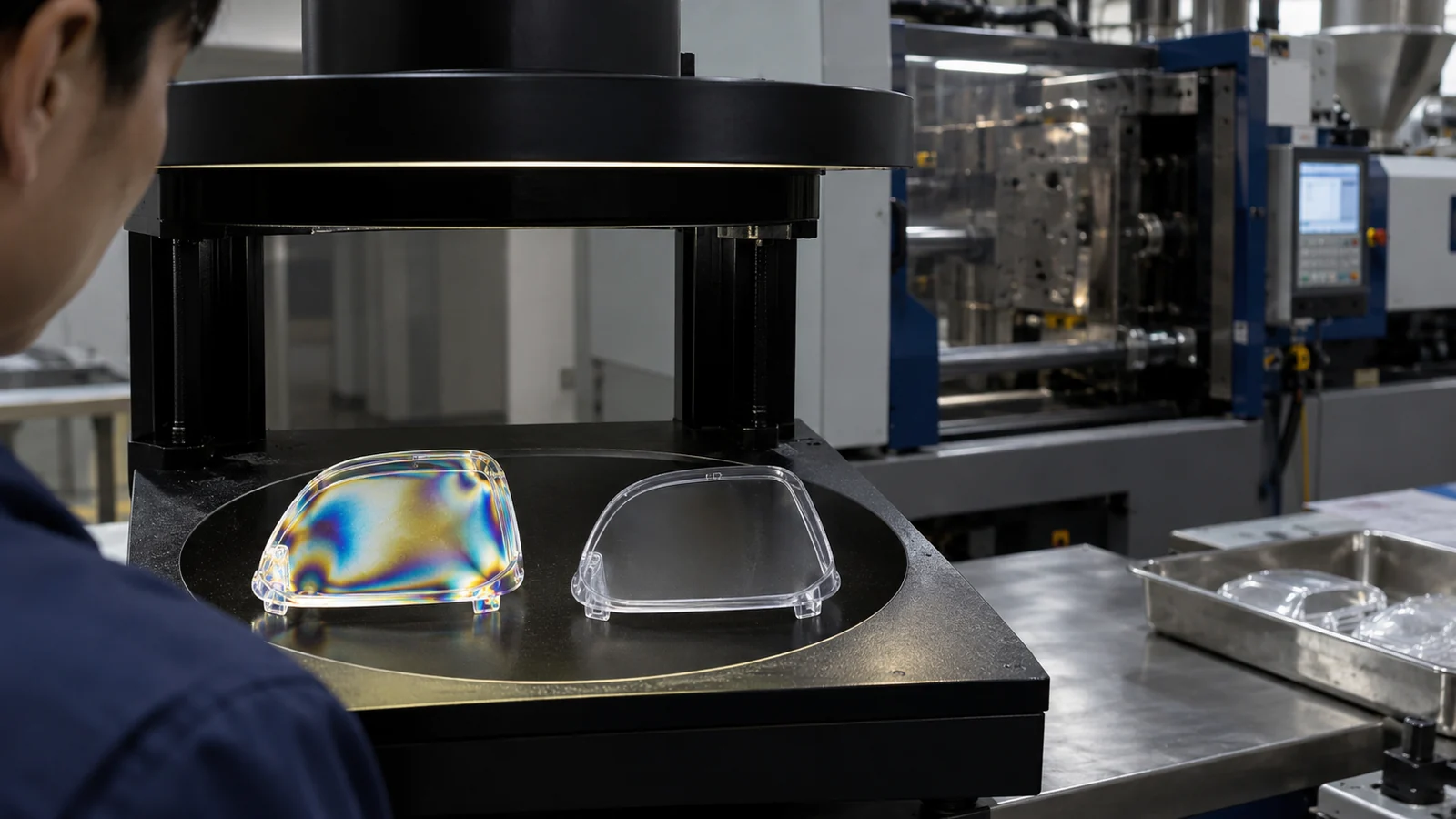
A well-chosen resin can lose its advantage inside a poorly designed part or process. Excess shear near a restrictive gate can leave orientation and stress in a transparent component. Uneven packing and cooling can change thickness, flatness and optical power. Moisture, contamination or excessive residence time can introduce streaks, bubbles, yellowing or black specks that have little to do with the published clarity of the base resin.
This is why one polished plaque is not enough evidence. Plaques are useful for material screening, but production geometry creates its own flow length, pressure drop, gate freeze, cooling gradient and ejection load. Thick sections deserve particular attention because the center can remain hot after the skin has solidified. The result may be sink, voids, delayed shrinkage or optical distortion even though the surface initially looks acceptable.
Gate location should keep the vestige and the highest-shear region away from the critical optical path when geometry allows. At the same time, moving the gate too far away can extend the flow path and reduce packing control. Material, part and mold decisions therefore need to be made together rather than passed between teams as separate approvals.
Use a Drawing-Ready Decision Sequence
A practical material decision can be made in six passes:
- Define the optical job. State whether the part transmits an image, guides illumination, diffuses light or only provides a clear viewing window.
- Rank the failure consequences. Separate unacceptable fracture, haze, scratching, color shift, birefringence and dimensional drift.
- Map the environment. Record temperature, UV exposure, chemicals, cleaning, assembly load and expected service life.
- Review molding geometry. Mark thick sections, long flow paths, gates, weld lines, ejection areas and cosmetic surfaces.
- Select actual grades. Compare supplier data under relevant test conditions; do not transfer one grade’s values to the entire polymer family.
- Write the validation plan. Define how optical, dimensional, mechanical and environmental performance will be measured on molded parts.
This sequence may still produce two viable candidates. That is not indecision. It is a signal to mold representative samples or use prototype tooling before committing production steel, especially when coating, texture, assembly stress or thick optical geometry changes the material behavior.
What to Validate Before Approving the Resin

Approval should connect every critical requirement to a method, sample location and acceptance rule. “Clear” is not a measurable requirement by itself. Depending on the product, the control plan may include transmission or haze, color, focal or light-output performance, surface defects, dimensions, flatness, birefringence, impact, coating adhesion and environmental conditioning.
Inspect the critical optical zone separately from nonfunctional edges and gate areas. Record cavity identity when a multicavity mold is used, because one cavity can reproduce or cool differently from another. First-article results establish whether the tool can make the part; capability data across a stable run shows whether it can keep making it.
A useful RFQ therefore includes the 3D model, drawing, optical region, target resin or candidate grades, annual quantity, appearance standard, operating environment and required reports. Where traceability and inspection stages matter, define the required records and acceptance stages alongside the molding proposal.
자주 묻는 질문

Is acrylic always clearer than polycarbonate?
Acrylic is often the stronger starting point for high transmission and outdoor clarity, but the finished-part result depends on grade, thickness, surface replication, color, stress and processing. Compare molded samples under the product’s actual optical test rather than selecting from one headline value.
Is polycarbonate always the safer choice for impact?
Polycarbonate generally offers the better starting point when impact is critical, but geometry and environment can remove that advantage. Notches, weld lines, high assembly stress and incompatible chemicals must be included in the test condition.
Can one mold run both PC and PMMA?
Sometimes, but it should not be assumed. Different shrinkage behavior, processing windows, gate response and ejection behavior may require compromises. A tool optimized around one material may not produce equivalent dimensions or optical quality with the other.
Which material is cheaper for a molded optical part?
Resin price alone cannot answer the question. Tooling changes, coating, cycle time, reject rate, handling protection and field failure can outweigh the pellet-price difference. Compare the total route needed to meet the same approved specification.
What should be sent for a material review?
Send the 3D model, drawing, critical optical area, environment, mechanical loads, cleaning chemicals, quantity, appearance criteria and required validation reports. If a grade has already been specified, include the complete supplier and grade designation.