
A stack mold is worth evaluating when a steady production program needs more parts per press cycle and the part geometry can be arranged across multiple parting planes. It is not automatically faster or cheaper. The decision depends on actual demand, mold layout, press opening and clamp constraints, hot-runner strategy, automation, validation effort, and maintenance. A conventional mold may remain the lower-risk choice when the forecast is uncertain or a simpler tool already meets output needs. A stack mold vs conventional mold comparison should start with required annual output and parts per cycle, not a headline claim about doubling production.
Compare good parts per hour, not cavities per cycle. Include realistic cycle time, yield, planned tool maintenance, changeovers, press availability, and downstream capacity. A stack architecture makes sense only when the added usable output can be absorbed by the program.
In this article:
- What changes in a stack layout?
- Compare production economics
- Check the press and process envelope
- A practical go/no-go sequence
- FAQ
What changes in a stack layout?
A conventional mold forms parts on one main parting plane. A stack mold adds another parting plane and arranges cavities in layers. A suitable design can fill both levels during a cycle, increasing theoretical output without simply doubling the mold’s projected area. In return, the tool architecture, opening sequence, runner arrangement, support structure, and part handling become more complex.
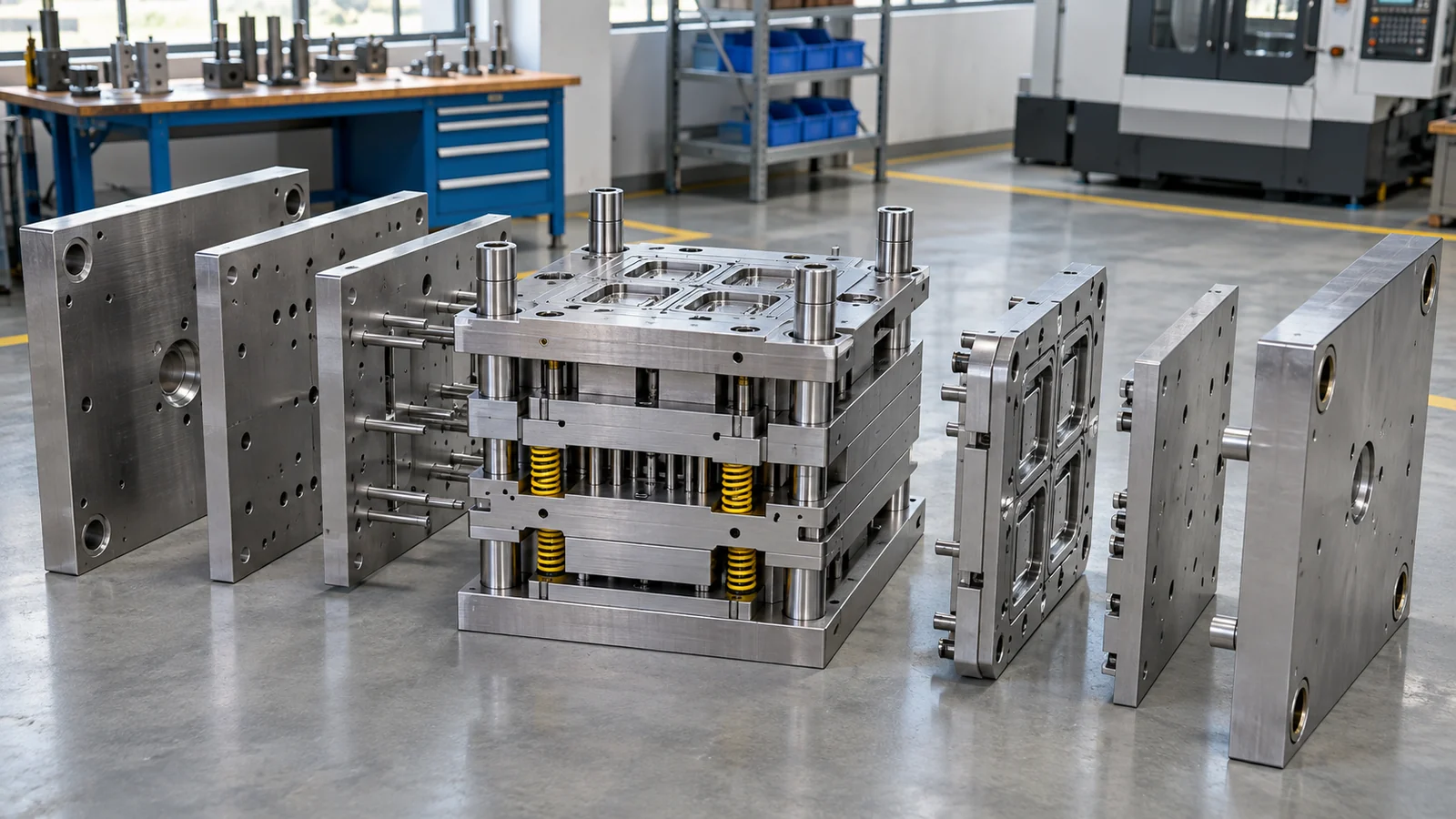 More cavities do not guarantee more sellable parts. If the levels do not fill or cool consistently, ejection is unreliable, or handling is awkward, theoretical output may not translate to stable production. Begin with the part layout and quality requirements, then ask whether the stack arrangement can meet them.
Compare production economics
Use the same resin, part, acceptance criteria, and demand forecast for both concepts. Estimate good parts per hour after accounting for cycle time, cavity yield, changeover, planned maintenance, and realistic press availability. Include startup scrap, runner assumptions, inspection, deflashing, assembly, and any downstream bottleneck. Review stack mold vs conventional mold against press tonnage, mold height, daylight, tie-bar spacing, cooling layout, and the maintenance skills available.
| Factor | Stack tool is stronger when… | Conventional tool is stronger when… |
|---|---|---|
| Demand | Forecast is sustained and can use added output. | Demand is uncertain or still being validated. |
| Tool complexity | The team can validate and maintain the architecture. | Qualification speed and simple service are priorities. |
| Economics | Added output offsets tool and validation cost. | A simpler tool meets volume at lower lifecycle risk. |
Keep assumptions symmetrical. Do not compare theoretical maximum output for the stack mold with a conservative production estimate for the conventional mold. Ask each supplier to separate confirmed values from estimates, then test the business case with a cautious utilization scenario.
Check the press and process envelope
Confirm usable opening stroke, daylight, tie-bar spacing, platen size, clamp capacity, ejector arrangement, mold support, and setup access for the actual press. A stack tool may have different opening and force-distribution requirements. A paper fit based only on platen dimensions is not enough; the machine must accommodate the tool motion and allow practical inspection and service.
 Review the melt delivery and thermal behavior across cavity levels. Symmetrical runner lengths do not guarantee equal filling because restrictions, gates, temperatures, and cavity geometry also matter. Plan how fill balance, cooling, ejection, and part quality will be validated. Coordinate the concept with the site’s injection mold design review, including gate layout and maintenance access.
Maintenance planning is part of the economics. Identify wear components, necessary spares, service access, and the likely effect of a tool repair on delivery. If a stack concept wins only under perfect uptime assumptions, the business case is fragile.
A practical go/no-go sequence
- Prove the volume case. Use the demand forecast and good parts per hour.
- Confirm machine fit. Get written confirmation of clamp, opening, daylight, tie-bar, and handling limits.
- Define validation. Specify how each level’s filling, cooling, ejection, and quality will be checked.
- Price the lifecycle. Include tool cost, trials, spares, maintenance, and downtime exposure.
- Keep a fallback. Decide what happens if demand or the equipment plan changes.
If the concept still makes sense under conservative demand and availability assumptions, and there is a credible validation and service plan, a stack mold may be justified. Otherwise, a conventional mold can be the more controllable path. The stack mold vs conventional mold decision also depends on cycle time, changeover needs, spare-part strategy, and whether demand is stable enough to justify the added tooling complexity.
FAQ
Does a stack mold always make twice as many parts?
No. The theoretical cavity count must be translated into good parts per hour after cycle, yield, availability, handling, and maintenance are considered.
Can any press run a stack mold?
No. Confirm opening stroke, daylight, tie-bar spacing, platen, clamp, ejection, and tool-handling limits against the actual press.
When is conventional tooling safer?
It may be preferable when volume is uncertain, qualification time is short, or a simpler tool meets required output with less maintenance exposure.
What belongs in the supplier comparison?
Compare layout, output assumptions, runner and gate concept, press requirements, validation, spares, service access, and lifecycle cost using the same demand and acceptance assumptions.