
A large molded housing can be inexpensive at the press and expensive to deliver undamaged. Large part injection molding cost includes more than steel and resin: cooling time, accepted yield, removal, inspection support, protective packaging, and shipping volume can change the result. Compare alternatives at the same accepted, delivered assembly—not just by mold quotation or cost per kilogram.
This approach is useful when deciding whether a large enclosure should be molded as one piece or divided into smaller parts. Neither architecture is automatically cheaper. The decision depends on tooling, joining, cosmetics, service access, logistics, and the quantity the program can realistically use.
Set the boundary at the delivered usable part
Start with a common commercial boundary. Does the price cover a part at the molding machine, inspected and packed at the factory, or delivered to the assembly location? Freight terms, protective materials, packaging return arrangements, and inspection exclusions can make two unit prices incomparable.
Large components can occupy significant shipping and storage space without weighing much. Nesting may help, but only if it does not scratch the surface, distort the flange, or load a fragile feature. A design that reduces resin weight while requiring much larger protective packaging may not reduce landed cost.
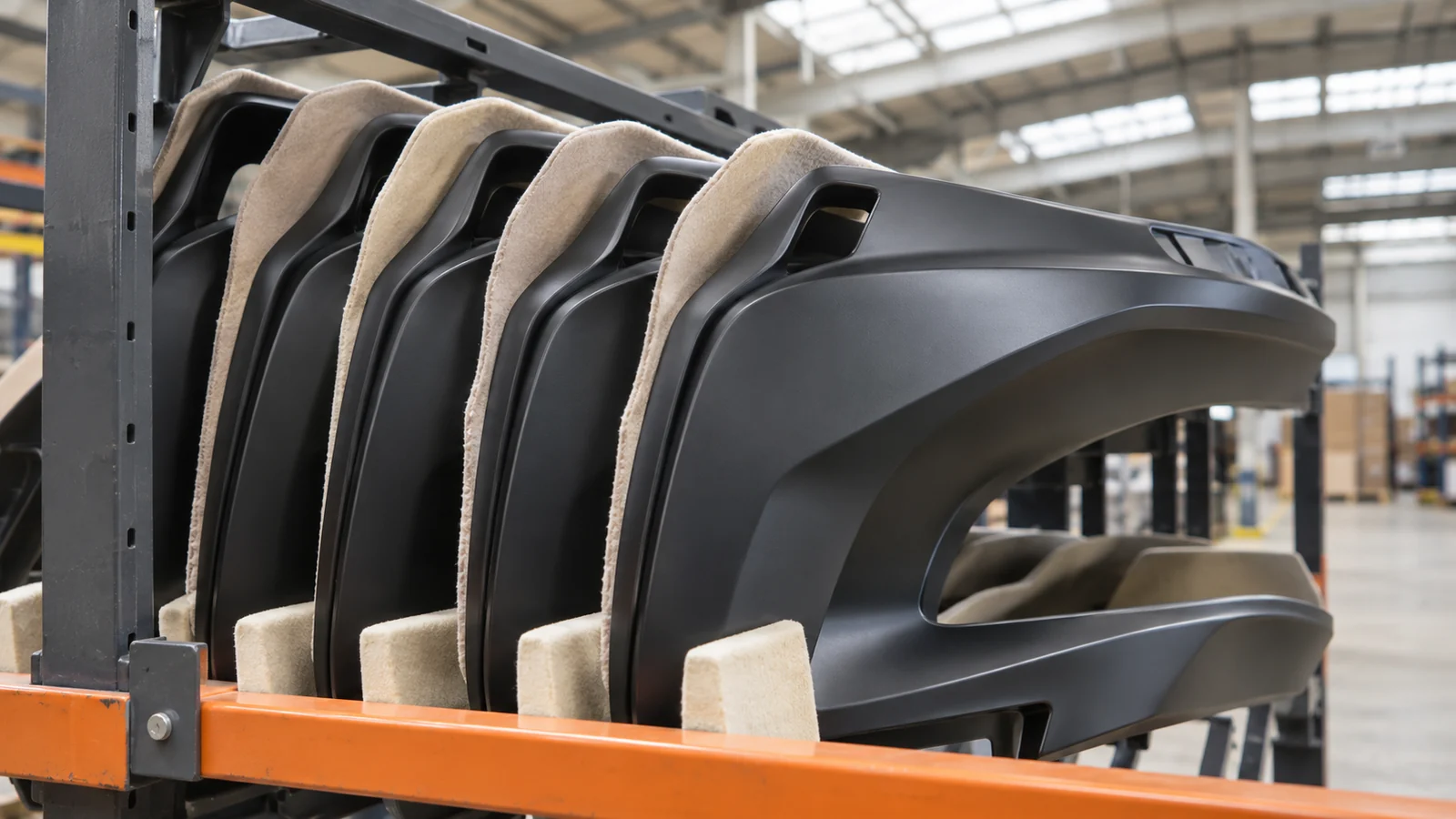
Ask for a scoped large part injection molding cost review that identifies the included processes. Do not infer a machine selection or production rate from the outside dimensions alone; the mold, projected area, resin, flow, and removal requirements all matter.
Five cost buckets that deserve separate assumptions
Keep fixed investment separate from recurring production and logistics. The point is not to request confidential supplier rates. It is to understand which design or purchasing decision changes each part of the quotation.
| Cost bucket | Relevant project inputs | Useful question |
|---|---|---|
| Tool construction | Envelope, actions, cooling, finish, and expected program life | Which features create most of the construction work? |
| Material and accepted yield | Exact grade, part weight, runners, startup, and rejection criteria | Are costs based on accepted parts or gross output? |
| Cycle and removal | Cooling, release, support, and safe handling | What limits the cycle beyond fill time? |
| Finishing and inspection | Cosmetic standard, fixtures, checks, and rework policy | Which operations remain after molding? |
| Packaging and transport | Pack density, surface protection, freight terms, and damage risk | What arrives ready for assembly? |
Use realistic quantities and release schedules. A lifetime forecast is not the same as an initial purchase order. Repeated small releases can require setup, storage, or handling arrangements that differ from one continuous run, even when the annual total matches.
One large shell or several joined panels?
A one-piece design can remove joints, fasteners, and assembly work. It may also create a larger tool, a longer flow path, more demanding removal, and a less efficient shipping shape. Splitting the housing can simplify individual parts but introduce seams, tolerance stacks, and joining operations.
Consider a hypothetical equipment enclosure with two access zones. A single shell may look cleaner, but a removable panel could improve service access and reduce replacement cost. Conversely, splitting a load-bearing cover only to use a smaller mold can create extra assembly fixtures and fasteners. Compare both concepts against the same appearance and functional requirements.
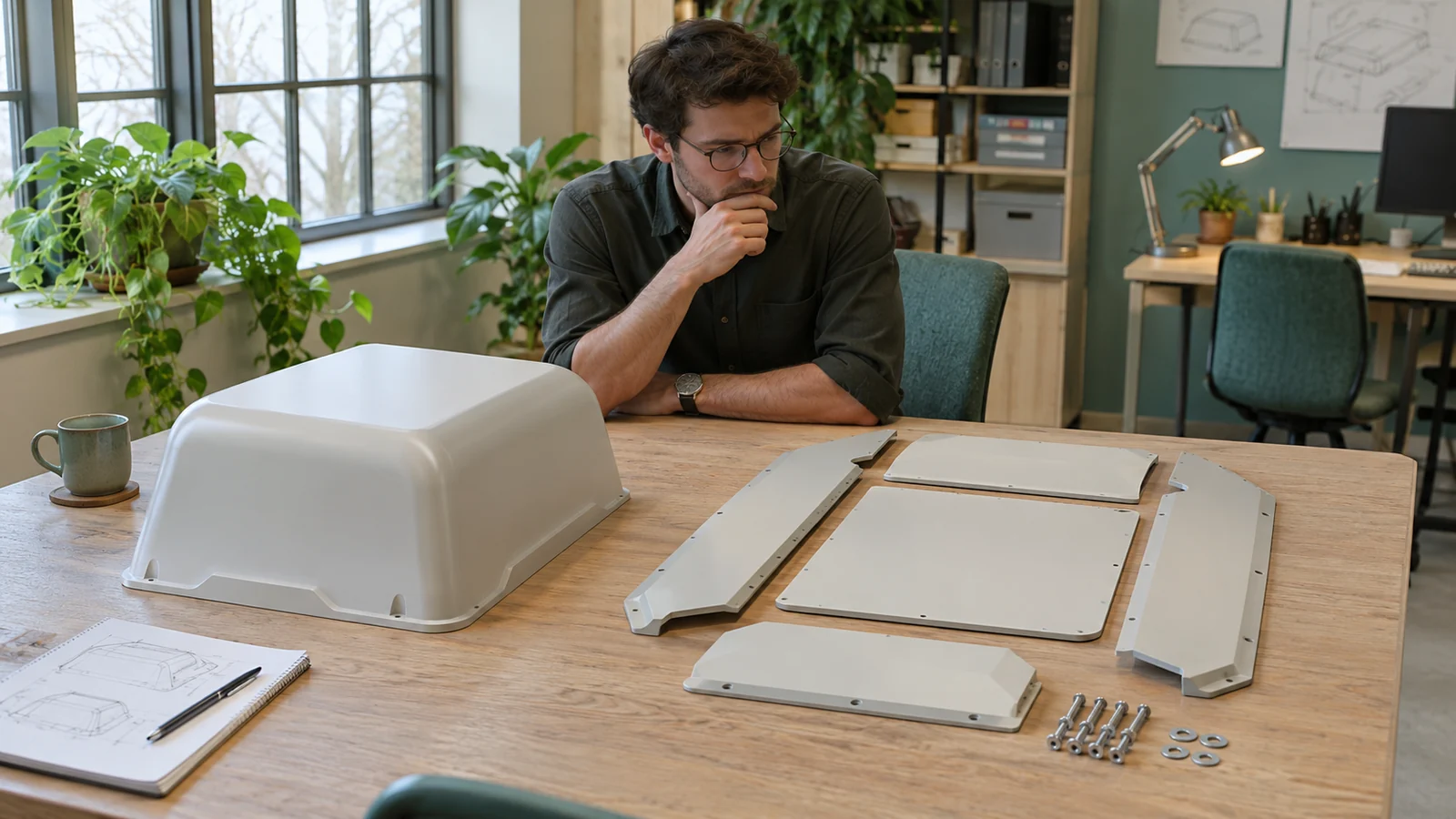
Include the joining route in the early concept review. Screws, clips, welding, and adhesive bonding create different access, maintenance, and inspection needs. The site’s post-molding assembly page provides context for that downstream scope; the selected joint still needs part-specific design and validation.
Cooling and rejection can outweigh a resin saving
Reducing a thick section may decrease cooling demand and material use, but an inadequate wall or abrupt transition can introduce fill or structural problems. A material change might lower purchase price while increasing cycle difficulty, cosmetic rejection, or assembly mismatch. Evaluate the accepted part, not a single input price.
Cosmetic criteria are particularly important for large panels. A broad appearance face can reveal sink, flow variation, or handling damage. If the buyer and supplier use different lighting, viewing distance, or limit samples, the rejection assumption in the quote may not represent the real approval standard.
A design-for-manufacturing review should therefore relate each cost-saving proposal to quality consequences. Removing mass, changing a gate, or adding texture can have multiple effects. Ask what must be rechecked after the proposed change rather than assuming the original acceptance remains valid.
Packaging is part of the manufacturing concept
Check the support points on a representative packed part. A flange designed only for assembly may not be a safe place to carry stacking loads. A protruding boss or return lip can also prevent efficient nesting, even when the exterior surfaces appear compatible. Test the packaging arrangement with the agreed surface protection rather than approving a carton by its outside dimensions.
For a hypothetical broad equipment cover, separate panels might pack densely but require more handling and fastening at destination. A one-piece shell might remove that assembly work yet consume more transport volume. Compare the complete delivered configuration, including which protective items are disposable or returnable and who manages them. Do not assume that lower freight weight means a lower freight charge.
Make the economic comparison auditable
A simple project model is: total program cost equals tooling, plus accepted quantity multiplied by recurring delivered cost, plus separately identified validation or revision work. For a split design, recurring cost must include the extra components, joints, inspection, and assembly labor on a comparable basis.
Break-even calculations are useful only when both concepts meet the same specification and their assumptions remain visible. A mathematical crossover does not prove that demand will reach that quantity, that the design will stay unchanged, or that a tool will produce indefinitely without maintenance.
- Define one accepted assembly and the delivery boundary.
- Quote the one-piece and split concepts to the same resin and finish requirements.
- List fixed, recurring, and contingent costs separately.
- Compare plausible release quantities, not only the largest forecast.
- Review handling and packaging with representative samples.
- Record which assumptions must be confirmed at the trial.
This makes large part injection molding cost a design and purchasing decision rather than an argument about one high tooling number. The best route is the one that meets the required product outcome at a defensible total cost.
Cost questions before purchase approval
Is a large part always more expensive than a small complex part?
No. Size contributes to tooling, processing, and logistics, but intricate actions, tight features, and demanding finishes can make a smaller part costly. Compare the complete construction and acceptance scope.
Can thicker walls reduce the cost by avoiding ribs?
Not necessarily. Thick sections can add material and cooling demand and may create sink or void concerns. Assess stiffness and moldability together rather than replacing a reviewed rib structure with solid mass.
Should packaging wait until production starts?
No. Packaging can affect pack density, cosmetic damage, and deformation during transport. Review it before the recurring cost and delivery plan are approved.