
The harder steel is not automatically the safer mold purchase. Injection mold steel selection must balance wear, corrosion, toughness, surface quality, thermal behavior, and the way each tool component is made and maintained. A useful specification names the material condition and the work it must perform, not only a familiar grade.
This becomes important when two quotations offer different steels for the same plastic part. Before comparing price, establish whether they cover the same cavity, core, moving components, finish, and production duty. A cheaper mold base is not the same decision as a cheaper cavity insert, and one grade need not be the best answer everywhere.
Write the exposure before writing the grade
Start with the exact resin and its reinforcement or additive package. Abrasive fillers, corrosive exposure, processing temperature, and deposits can place different demands on the tool. Include the environment around the mold as well: storage humidity and cooling-water conditions can matter even when the polymer itself is not the dominant corrosion risk.
Then connect those demands to the part. A small shutoff, slender core, optical face, or heavily loaded sliding surface may become limiting before the broad cavity wall. Describe what failure would reject the part: visible pitting, flash, lost detail, dimensional drift, or component damage. Those outcomes establish the property trade-offs worth paying for.
Uddeholm’s injection-moulding guidance identifies production duty, plastic, mold size, and surface finish as selection factors. Use them as a joined specification. A grade recommended for one resin and finish cannot be assumed suitable for another simply because the proposed tool life sounds similar.
Do not buy the whole mold as one block of steel
The mold base, cavity, core, gate inserts, shutoffs, and moving components perform different jobs. Some regions need a finished surface; others need support, movement, wear resistance, or replaceability. Listing one premium steel for the entire tool can conceal where the material is essential and where it adds cost without solving the limiting problem.
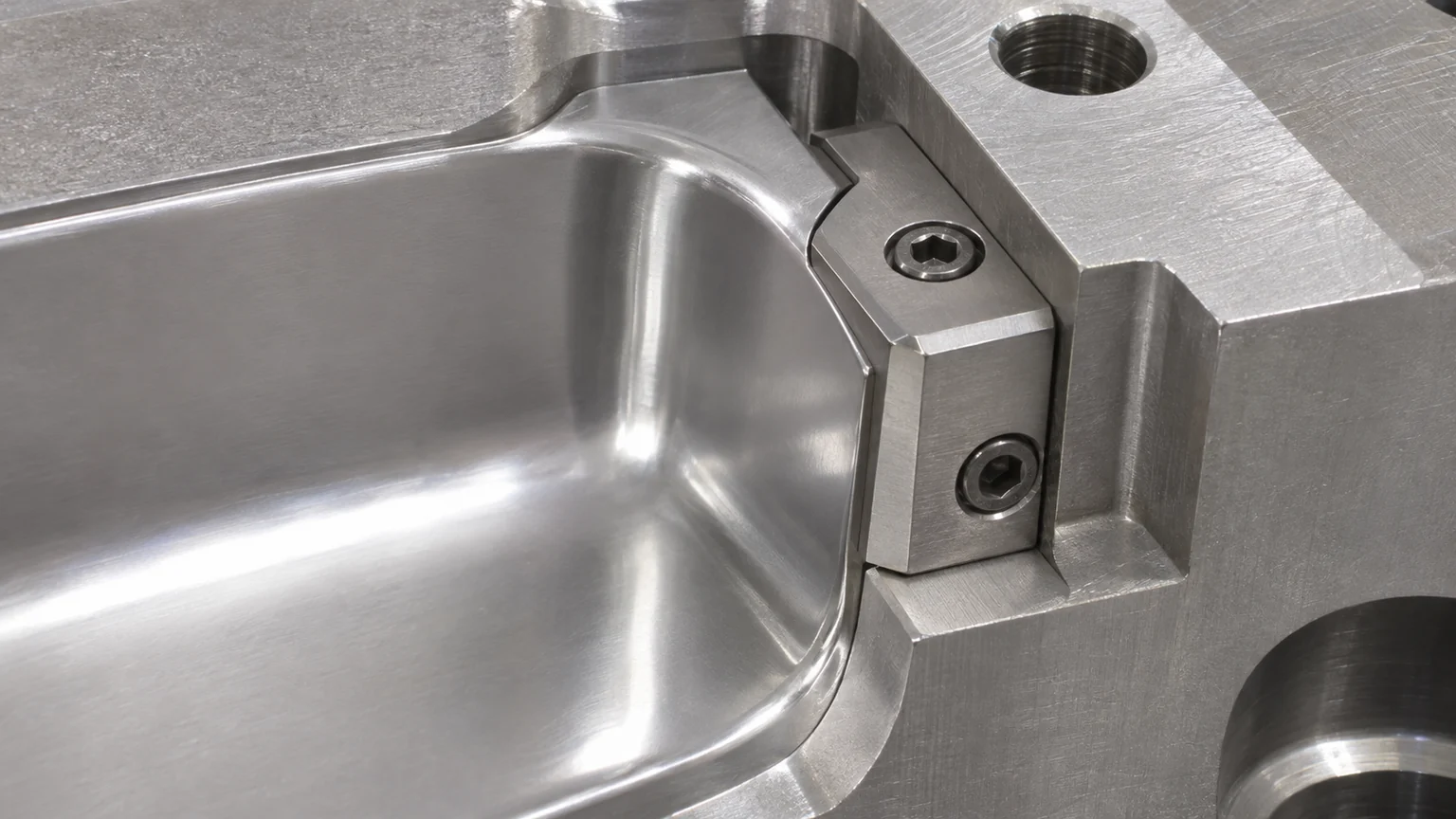
An injection mold steel selection discussion should therefore start with a component schedule. For each critical region, record the proposed grade, supplier, delivery condition, intended treatment, and reason for selection. Where a standardized component is specified, retain its manufacturer’s identification instead of substituting an approximate shop description.
| Mold region | Main selection question | Evidence to request |
|---|---|---|
| Cavity or cosmetic insert | Can the material support the required finish and exposure? | Grade identity, condition, finish requirements, and relevant treatment record |
| Thin core or shutoff | How are toughness, wear, and support balanced? | Construction review and rationale for the local material |
| Moving contact surface | How will friction and wear be controlled? | Material pairing, treatment, lubrication, and replacement approach |
| Supporting structure | Will the construction maintain alignment and support? | Drawing, load-support concept, and material specification |
The schedule also makes substitutions visible. “Equivalent steel” needs an engineering review of the relevant properties and condition; a matching hardness reading is not enough to establish equivalence.
A grade name does not describe the final condition
Prehardened and through-hardened routes change how toolmaking is planned. Heat treatment, machining sequence, stress relief where appropriate, and finishing can influence distortion risk and the work needed to recover the intended geometry. The steel designation alone does not tell the buyer how those operations were controlled.
Surface treatment is another separate decision. Nitriding or a coating may address a particular wear or release problem, but it does not turn an unsuitable underlying construction into a universally durable one. Define the functional surface and inspect the relevant dimensions and finish after the planned treatments.
For a custom mold making project, request the material and treatment records that matter to the approved drawing. Do not impose unrelated certificates just to enlarge the paperwork package. The objective is traceability of the property and condition on which the tool design depends.
Polish, texture, and cooling can pull the decision apart
A mold face intended to reproduce a demanding visible finish needs more than nominal hardness. Material cleanliness, consistency, surface preparation, and the finishing process influence what can be achieved. Agree the appearance reference and the region to which it applies before treating “mirror finish” as a complete requirement.
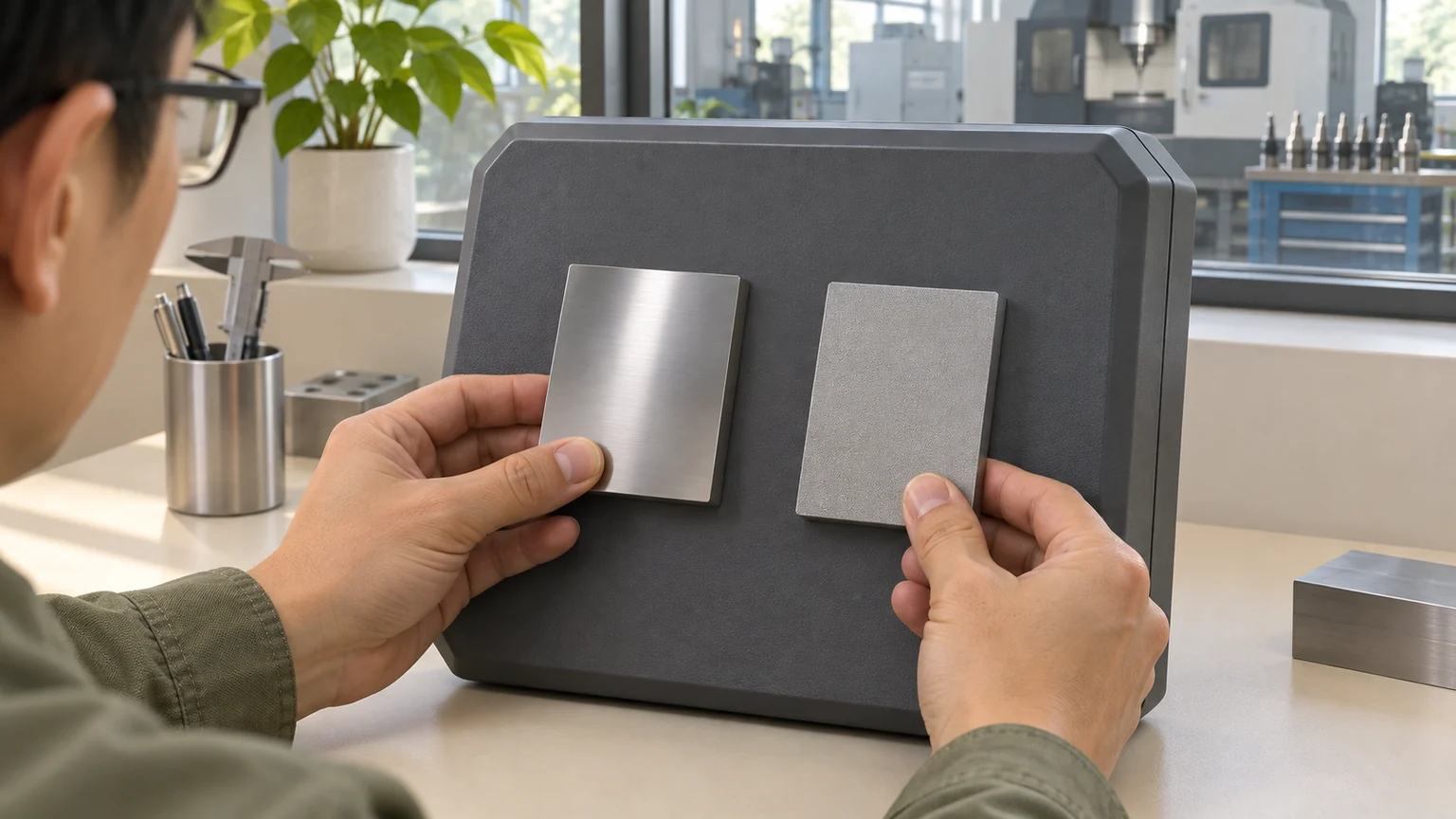
Thermal performance introduces a different trade-off. A selection that addresses wear or corrosion may not provide the heat-transfer behavior the initial cycle assumption relied on. Review material and cooling construction together rather than using a resin-independent cycle promise to justify a steel upgrade.
Consider an illustrative enclosure with a visible front face and a narrow internal shutoff. Its appearance face and shutoff do not necessarily have the same limiting risk. A local insert strategy may help separate those needs, but its support, interfaces, and serviceability still require design review. This example describes a decision method, not a prescription for a specific steel combination.
Compare quotations with a component-level clarification list
When two toolmakers propose different materials, ask each to explain the relevant region and risk rather than requesting a single “upgrade price.” One proposal may include a replaceable gate insert while another machines the feature directly into a larger component. The grade difference cannot be evaluated independently of that construction.
Prepare a clarification list with columns for component identity, proposed grade, condition, treatment, finish, and replacement route. Mark open items instead of resolving them through an unsupported equivalence claim. Where a premium grade is proposed, ask what failure risk it addresses and how that benefit will be verified.
Keep the agreed schedule with the purchase specification and the final tool documentation. If a change is accepted during manufacture, preserve its reason and approval rather than silently replacing the original entry. This makes the commercial comparison auditable without pretending that every mold project needs the same steel specification.
Make repair and acceptance part of the purchase
A tool is a maintained assembly. Ask how the critical regions can be inspected, repaired, refinished, or replaced without losing their approved relationship to the part. Weldability and a practical replacement route may matter when the design is still evolving; neither should be assumed from a familiar grade name.
Use tool trial and validation to assess the completed tool, not to substitute for missing material traceability. Trial parts show whether the assembled construction can reproduce the required features under the agreed process. They do not by themselves verify every steel specification or guarantee indefinite service life.
- Identify the exact resin and the surfaces or features that govern acceptance.
- Separate cavity, core, support, and moving-component material decisions.
- Record delivery condition, treatment, and permitted substitution controls.
- Agree finish and dimensional checks after the relevant manufacturing stages.
- Define inspection, repair access, and replacement provisions.
That makes injection mold steel selection a defensible purchasing decision. The goal is neither the highest hardness nor the longest list of premium grades. It is a traceable construction that addresses the actual failure risks at the required production duty.
Questions to settle before accepting the steel schedule
Does a harder steel always give longer mold life?
No. Wear resistance is only one consideration. Toughness, corrosion, geometry, alignment, treatment, and maintenance can govern useful life. Specify the failure risk before choosing a harder material.
Can a mold class replace the material specification?
No. A classification supports a construction and production-duty discussion, but the critical components still need identified grades and conditions. The class label alone is not proof of the finished tool’s properties.
Should every component use the same steel?
Not necessarily. Different tool regions can justify different materials. The design must account for their support, interfaces, operating conditions, and maintenance rather than treating a mixed construction as automatically better or worse.