
Gate Removal
Gate removal separates an injection-molded component from its feed connection and leaves the gate area in a specified condition. A remaining projection can obstruct assembly; an overly deep cut can damage the part. The right solution starts with gate location and geometry, then considers resin behavior, support during separation and whether the surface is functional, visible or hidden.
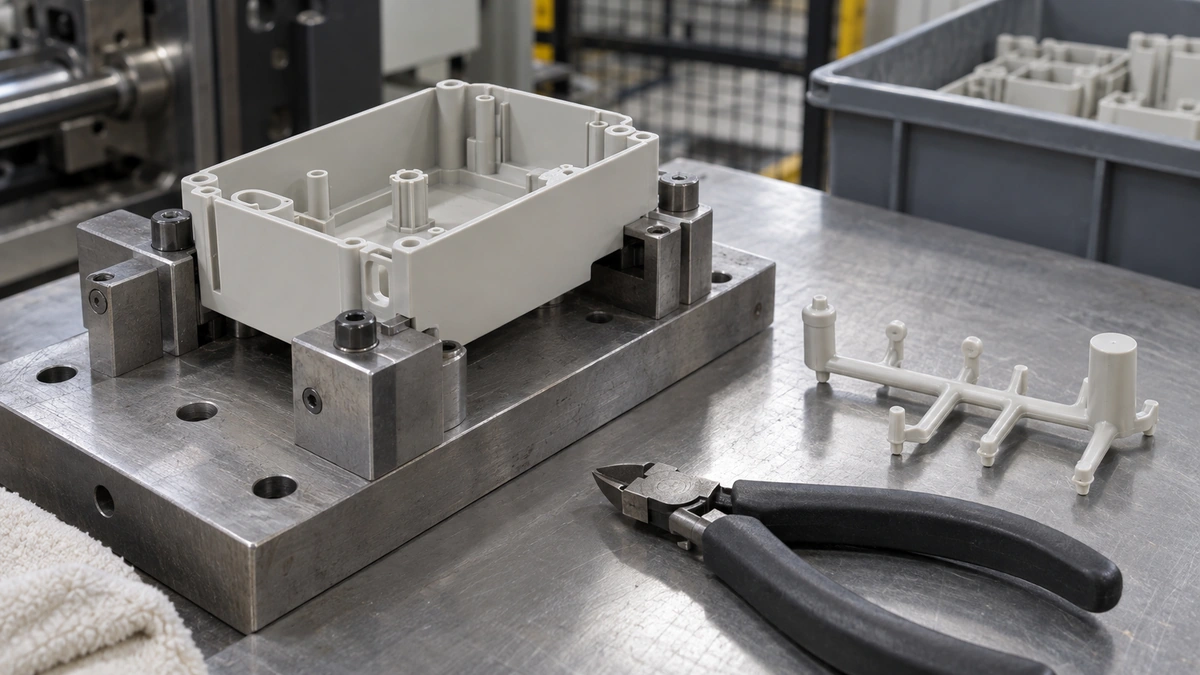
The gate location determines the finishing problem
The gate must serve the molding process, but its position also affects the finished product. Locating a vestige on a sealing face, sliding interface or highly visible panel can turn a simple separation into a difficult finishing operation. Review the gate zone while the custom mold is being designed—not only after the first samples arrive.
Some gate designs separate during ejection; others leave runners attached for a secondary operation. Automatic separation still needs inspection. A broken connection can leave a projection, depression or local whitening that matters to the application.
Specify the gate area, not just the word “flush”
| Requirement | What to show on the drawing |
|---|---|
| Assembly clearance | Maximum projection relative to the adjacent surface |
| Structural integrity | Limits on undercutting or damage to the parent wall |
| Appearance | Permitted witness area, whitening and inspection conditions |
| Cleanliness | Whether loose slivers or detached fragments are unacceptable |
The gate witness may remain visible after the projecting material is removed. If an invisible surface is essential, discuss relocation or a different part architecture instead of assuming polishing will erase every trace.
Control the separation load
Support the part close enough to prevent bending while preserving tool access. Tool sharpness, cut direction and part temperature can change the result. A trial should examine both the surface and the surrounding wall for stress damage, especially near thin sections or transparent features.
For repeated production, a locating fixture helps keep the cut in the same position. Use samples from relevant cavities and inspect the gate condition after the subsequent assembly or environmental exposure where that exposure could reveal cracking.
Common buyer questions
Does a smaller gate always make removal easier?
Not necessarily. Gate dimensions must also allow suitable filling and packing. Optimizing only the trimming step can compromise the molded part.
Can a gate mark be accepted on a cosmetic surface?
Yes, if its size and appearance are defined and approved. A boundary sample is usually more meaningful than an undefined “good finish” requirement.
Is gate removal included automatically?
The required finish and inspection must be explicit in the project scope. Separation from the runner and a tightly controlled cosmetic finish are not equivalent requirements.
Review molding and finishing together
Provide CAD, the resin grade and a marked gate-acceptance zone when discussing plastic injection molding. Tie acceptance to the quality-control plan so that a sample approval can be repeated in production.