
Injection Mold Trial and Validation
Locking in repeatable part dimensions and establishing a robust scientific molding window before mass manufacturing requires systematic trial and validation protocols. Injection mold trial and validation services systematically verify tool steel cavities, melt rheology, and cooling kinetics through T0, T1, and T2 sampling stages. At Jucheng Precision, an ISO 9001, ISO 13485, and IATF 16949 certified contract manufacturer, we perform rigorous tool sampling on 35+ electric presses. Utilizing decoupled scientific molding, full Zeiss CMM dimensional inspection, and FMEA risk analysis, we eliminate warp, sink marks, and flash, ensuring CPK > 1.67 process stability before final tool sign-off.
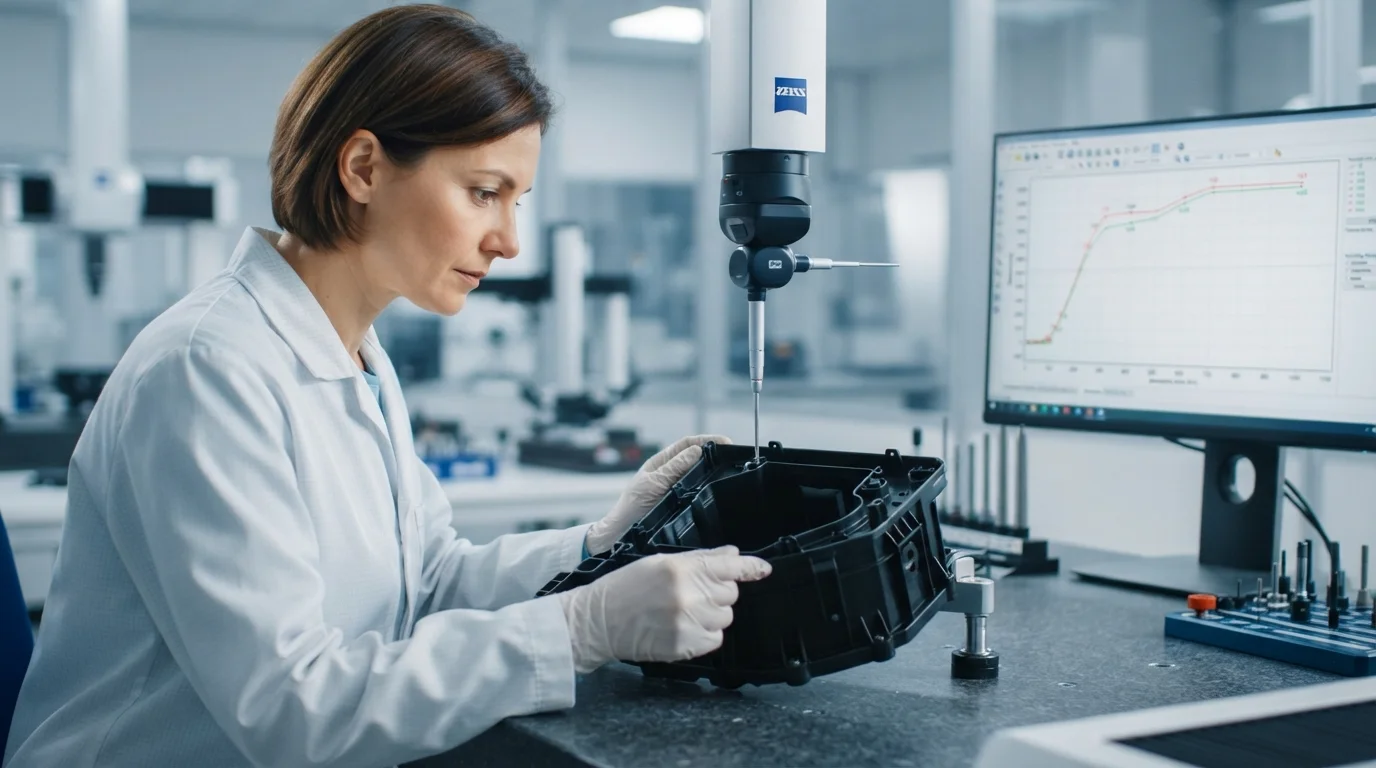
Structured T0 to T2 Mold Trial Workflow
Scientific Mold Trial & Validation follows a standardized 3-stage sampling protocol to verify cavity steel dimensions and lock in stable machine parameters:
T0 Trial (In-House Mechanical Test)
Internal tool dry-run to verify mechanical action, ejection movement, slider locks, cooling water seal integrity, and initial cavity filling.
T1 Trial (First-Off Customer Sampling)
Production resin sampling run under decoupled scientific molding profiles. Yields initial prototype samples for full Zeiss CMM dimensional mapping.
T2 Trial (Final Production Approval)
Final tool validation following minor steel tuning. Verifies CPK > 1.67 process stability before releasing the tool for mass production.
Comprehensive injection mold sampling and qualification services. At Jucheng Precision, we systematically validate every custom tool using decoupled scientific molding principles, establishing locked process parameters and CPK > 1.67 statistical quality capability before tool sign-off.
Mold Validation Matrix: Inspection Criteria & Testing Protocol
Our quality control engineers evaluate every T1 sample batch against strict dimensional and mechanical inspection criteria:
| Validation Stage | Testing Method & Inspection Tooling | Quality Output & Documentation |
|---|---|---|
| Full Dimensional Inspection | Zeiss CMM (Coordinate Measuring Machine) & Optical Profilometer | Complete FAI (First Article Inspection) report mapping 100% of CAD drawing critical-to-quality (CTQ) dimensions. |
| Cosmetic & Surface Verification | Gloss meters, surface roughness gauges (Ra), and visual lightboxes | Confirms zero sink marks, splay, jetting, or gas burns, verifying surface polish against target SPI or texture standards. |
| Functional Assembly Testing | Mating part check, snap-fit force gauges, and torque testing | Verifies real-world assembly fitment for ABS, Polycarbonate (PC), and Polyamide (PA/Nylon) structural enclosures. |
| Process Capability Lock | In-cavity pressure sensors & decoupled molding controllers | Establishes a locked 8-hour continuous stability run verifying CPK > 1.67 for Ép phun nhựa. |
Decoupled Process Lock & Scientific Molding Blueprint
Scientific mold validation replaces trial-and-error guesswork with empirical polymer rheology principles during Gia công khuôn mẫu tùy chỉnh:
1. Rheology Curve Study & Viscosity Lock
During T1 trials, we perform viscosity profiling across varying fill speeds. Identifying the exact injection velocity where viscosity stabilizes ensures identical filling behavior across raw material batch lot shifts.
2. Cavity Pressure Balancing in Multi-Cavity Tools
For Multi-Cavity Injection Mold builds, we verify fill balance across all 8, 16, or 32 cavity inserts. Imbalances are corrected by fine-tuning runner gate steel dimensions to achieve uniform cavity packing.
3. Gate Freeze & Packing Pressure Optimization
By weighing sample parts at incremental holding times, we pinpoint the exact second of gate seal. Locking holding pressure at gate seal eliminates backflow and prevents sink marks on Thin Wall Injection Molding parts.
4. Cleanroom Qualification for Medical Devices
For healthcare components molded in Biocompatible & Medical Grade Resin or high-temp Polyetheretherketone (PEEK), trials are conducted inside Cleanroom Injection Molding facilities under strict ISO 13485 protocols.
Frequently Asked Questions (FAQ)
Q: What is the difference between T0, T1, and T2 mold trials?
A: T0 is an internal mechanical dry-run. T1 is the first sample run delivered to the client with full CMM inspection reports. T2 is the final validation run following minor steel adjustments before mass production sign-off.
Q: What documentation is provided with T1 mold trial samples?
A: Every T1 sample delivery includes a full CMM First Article Inspection (FAI) report, locked scientific molding process sheets, material certs, and high-resolution part photos.
Q: How do you handle dimensional modifications if T1 samples are out of tolerance?
A: Out-of-tolerance dimensions are analyzed using CMM heat maps. Mold steel is adjusted in-house using our 5-axis CNC machining centers or wire EDM before running T2 validation samples.
Q: Can you perform mold trials on complex multi-material or insert tools?
A: Yes. We regularly perform trial sampling for Ép phun hai thành phần (2K tools) and Ép phun chèn on specialized rotary platen presses.