
Vacuum Metallization
Vacuum metallization deposits a thin metal layer onto a prepared surface in a vacuum process. For molded plastics, it can provide a metallic appearance without making the entire component from metal. The underlying surface, deposition route and any base or protective coatings must be considered together. Decorative appearance, optical performance and electrical performance are different requirements and should not be treated as interchangeable.
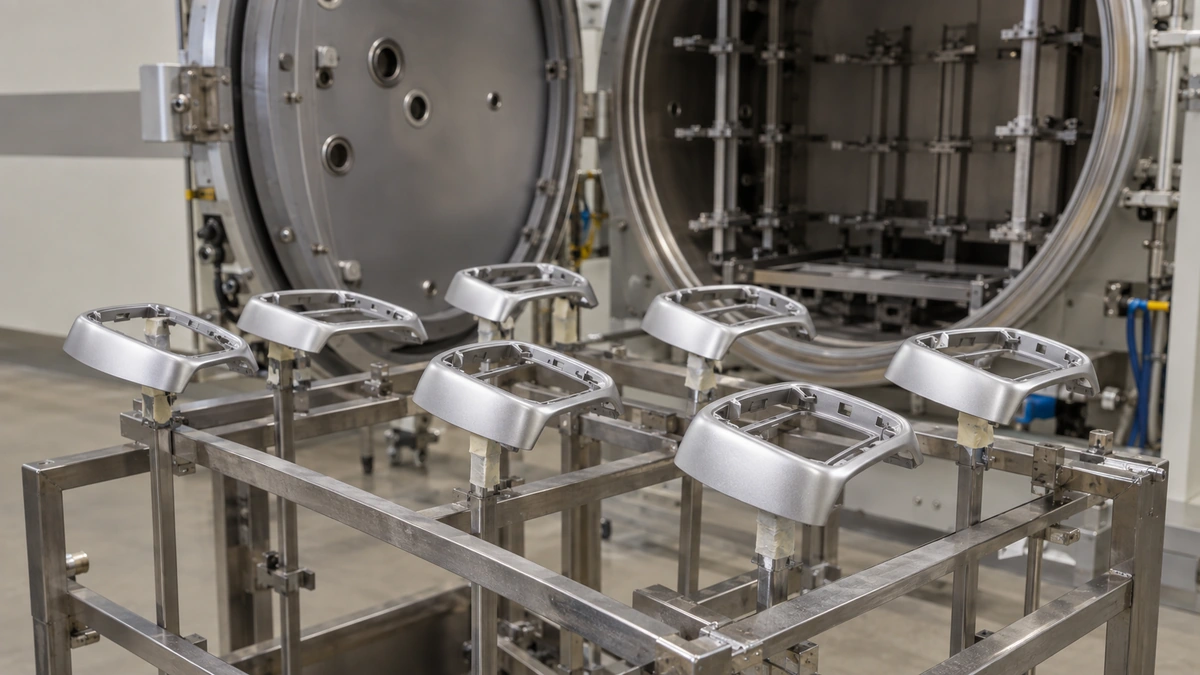
Specify what the metal layer must do
An ornamental bezel may be approved against an appearance sample. A reflector needs an optical requirement. A component intended for shielding needs a defined electrical and assembly-level performance target. A metallic-looking coating does not automatically satisfy the latter two applications.
Substrate quality remains visible
Sink, flow-related surface variation and scratches can become more apparent beneath a reflective finish. Base-coat selection may help establish a smooth deposition surface, but it does not justify ignoring molding defects. Review plastic injection molding surface requirements before approving the decorated sample.
The resin and preparation must tolerate the selected process. Outgassing, adhesion and thermal exposure require evaluation on the actual grade and molded condition, especially for moisture-sensitive materials.
Coverage is a geometry question
| Feature | Review point |
|---|---|
| Exposed decorative face | Uniform appearance and reference gloss |
| Deep recess | Access and potential variation in deposited coverage |
| Electrical contact zone | Required continuity and whether a topcoat is permitted |
| Mating feature | Masking and dimensional allowance for the complete finish |
Fixture orientation and masking affect coverage. Do not assume an outer face and a deep internal corner receive the same result. Specify where discontinuity is acceptable and where performance must be measured.
Approve the full stack, not an intermediate sample
Where the system includes base and top coatings, inspect after all stages and required conditioning. Check adhesion and appearance after the expected handling or environmental exposure. Packaging should prevent contact damage to visible surfaces.
Buyer questions
Is vacuum metallization the same as electroplating?
No. They use different deposition routes and can require different substrate preparation and finish stacks. Compare them against the application rather than appearance alone.
Does a thin metal film add metal-like structural strength?
It should not be treated as a replacement for a structural metal component without an application-specific design and validation.
Review the required result
Send CAD, resin grade, finish reference and performance criteria. Compare surface-finish options and agree the release checks through quality control.