
Laser Marking
Laser marking creates identification or decoration by producing a controlled change at the plastic surface. The response varies with resin, pigment, additives and laser conditions, so the process must be evaluated on the specified material. For a molded-part project, the useful result is not merely a visible mark: it is a readable identifier in an accessible location that remains suitable for the intended operating environment.
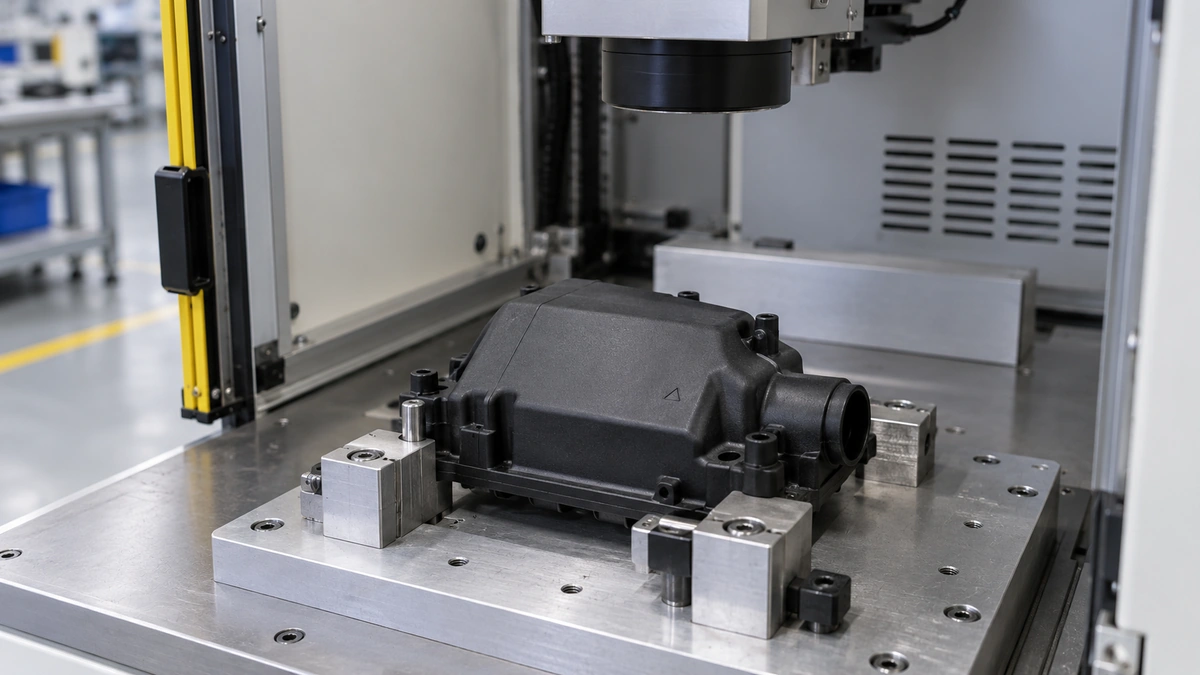
A readable mark begins with the resin
Two parts with the same nominal polymer name may mark differently because their colorants or additives differ. Confirm the production grade and color before sample approval. Do not assume a high-contrast result demonstrated on one black plastic will transfer to another.
Contrast must also be balanced against surface damage. A deeply altered region can be unacceptable near a stressed feature, sealing surface or thin wall. The target should be enough change for reliable identification, not the strongest possible visual effect.
Plan the identification area in the drawing
- Reserve a sufficiently flat or controllably curved region with clear access.
- Keep the marking field away from gates, textured transitions and high-stress corners where practical.
- Define orientation relative to assembly and inspection, not only the loose part.
- For machine-readable identification, agree on code format, available area and verification conditions.
Different marks need different acceptance checks
| Mark purpose | Release focus |
|---|---|
| Part or revision identifier | Correct content, location and legibility |
| Variable traceability data | Correct data association and readable output |
| Machine-readable code | Verification against the specified reading requirement |
| Cosmetic graphic | Approved contrast, edge quality and appearance |
A camera that reads a code once is not necessarily a complete verification method. Where traceability is critical, define the applicable grading requirement and how failed or duplicate marks will be handled.
Validate after realistic exposure
Inspect marks after the handling, cleaning and environmental conditions relevant to the product. Surface wear can matter even when no ink is involved. If a protective coating is added, test the complete marked and coated assembly rather than treating the steps independently.
Domande dell'acquirente
Can a laser produce any color on plastic?
No. Available appearance depends on the material response and selected process. Multicolor printed artwork may need a different decoration route.
Can the material grade change after approval?
Treat a grade, color or additive change as a reason to review the marking result again.
Prepare samples and data requirements together
Include CAD, resin details, an example identifier and expected production quantities. Review the mark with stampaggio a iniezione di materie plastiche, compare relevant finiture superficiali, and incorporate verification into controllo qualità.